I'm in the middle of my first "konbit" with MCC Haiti. Out in the sticks, a konbit is a work crew, assembled to do a harvest or dig a ditch or something like that. Within MCC, it's a meeting we do a couple times each year where all of the Haitian and blan staff get together and plan out the coming months. It's nice to get a break for a few days from the office, though I'm really starting to get comfortable there. I've even got a couple of new nicknames, or "tinon"s. Fito, who sits next to me, calls me "direkte," but my favorite is "blalman." Blalman is the words blan (white) and Allemagne (German) smooshed together. At first I assumed that this was because of my German last name. But I was totally off. A couple of the guys in the office assign soccer teams to people according to how much they eat. Big eaters are named after countries with strong teams. Someone who eats like a bird will be called Saudi Arabia, or the United States, for that matter. Pierre, the boss, loves to heap food on employees' plates, especially mine. And since I always eat every last bit, I'm called Germany.
Speaking of work, here's a good moral dilemma to chew on, if you feel like it. Jessica, the other MCC worker in my office, told me about something that happened last year. She was in the office one day when a couple of lawyers came and said that they needed to go to a police station and help get a man out. The story: the arrested man's brother was a mechanic who did some shoddy work on a car. The car owner's dad was a cop, so he showed up at the mechanic's house. The mechanic wasn't there, but his brother was. The cop and his partner beat up the mechanic's brother and tossed him in the clink. This kind of thing is all too common here.
So these lawyers showed up in the office looking for help for this poor man whose human rights had clearly been violated. When they saw Jessica, they eagerly asked her if she was available for the afternoon. She said yes. On the way to the police station, they told her what to say, and insisted that she speak only in English, even though she speaks Creole perfectly well. Be as blan as possible, they told her. This would supposedly attest to the fact that she was connected to powerful people, organizations, or governments, so much so that she didn't have to bother learning the language. The lawyers hoped this would sufficiently scare the policemen, who otherwise would have simply waited until some family member showed up to pay a hefty bribe.
Well, it worked. The mechanic's brother was released from jail. A wrong was righted. But it grieves me that the wrong was righted only by a larger wrong. Jessica felt really conflicted about the whole thing after the fact. Was she in fact reinforcing racism? Why should a seemingly clueless white person be able to do things that even trained Haitian lawyers could not? It's a toughie. I'm sure I'd do the same thing she did. It's not like she made anything worse. But still, it doesn't leave one with a sense of satisfaction.
There's a lot of stuff I would love to write about work, though I'm not really at liberty to do so because of the sensitive nature of human rights cases we work on. The good news is that kidnappings have hit a lull. Apparently it's pretty normal for crime and political unrest to mellow out during carnival season. I'll write more about this later, but every Sunday between New Year's and Mardi Gras is a huge party in the streets of Port-au-Prince. It disrupts absolutely everything, apparently including crime. I haven't yet taken in one of these carnival nights, just been stuck in traffic waiting for a cha (pronounced "shah") to pass. A cha is a party on wheels. Most are as big as a giant yacht, loaded with speakers, a dj or live band, and maybe a hundred or so people. There will be a guy in the front with a long stick to lift up power lines as the cha slowly rolls down the thoroughfare. And the streets are full of people, some with masks or hoods on, hanging out and waiting for the music to come to them. I'm sure I'll get some good photos sometime between now and Ash Wednesday.
I'll wrap it up now. We're about to head for dinner at Chez Wu, one of the two Chinese restaurants in Port-au-Prince. From what I hear, the Haitian version of Chinese food has a lot more goat than in North America.
Thursday, January 11, 2007
D'oh!
I'm trying to put a video up on here, but the computer's giving me grief, so I'm just going to wait on that one.
But anyhow, it's Christmas in January for me. I got a box of goodies from the fam today. I asked my mom for two shirts. I got four, of course. Plus beef jerky and chocolate (which arrived a little melty, but still so good).
My friend Heather asked a question in an e-mail a couple weeks ago - do you have many opportunities to meet 'regular' hatians?
It's one of those simple questions with a complicated answer. The Haitians I work with in the office everyday are not really part of the elite, but they're certainly not poor. They're part of the middle class, which is tiny in Haiti - who knows, maybe even smaller than the upper class. The thing is, poor people can't really leave, and most of the wealthy elite must stay because Haiti is the source of their wealth, though they usually send their kids abroad to study. The middle class is that group of people that both wants to and is able to move away. But plenty do stay, like the folks I work with. Pretty fun group. I'll give a video office tour some other time.
Beyond that, it's tough. I like talking to the woman I buy grapefruit from or the barbecue master I buy chicken from on occasion. But for getting to know people my age, so far I've been restricted to meeting friends of friends. And they're great, but they're all coming from that same small sector as the people I work with. The poorest population of Port-au-Prince is kind of off-limits. One of the first things that happened in my in-country orientation was looking at a big map of the city. My supervisor pointed out a swath of land, the four inches closest to the water for the whole length of the waterfront - a huge area - and said, "this is the no-go zone."
It's true that kidnappings have been pretty bad, and it's a good idea to be careful. But there's something about the phrase "no-go zone" that's inherently frustrating. It would be hard enough to establish any kind of real friendship with someone living in the "no-go zone" for any number of difficult social reasons. But add to it the fact that these people live somewhere white people almost never, ever go without automatic weapons. I'm hopeful for change in this category. In three years' time, there's a good chance the UN will be out of here, and I feel like that will be a good thing.
But anyhow, it's Christmas in January for me. I got a box of goodies from the fam today. I asked my mom for two shirts. I got four, of course. Plus beef jerky and chocolate (which arrived a little melty, but still so good).
My friend Heather asked a question in an e-mail a couple weeks ago - do you have many opportunities to meet 'regular' hatians?
It's one of those simple questions with a complicated answer. The Haitians I work with in the office everyday are not really part of the elite, but they're certainly not poor. They're part of the middle class, which is tiny in Haiti - who knows, maybe even smaller than the upper class. The thing is, poor people can't really leave, and most of the wealthy elite must stay because Haiti is the source of their wealth, though they usually send their kids abroad to study. The middle class is that group of people that both wants to and is able to move away. But plenty do stay, like the folks I work with. Pretty fun group. I'll give a video office tour some other time.
Beyond that, it's tough. I like talking to the woman I buy grapefruit from or the barbecue master I buy chicken from on occasion. But for getting to know people my age, so far I've been restricted to meeting friends of friends. And they're great, but they're all coming from that same small sector as the people I work with. The poorest population of Port-au-Prince is kind of off-limits. One of the first things that happened in my in-country orientation was looking at a big map of the city. My supervisor pointed out a swath of land, the four inches closest to the water for the whole length of the waterfront - a huge area - and said, "this is the no-go zone."
It's true that kidnappings have been pretty bad, and it's a good idea to be careful. But there's something about the phrase "no-go zone" that's inherently frustrating. It would be hard enough to establish any kind of real friendship with someone living in the "no-go zone" for any number of difficult social reasons. But add to it the fact that these people live somewhere white people almost never, ever go without automatic weapons. I'm hopeful for change in this category. In three years' time, there's a good chance the UN will be out of here, and I feel like that will be a good thing.


Saturday, January 06, 2007
That Voodoo You Do
I've been meaning to write about Voodoo for some time now. I don't have much to offer but the conversations I've had and things I've heard, seen, and read. I still haven't been to a Voodoo ceremony, though during my homestay, a couple times a week, I could hear those drums beating not far away.
The first thing I've observed is that everyone believes in Voodoo. Not everyone practices it, but everyone believes in it. Plenty of Haitians think it's evil and wrong and the source of all the country's problems, but nobody thinks it's untrue. So what does a Voodooist believe? To be very brief about it, Voodoo is the belief that there are spirits or gods called loas. They can possess people momentarily, and put them into a trance where they may not feel a candle held directly under the palm or even the chin, or perhaps the person would move around on the ground like a snake and even go up trees and walls in ways that don't seem quite humanly possible. Again, I haven't seen anything like that for myself here yet, but it's just a given for Haitians. Baptists missionaries believe it's devil worship in another form. But from what I gather, even though Baptist Haitians think it's evil, they're still operating from a worldview that includes the Voodoo gods and werewolves and all that.
Ah yes, werewolves, or lougawou. It's believed that some people slip out of their human skin to reveal a werewolf that can fly and shoot fire from its hind quarters. If a person who is secretly a lougawou comes to the house of a pregnant woman, he or she will ask the pregnant woman for salt. If the woman gives the lougawou salt, her child will be stillborn. Random, I know. The way to deal with a lougawou is, if you find the human skin that has been shed, put salt and pepper on it. When the lougawou returns, he'll put on the skin and start itching and eventually go crazy.
The roots of Voodoo are African animist beliefs combined with Catholicism. In fact there is a corresponding Catholic saint for every loa in the Voodoo pantheon. And practitioners, or houngans, will tell you that their spells and incantations have no effect on an unbaptized person. The memory of slavery is also a strong element of Voodoo. Old shackles are incorporated into shrines often. It was in fact Voodoo which inspired the slave revolt that led to independence in 1804.
Speaking of, here's an interesting tangent. Within twenty years of Columbus landing in Haiti, on Christmas Eve of 1492, the indiginous population was withering and on the verge of collapse from disease and abuse at the hands of the Spanish. The representative of the Roman Catholic Church was struck to the core by the disappearance of this beautiful culture. He begged the Spanish colonizers to leave the Taino and Arawak people alone -- but don't cheer yet. To placate the colonizers, this priest argued that they should bring slaves from Africa instead. The deeply ingrained racism of Europe had been directed specifically at Africa. Of course white people were superior to non-white people, reasoned Europe, but Africans weren't even considered human.
This conscientious priest helped kick off the international slave trave. And because of him, Haiti became slavery ground zero. Slavery made Spain and then France incredibly wealthy -- the single colony was more lucrative than the thirteen British colonies combined at the time of independence. Haiti was the place where the process of breaking the spirit of west Africans was fine-tuned into a science. It was a vast machine that chugged along for centuries, fueled by the blood of human beings. But under this incredible oppression the slaves would find ways to carry out their traditions the way they had in Africa. The network of people who practiced and officiated these rites allowed a level of coordination that would have been impossible otherwise. While the white God of the colonial overlords told these slaves that they deserved their lot in life, Voodoo gave an outlet for people to escape their suffering through ecstatic worship. And eventually, Voodoo allowed people to say that they deserved freedom, and would fight for it, possessed with the strength of the loas.
For these reasons, Voodoo is fundamental to the character of Haiti. It's been a force of inspiration, to be sure. But there are many problems that come along with it. There are two branches of Voodoo. Kind of a leaded and unleaded. White magic versus black magic. Many practice Voodoo to get in balance with unseen spiritual forces, to get answers to plaguing questions, no harm done. But it is also used for outright malicious ends. The acquired knowledge of Voodoo is immense. There are plenty of quacks among the bokors (witch doctors) as in any medical field -- but generally these are people with an encyclopedic knowledge of natural cures. But this goes both ways too. The knowledge also includes recipes for all sorts of poison powders and things like that, often used to exact revenge. An American woman I met here, who is very sympathetic to Voodoo, did tell me that these days Haitians go to church when they feel like being good and they go to the Voodoo priest when they feel like being bad.
Crossroads are very important in Voodoo. It's common to see Voodoo effects at a place where paths cross. Things like coins pounded into the soil. In Dezam there was a spot I walked by everyday where a path crossed a dry riverbed. One day there was a half of a coconut shell, filled with some kind of chopped plant matter. A lot of red and black (the unofficial colors of Voodoo) thread was wound around the half-shell so the plant stuff wouldn't spill out. Next to this was a wand of leafy twigs, wrapped in a sheet of notebook paper with handwriting on it, and also wrapped in red and black thread. I asked someone what it all meant and here's what he said was the most likely explanation: a person, let's say a man, went to an houngan (Voodoo priest) either because he was in love with or angry with some other person. The man brought some paper that the target person had written on, as well as some money, and told the houngan about the situation and where the target person would usually walk. The houngan then prepared these things and put them by the road so that a) this woman might fall in love with this man; or b) the enemy of this man might be struck down by illness.
There's definitely a lot of money spent in the practice of Voodoo that could be put to more practical uses; the same is true of all religions. Sometimes Voodoo is a source of solidarity; sometimes it will divide a community with vicious backstabbing or worse, where nobody gains except the houngan. Again, not radically different than any other main religion, in reality.
So what do I think? I have no idea. Haiti isn't going to get rid of Voodoo, no matter what happens. I'm a pretty skeptical person, so it's easy to brush off the idea of roaming invisible spirits. But the things I've read and stories I've heard send chills down my spine. Crazy things happen; whether or not there's a natural explanation for it is another question. I'm sure I'll continue to learn more about it, and when I do I'll write about it here. And if you have any questions, e-mail me or comment here and I'll see what I know.
The first thing I've observed is that everyone believes in Voodoo. Not everyone practices it, but everyone believes in it. Plenty of Haitians think it's evil and wrong and the source of all the country's problems, but nobody thinks it's untrue. So what does a Voodooist believe? To be very brief about it, Voodoo is the belief that there are spirits or gods called loas. They can possess people momentarily, and put them into a trance where they may not feel a candle held directly under the palm or even the chin, or perhaps the person would move around on the ground like a snake and even go up trees and walls in ways that don't seem quite humanly possible. Again, I haven't seen anything like that for myself here yet, but it's just a given for Haitians. Baptists missionaries believe it's devil worship in another form. But from what I gather, even though Baptist Haitians think it's evil, they're still operating from a worldview that includes the Voodoo gods and werewolves and all that.
Ah yes, werewolves, or lougawou. It's believed that some people slip out of their human skin to reveal a werewolf that can fly and shoot fire from its hind quarters. If a person who is secretly a lougawou comes to the house of a pregnant woman, he or she will ask the pregnant woman for salt. If the woman gives the lougawou salt, her child will be stillborn. Random, I know. The way to deal with a lougawou is, if you find the human skin that has been shed, put salt and pepper on it. When the lougawou returns, he'll put on the skin and start itching and eventually go crazy.
The roots of Voodoo are African animist beliefs combined with Catholicism. In fact there is a corresponding Catholic saint for every loa in the Voodoo pantheon. And practitioners, or houngans, will tell you that their spells and incantations have no effect on an unbaptized person. The memory of slavery is also a strong element of Voodoo. Old shackles are incorporated into shrines often. It was in fact Voodoo which inspired the slave revolt that led to independence in 1804.
Speaking of, here's an interesting tangent. Within twenty years of Columbus landing in Haiti, on Christmas Eve of 1492, the indiginous population was withering and on the verge of collapse from disease and abuse at the hands of the Spanish. The representative of the Roman Catholic Church was struck to the core by the disappearance of this beautiful culture. He begged the Spanish colonizers to leave the Taino and Arawak people alone -- but don't cheer yet. To placate the colonizers, this priest argued that they should bring slaves from Africa instead. The deeply ingrained racism of Europe had been directed specifically at Africa. Of course white people were superior to non-white people, reasoned Europe, but Africans weren't even considered human.
This conscientious priest helped kick off the international slave trave. And because of him, Haiti became slavery ground zero. Slavery made Spain and then France incredibly wealthy -- the single colony was more lucrative than the thirteen British colonies combined at the time of independence. Haiti was the place where the process of breaking the spirit of west Africans was fine-tuned into a science. It was a vast machine that chugged along for centuries, fueled by the blood of human beings. But under this incredible oppression the slaves would find ways to carry out their traditions the way they had in Africa. The network of people who practiced and officiated these rites allowed a level of coordination that would have been impossible otherwise. While the white God of the colonial overlords told these slaves that they deserved their lot in life, Voodoo gave an outlet for people to escape their suffering through ecstatic worship. And eventually, Voodoo allowed people to say that they deserved freedom, and would fight for it, possessed with the strength of the loas.
For these reasons, Voodoo is fundamental to the character of Haiti. It's been a force of inspiration, to be sure. But there are many problems that come along with it. There are two branches of Voodoo. Kind of a leaded and unleaded. White magic versus black magic. Many practice Voodoo to get in balance with unseen spiritual forces, to get answers to plaguing questions, no harm done. But it is also used for outright malicious ends. The acquired knowledge of Voodoo is immense. There are plenty of quacks among the bokors (witch doctors) as in any medical field -- but generally these are people with an encyclopedic knowledge of natural cures. But this goes both ways too. The knowledge also includes recipes for all sorts of poison powders and things like that, often used to exact revenge. An American woman I met here, who is very sympathetic to Voodoo, did tell me that these days Haitians go to church when they feel like being good and they go to the Voodoo priest when they feel like being bad.
Crossroads are very important in Voodoo. It's common to see Voodoo effects at a place where paths cross. Things like coins pounded into the soil. In Dezam there was a spot I walked by everyday where a path crossed a dry riverbed. One day there was a half of a coconut shell, filled with some kind of chopped plant matter. A lot of red and black (the unofficial colors of Voodoo) thread was wound around the half-shell so the plant stuff wouldn't spill out. Next to this was a wand of leafy twigs, wrapped in a sheet of notebook paper with handwriting on it, and also wrapped in red and black thread. I asked someone what it all meant and here's what he said was the most likely explanation: a person, let's say a man, went to an houngan (Voodoo priest) either because he was in love with or angry with some other person. The man brought some paper that the target person had written on, as well as some money, and told the houngan about the situation and where the target person would usually walk. The houngan then prepared these things and put them by the road so that a) this woman might fall in love with this man; or b) the enemy of this man might be struck down by illness.
There's definitely a lot of money spent in the practice of Voodoo that could be put to more practical uses; the same is true of all religions. Sometimes Voodoo is a source of solidarity; sometimes it will divide a community with vicious backstabbing or worse, where nobody gains except the houngan. Again, not radically different than any other main religion, in reality.
So what do I think? I have no idea. Haiti isn't going to get rid of Voodoo, no matter what happens. I'm a pretty skeptical person, so it's easy to brush off the idea of roaming invisible spirits. But the things I've read and stories I've heard send chills down my spine. Crazy things happen; whether or not there's a natural explanation for it is another question. I'm sure I'll continue to learn more about it, and when I do I'll write about it here. And if you have any questions, e-mail me or comment here and I'll see what I know.
Tuesday, January 02, 2007
Land of the Free
New Year's is when Haitians traditionally celebrate their independence. What that means around here is pumpkin soup, and lots of it. More like stew, actually, with the big chunks of bone and meat, potato, taro, onions, cabbage and other good things. Experienced MCCers in Haiti can usually finagle at least three separate servings of pumkin soup between New Years and Jan. 2. My landlady showed up with an enormous bowl of the stuff yesterday, and I didn't finish it until this morning.
Also yesterday, I got together with a friend of a friend. A woman I used to go to church with, Joanne Sprunger, was excited when she found out I was coming to live in Haiti. She did a homestay here in the early 80s (if I remember right) and stayed with a family that she remains in contact with. I got in touch with Madame Madeleine Boncy a few days ago and she invited me to spend Independence Day with her family. It was my first time hanging out at home with the Haitian upper class. Madame Boncy's two sons, Pierre and Jacque, are both doctors - one is the head of neurology at the Haitian University Hospital.
As is often the case among upper class families in Haiti, there was a variety of skin tones present. I hope it won't seem crude or inappropriate to talk about skin color so openly, but I've become used to these kinds of conversations. Haitians are expert at recognizing and comparing skin tones. Walking around on the streets, most of the Haitians you see are quite dark. But if you start looking into windows of the SUVs flying past, it's a different world. That's where you're likely to see many more white people as well as Haitians with much lighter skin than those sharing the sidewalk with you. Haiti has always been stratified in this way. The country's wealth is concentrated in the hands of a tiny elite, which is largely mulatto. Oh, and "mulatto" is not an offensive word here, it's used all the time. The elite has been a target of public resentment at different points because those with wealth are obviously benefiting somehow from a situation that can only be described as miserable to most Haitians. And indeed it's true that much of the wealth in Haiti is ill-gotten.
But there are also people like the Boncy family. They used their relative wealth to send their boys to school in the states and return to Haiti as doctors. Pierre and Jacque were both very interesting men to talk to. Jacque, who studied at the University of Illinois, informed me that it was a native Haitian who founded Chicago. I looked it up, and what do you know? Both of the doctors had a Colin Powell kind of complexion. Their father, who was also a doctor, died twenty years ago. The family clearly loves Haiti and chooses to live here, though they are part of that tiny group who has the ability to leave.
Madeleine Boncy will go down in memory as one of the most elegant women I've ever met. She was incredibly gracious, funny and welcoming, and spoke with a slight Barbara Walters rasp. Agewise, I would have guessed she was in her 60s, and very well preserved. Truth is she's in her 80s and very very well preserved.
Sitting out in the leafy courtyard of the Boncy house, the conversation would flow easily from English to French to Creole and back to French. The food was phenomenal. An older woman was there, a friend of the family who lost her husband some years ago. Her skin, if this is even possible, was lighter than mine, though she clearly had some African ancestry. She was telling about a friend of hers from the states who came to visit and was shocked by the organized chaos of Port-au-Prince traffic. "You really are free here in Haiti, aren't you," the friend said. A good joke for Independence Day.
While I'm talking about race and classy women, I should also mention my landlady. Her name is Madame Assali. She is very dark and her face bursts with expression. She certainly understands Creole, but her own speech is about 90% French. Her husband is either totally or mostly French in ancestry, though he uses Creole more than she does. Her house is immaculate and she runs a little boutique out of her front room selling fancy French perfume and stuff like that. As soon as I'm done writing this I'll head home for dinner with Madame and Monsieur Assali.
Speaking of, I should probably wrap up. But first I want to answer a couple questions. It's hard for me to know what are the big holes in your picture of Haiti if you are reading this and you've never been here. If you can put them into words, e-mail me. Here's some questions I got from my friend Almarie:
Does the air there have a smell, a distinctive smell? More than the difference between Port-au-Prince and andeyo? Did you bring three backpacks full of books to read over the next three years (or three months), and are there places to buy or borrow new and used books/reading material there? If so, what's the selection like? Are men and/or women more likely to be wearing a hat, footwear, or both? Or neither? What, so far, is your favorite sound in Haiti? Is there new year celebration?
Most of the smells are like anywhere in the third world - exhaust fumes, burning garbage, rotting plant matter in the gutter. But there's also the flowers and other plants that grow in abundance and seem to deflect a lot of the badness. Overall I don't mind it a bit. I hate that I'm breathing so much particulate matter in the air, but it's a smell I've grown to love. It's a smell that says: adventure awaits. The one unique addition in Haiti is the charcoal. Sometimes it's nice and it smells like a barbecue everywhere you go. Sometimes it smells more like too-green wood being burned, which is unpleasant. I think that's more when the wood is being burned to make charcoal, and not when the charcoal itself is being used.
Ack! The time! I'll have to answer the other questions later. Happy New Year to everyone! Out with the old, in with the new!
Also yesterday, I got together with a friend of a friend. A woman I used to go to church with, Joanne Sprunger, was excited when she found out I was coming to live in Haiti. She did a homestay here in the early 80s (if I remember right) and stayed with a family that she remains in contact with. I got in touch with Madame Madeleine Boncy a few days ago and she invited me to spend Independence Day with her family. It was my first time hanging out at home with the Haitian upper class. Madame Boncy's two sons, Pierre and Jacque, are both doctors - one is the head of neurology at the Haitian University Hospital.
As is often the case among upper class families in Haiti, there was a variety of skin tones present. I hope it won't seem crude or inappropriate to talk about skin color so openly, but I've become used to these kinds of conversations. Haitians are expert at recognizing and comparing skin tones. Walking around on the streets, most of the Haitians you see are quite dark. But if you start looking into windows of the SUVs flying past, it's a different world. That's where you're likely to see many more white people as well as Haitians with much lighter skin than those sharing the sidewalk with you. Haiti has always been stratified in this way. The country's wealth is concentrated in the hands of a tiny elite, which is largely mulatto. Oh, and "mulatto" is not an offensive word here, it's used all the time. The elite has been a target of public resentment at different points because those with wealth are obviously benefiting somehow from a situation that can only be described as miserable to most Haitians. And indeed it's true that much of the wealth in Haiti is ill-gotten.
But there are also people like the Boncy family. They used their relative wealth to send their boys to school in the states and return to Haiti as doctors. Pierre and Jacque were both very interesting men to talk to. Jacque, who studied at the University of Illinois, informed me that it was a native Haitian who founded Chicago. I looked it up, and what do you know? Both of the doctors had a Colin Powell kind of complexion. Their father, who was also a doctor, died twenty years ago. The family clearly loves Haiti and chooses to live here, though they are part of that tiny group who has the ability to leave.
Madeleine Boncy will go down in memory as one of the most elegant women I've ever met. She was incredibly gracious, funny and welcoming, and spoke with a slight Barbara Walters rasp. Agewise, I would have guessed she was in her 60s, and very well preserved. Truth is she's in her 80s and very very well preserved.
Sitting out in the leafy courtyard of the Boncy house, the conversation would flow easily from English to French to Creole and back to French. The food was phenomenal. An older woman was there, a friend of the family who lost her husband some years ago. Her skin, if this is even possible, was lighter than mine, though she clearly had some African ancestry. She was telling about a friend of hers from the states who came to visit and was shocked by the organized chaos of Port-au-Prince traffic. "You really are free here in Haiti, aren't you," the friend said. A good joke for Independence Day.
While I'm talking about race and classy women, I should also mention my landlady. Her name is Madame Assali. She is very dark and her face bursts with expression. She certainly understands Creole, but her own speech is about 90% French. Her husband is either totally or mostly French in ancestry, though he uses Creole more than she does. Her house is immaculate and she runs a little boutique out of her front room selling fancy French perfume and stuff like that. As soon as I'm done writing this I'll head home for dinner with Madame and Monsieur Assali.
Speaking of, I should probably wrap up. But first I want to answer a couple questions. It's hard for me to know what are the big holes in your picture of Haiti if you are reading this and you've never been here. If you can put them into words, e-mail me. Here's some questions I got from my friend Almarie:
Does the air there have a smell, a distinctive smell? More than the difference between Port-au-Prince and andeyo? Did you bring three backpacks full of books to read over the next three years (or three months), and are there places to buy or borrow new and used books/reading material there? If so, what's the selection like? Are men and/or women more likely to be wearing a hat, footwear, or both? Or neither? What, so far, is your favorite sound in Haiti? Is there new year celebration?
Most of the smells are like anywhere in the third world - exhaust fumes, burning garbage, rotting plant matter in the gutter. But there's also the flowers and other plants that grow in abundance and seem to deflect a lot of the badness. Overall I don't mind it a bit. I hate that I'm breathing so much particulate matter in the air, but it's a smell I've grown to love. It's a smell that says: adventure awaits. The one unique addition in Haiti is the charcoal. Sometimes it's nice and it smells like a barbecue everywhere you go. Sometimes it smells more like too-green wood being burned, which is unpleasant. I think that's more when the wood is being burned to make charcoal, and not when the charcoal itself is being used.
Ack! The time! I'll have to answer the other questions later. Happy New Year to everyone! Out with the old, in with the new!
Friday, December 29, 2006
It's a Port-au-Prince Christmas
This was my first Christmas ever away from home. I didn't have very high expectations. Driving around Port-au-Prince, it's clear that Christmas here doesn't bear much in common with the North American version of the holiday. Strings of lights are rare when you have to burn gas in a generator just to keep the inside of your house lit. For the most part, the Christmas displays seemed to exist solely for the benefit of missionaries and other homesick blans (UN, embassy, and NGO workers). For example, the big plastic Christmas trees decked in lights in front of Gold's Gym. Or the life-size, mechanized Santa Claus creepily ringing his bell outside the door of a fancy French bakery. The more white people a store is visited by, the more likely you are to find inflated snowmen and reindeer and other ridiculously out-of-place items.
There is a Haitian version of a Christmas tree which is often seen in roadside markets. They usually take a tree about 4 feet tall, strip all its leaves and paint it white. Another tradition is making little houses and churches, about the size of a classroom globe. The buildings are put together with paperboard, windows and doors are cut all over the sides with patterns of colored tissue glued to cover the holes. Then a candle is placed inside. Not the safest of decorations, but very pretty.
My contribution to Christmas this year was the same as it usually is back home: almond roca. I wasn't sure I'd be able to pull it off. I had to roast skinny Haitian almonds and use raw cane sugar, but otherwise I was able to find all the same stuff. Of course once it was made, I wasn't really sure what to do with it. I was afraid the chocolate would melt in the heat, so I put it in my little fridge. The inverter batteries didn't last very long, and my fridge lost power, and as the cold almond roca went to room temperature, water condensed on its surface. I could go on, but suffice it to say that by Christmas day when I was giving away the last bit of roca it was a melty, chocolatey blob.
I spent most of Christmas Eve just hanging out with Charity, who runs the MCC office, and her friend Trish. Trish, I discovered, went to Seattle Pacific and graduated just a year before me. The most surprising thing about that was the fact that we didn't recognize each other immediately as fellow alumni. Basically she came here right after college to teach elementary school. She fell in love and got married to an Arab Haitian. Confused?
Another random fact about Haiti is that there are thousands of Lebanese and Palestinian people - mostly Christian - living in the capital. Click here for an interesting article on this phenomenon. They came in several waves for several reasons, and though they all speak Creole and call themselves Haitian first and foremost, most live in an insular community in the hills above Port-au-Prince. But the insularity is only social, Arab Haitians are completely integrated into the business scene, owning most of the supermarkets and some of the sweatshops in Port-au-Prince.
On the evening of the Eve, I went with Charity and Trish to a get-together at the house of an American missionary. There was a short service before the food came out. We sang Silent Night by candlelight, which I'm used to doing every Christmas Eve in Medford. There were probably about 25 people there - mostly Americans, mostly missionaries.
I'm a little wary of missionairies in Haiti. Well, everywhere. Many missionaries are the absolute salt of the earth, people who are giving what they have to give driven by pure compassion. But too often it seems that American missionaries confuse the military and economic superiority of the US with some kind of moral superiority. They see Voodoo as devil worship. I'll write more about the very complicated subject of Voodoo later, but right now I'll just say this: it's not devil worship.
So anyway, at this Christmas party I got to talking with the host a little bit. He's a doctor who's been providing free medical care to peasants in the southeast for 20 years. A fascinating person, definitely one of the salt-of-the-earth types. He was a conservative in the sense that he was generally pessimistic about human nature. But instead of blaming Haitians for all of the country's problems, as conservatives often do, he was keenly aware of the destruction wrought by US economic and military policy. As he gave me example after example, he waived his arms around the room at his other guests and said, "These people all think I'm nuts!" And indeed I did get the sense that other people had heard it all before. I plan to spend more time with this doctor.
So all in all it was a lovely Christmas Eve, comforting and challenging. On Christmas day, I got together with Matt and Esther (reforestation workers), Charity (country representative), and Trish and Tariq (SPU girl and Haitian husband) for pumpkin pancakes at Charity's house. Later I went hiking with Matt and Esther. Here's Matt and I, looking out from a point so high that we were in a cloud:

And here's Matt and Esther's adopted daughter Gabriela, aka most perfect baby of all time:

The day after Christmas Matthew, Esther, Gabriela and I went up to a place called Seguin. To get there you drive southeast out of Port-au-Prince for an hour until you're way up in the mountains. Then you leave your vehicle behind and walk. The landscape is stunning up there. The climate is quite different. The people selling used clothing have laid out jackets and sweaters. Instead of seeing oranges and bananas for sale everywhere, it's carrots and leeks. It seems like every square inch of farmable land is being used for something. Impassible slopes are terraced into little rows, and the road is always going up, down, or sideways along the steepest of grades. All the while you're passing villagers, mainly women in groups, walking and gossiping about whatever while balancing enormous loads on top of their heads.
And then, after four hours of this, the road levels out and you arrive in a pine forest, one of the few areas in Haiti that is, at least officially, protected from deforestation. We stayed in a lodge surrounded by flowers and grass. I was so beat from the hike that I laid down for a nap. Even in the middle of the day it was cold from the mountain wind. I tried to find a spot with filtered light so I wouldn't freeze:

But the light wasn't filtered enough. I actually burned the backs of my hands, I think for the first time in my life. And my face is peeling heavily right now.
The lodge is run by a fascinating character named Winnie. His parents were both Haitian, one black and one Arab. He lives up there in his mountain paradise, spending his days philosophizing about the problems and potential of his beloved Haiti. He's got wind and solar power, and he's always experimenting with plants and even a fish pond. Here's Winnie with Gabriela:

We all felt like we could have spent a month up there. Each day I woke up with a little shiver, put on my boots and walked out to a hill where I could see all the way to the ocean off the southern coast. Perched on a rock in the middle of one of Winnie's future bamboo forests, huddled in my fleece, listening to The Flaming Lips on my iPod, it was hard to imagine a more perfect moment.
But eventually we did have to leave. When we finally made it back to the truck, we found it had been incorporated into the market.

There is a Haitian version of a Christmas tree which is often seen in roadside markets. They usually take a tree about 4 feet tall, strip all its leaves and paint it white. Another tradition is making little houses and churches, about the size of a classroom globe. The buildings are put together with paperboard, windows and doors are cut all over the sides with patterns of colored tissue glued to cover the holes. Then a candle is placed inside. Not the safest of decorations, but very pretty.
My contribution to Christmas this year was the same as it usually is back home: almond roca. I wasn't sure I'd be able to pull it off. I had to roast skinny Haitian almonds and use raw cane sugar, but otherwise I was able to find all the same stuff. Of course once it was made, I wasn't really sure what to do with it. I was afraid the chocolate would melt in the heat, so I put it in my little fridge. The inverter batteries didn't last very long, and my fridge lost power, and as the cold almond roca went to room temperature, water condensed on its surface. I could go on, but suffice it to say that by Christmas day when I was giving away the last bit of roca it was a melty, chocolatey blob.
I spent most of Christmas Eve just hanging out with Charity, who runs the MCC office, and her friend Trish. Trish, I discovered, went to Seattle Pacific and graduated just a year before me. The most surprising thing about that was the fact that we didn't recognize each other immediately as fellow alumni. Basically she came here right after college to teach elementary school. She fell in love and got married to an Arab Haitian. Confused?
Another random fact about Haiti is that there are thousands of Lebanese and Palestinian people - mostly Christian - living in the capital. Click here for an interesting article on this phenomenon. They came in several waves for several reasons, and though they all speak Creole and call themselves Haitian first and foremost, most live in an insular community in the hills above Port-au-Prince. But the insularity is only social, Arab Haitians are completely integrated into the business scene, owning most of the supermarkets and some of the sweatshops in Port-au-Prince.
On the evening of the Eve, I went with Charity and Trish to a get-together at the house of an American missionary. There was a short service before the food came out. We sang Silent Night by candlelight, which I'm used to doing every Christmas Eve in Medford. There were probably about 25 people there - mostly Americans, mostly missionaries.
I'm a little wary of missionairies in Haiti. Well, everywhere. Many missionaries are the absolute salt of the earth, people who are giving what they have to give driven by pure compassion. But too often it seems that American missionaries confuse the military and economic superiority of the US with some kind of moral superiority. They see Voodoo as devil worship. I'll write more about the very complicated subject of Voodoo later, but right now I'll just say this: it's not devil worship.
So anyway, at this Christmas party I got to talking with the host a little bit. He's a doctor who's been providing free medical care to peasants in the southeast for 20 years. A fascinating person, definitely one of the salt-of-the-earth types. He was a conservative in the sense that he was generally pessimistic about human nature. But instead of blaming Haitians for all of the country's problems, as conservatives often do, he was keenly aware of the destruction wrought by US economic and military policy. As he gave me example after example, he waived his arms around the room at his other guests and said, "These people all think I'm nuts!" And indeed I did get the sense that other people had heard it all before. I plan to spend more time with this doctor.
So all in all it was a lovely Christmas Eve, comforting and challenging. On Christmas day, I got together with Matt and Esther (reforestation workers), Charity (country representative), and Trish and Tariq (SPU girl and Haitian husband) for pumpkin pancakes at Charity's house. Later I went hiking with Matt and Esther. Here's Matt and I, looking out from a point so high that we were in a cloud:

And here's Matt and Esther's adopted daughter Gabriela, aka most perfect baby of all time:

The day after Christmas Matthew, Esther, Gabriela and I went up to a place called Seguin. To get there you drive southeast out of Port-au-Prince for an hour until you're way up in the mountains. Then you leave your vehicle behind and walk. The landscape is stunning up there. The climate is quite different. The people selling used clothing have laid out jackets and sweaters. Instead of seeing oranges and bananas for sale everywhere, it's carrots and leeks. It seems like every square inch of farmable land is being used for something. Impassible slopes are terraced into little rows, and the road is always going up, down, or sideways along the steepest of grades. All the while you're passing villagers, mainly women in groups, walking and gossiping about whatever while balancing enormous loads on top of their heads.
And then, after four hours of this, the road levels out and you arrive in a pine forest, one of the few areas in Haiti that is, at least officially, protected from deforestation. We stayed in a lodge surrounded by flowers and grass. I was so beat from the hike that I laid down for a nap. Even in the middle of the day it was cold from the mountain wind. I tried to find a spot with filtered light so I wouldn't freeze:

But the light wasn't filtered enough. I actually burned the backs of my hands, I think for the first time in my life. And my face is peeling heavily right now.
The lodge is run by a fascinating character named Winnie. His parents were both Haitian, one black and one Arab. He lives up there in his mountain paradise, spending his days philosophizing about the problems and potential of his beloved Haiti. He's got wind and solar power, and he's always experimenting with plants and even a fish pond. Here's Winnie with Gabriela:

We all felt like we could have spent a month up there. Each day I woke up with a little shiver, put on my boots and walked out to a hill where I could see all the way to the ocean off the southern coast. Perched on a rock in the middle of one of Winnie's future bamboo forests, huddled in my fleece, listening to The Flaming Lips on my iPod, it was hard to imagine a more perfect moment.
But eventually we did have to leave. When we finally made it back to the truck, we found it had been incorporated into the market.

Saturday, December 23, 2006
Dwa moun
"Dwa moun" is Creole for human rights. When people here ask me what I'm doing in Haiti if I'm not a missionary and not a soldier, I say "m'ap travay sou dwa moun." - I work on human rights.
In many ways it's an office like any other. There are computers, meetings, deadlines and egos. But some distinctly Haitian aspects as well: our daily lunch together as a staff; the handyman who is grooming and adoring his fighting rooster when he's not out running errands; the boss who surivived an assassination attempt. In 1998, not even during an especially turbulent time in Haiti, he was shot twice in his car just a half block from the office. There were two MCC volunteers in the back seat at the time.
The lunches are amazing. I've been trained onto the Haitian food schedule, where lunch is by far the biggest meal each day. Breakfast is usually about the second biggest meal. And oddly enough, as far as I can tell, the most popular breakfast food in Haiti is spaghetti. As the story goes, some Italian company came here in the 80s trying to get their foot in the door of the national food market. They realized that Haitians wouldn't give up rice for lunch, and dinner is usually pretty small, so they somehow convinced people to start eating spaghetti for breakfast - probably by giving away a whole lot of free noodles. And indeed it is quite inexpensive, so it caught on quickly. When I was out in Dezam I had it about every other day. It was always prepared with a little bit of smoked fish to give it flavor, but no marinara or anything like that.
But back to lunch. There's almost always rice. To accompany it there may be fish, chicken (the best ever) or conch meat. And always there is a big pitcher of fresh squeezed juice. Most of the juices they make are incredibly sour, which is why there are always big sugar pourers on the table. And my do the Haitians love their sugar. The coffee made on the street in Dezam was sweet to the point where it must have been super saturated. Adding one more tiny spoonful of sugar would probably have caused the whole thing to crystallize. I heard once that it was made with straight juice from the cane, which I don't doubt. It would definitely explain why I couldn't find coffee anywhere that didn't already have sugar added.
My pad is up the hill from downtown Port-au-Prince in an area called Petionville. In a lot of my reading about Haiti, I saw Petionville referred to as a wealthy suburb. It's true that there are some wealthy people there, but "wealthy suburb" is a little misleading. Most "wealthy suburbs" don't have throngs of people out walking around, stands selling chicken, pork and fried plantains on the sidewalk, enormous trucks belching diesel exhaust, and an occasional barnyard animal here or there. Just a few doors down from my studio is the entrance to a sprawling shantytown with people densely packed into concrete houses and tin shacks, stacked right on top of each other against a steep slope. Across the street is a building where a big brass band practices most every night. I've got their repetoire down by heart now.
Life inside my apartment isn't much different than other places I've lived with one major exception: electricity. When I was gearing up to move here, I was told in a phone interview with MCC that there was only four hours of electricity a day. I thought to myself that this must be a worst-case scenario. "As little as four hours a day" is surely what they meant to say. Wrong-o. Four hours if you're lucky. Because of this, most houses that can afford it have an inverter, and maybe a generator. An inverter is a device that pulls power off the grid during those rare hours when it's possible - and a generator if necessary - and stores it up in big car-size batteries. I've had to learn to be very, very economical with the inverter power. All of my light bulbs are those energy-efficient coiled flourescent types. When they're not getting enough power they blink like strobe lights. The first time this happened to me was in the bathroom as I was brushing my teeth; it created a kind of horror movie atmosphere. I have a mini refrigerator which, even on it's lowest setting, takes more power than the inverter can provide in any 24 hour period. So at this point the refrigerator is another storage area. Maybe someday I will use it to cool food.
This probably sounds miserable, but it has it's charms. Most nights, after a certain point when the lights start blinking, I transition to candlelight. There's something very soothing about it. I may not be ready to give this habit up. And no refrigerator just means buying food fresher and more often. And every time I hit the streets of Petionville in search of produce or a ready-made meal, I can count on seeing, hearing, or being right in the middle of some kind of excitement. It gets the blood pumping.
Gotta run. Next time: Christmas in Haiti.
In many ways it's an office like any other. There are computers, meetings, deadlines and egos. But some distinctly Haitian aspects as well: our daily lunch together as a staff; the handyman who is grooming and adoring his fighting rooster when he's not out running errands; the boss who surivived an assassination attempt. In 1998, not even during an especially turbulent time in Haiti, he was shot twice in his car just a half block from the office. There were two MCC volunteers in the back seat at the time.
The lunches are amazing. I've been trained onto the Haitian food schedule, where lunch is by far the biggest meal each day. Breakfast is usually about the second biggest meal. And oddly enough, as far as I can tell, the most popular breakfast food in Haiti is spaghetti. As the story goes, some Italian company came here in the 80s trying to get their foot in the door of the national food market. They realized that Haitians wouldn't give up rice for lunch, and dinner is usually pretty small, so they somehow convinced people to start eating spaghetti for breakfast - probably by giving away a whole lot of free noodles. And indeed it is quite inexpensive, so it caught on quickly. When I was out in Dezam I had it about every other day. It was always prepared with a little bit of smoked fish to give it flavor, but no marinara or anything like that.
But back to lunch. There's almost always rice. To accompany it there may be fish, chicken (the best ever) or conch meat. And always there is a big pitcher of fresh squeezed juice. Most of the juices they make are incredibly sour, which is why there are always big sugar pourers on the table. And my do the Haitians love their sugar. The coffee made on the street in Dezam was sweet to the point where it must have been super saturated. Adding one more tiny spoonful of sugar would probably have caused the whole thing to crystallize. I heard once that it was made with straight juice from the cane, which I don't doubt. It would definitely explain why I couldn't find coffee anywhere that didn't already have sugar added.
My pad is up the hill from downtown Port-au-Prince in an area called Petionville. In a lot of my reading about Haiti, I saw Petionville referred to as a wealthy suburb. It's true that there are some wealthy people there, but "wealthy suburb" is a little misleading. Most "wealthy suburbs" don't have throngs of people out walking around, stands selling chicken, pork and fried plantains on the sidewalk, enormous trucks belching diesel exhaust, and an occasional barnyard animal here or there. Just a few doors down from my studio is the entrance to a sprawling shantytown with people densely packed into concrete houses and tin shacks, stacked right on top of each other against a steep slope. Across the street is a building where a big brass band practices most every night. I've got their repetoire down by heart now.
Life inside my apartment isn't much different than other places I've lived with one major exception: electricity. When I was gearing up to move here, I was told in a phone interview with MCC that there was only four hours of electricity a day. I thought to myself that this must be a worst-case scenario. "As little as four hours a day" is surely what they meant to say. Wrong-o. Four hours if you're lucky. Because of this, most houses that can afford it have an inverter, and maybe a generator. An inverter is a device that pulls power off the grid during those rare hours when it's possible - and a generator if necessary - and stores it up in big car-size batteries. I've had to learn to be very, very economical with the inverter power. All of my light bulbs are those energy-efficient coiled flourescent types. When they're not getting enough power they blink like strobe lights. The first time this happened to me was in the bathroom as I was brushing my teeth; it created a kind of horror movie atmosphere. I have a mini refrigerator which, even on it's lowest setting, takes more power than the inverter can provide in any 24 hour period. So at this point the refrigerator is another storage area. Maybe someday I will use it to cool food.
This probably sounds miserable, but it has it's charms. Most nights, after a certain point when the lights start blinking, I transition to candlelight. There's something very soothing about it. I may not be ready to give this habit up. And no refrigerator just means buying food fresher and more often. And every time I hit the streets of Petionville in search of produce or a ready-made meal, I can count on seeing, hearing, or being right in the middle of some kind of excitement. It gets the blood pumping.
Gotta run. Next time: Christmas in Haiti.
Tuesday, December 19, 2006
Have some log
We just had a little Christmas party here in the office, complete with Kompa music and a buche de noel - which in case you don't know is a French holiday treat: a chocolate cake shaped like a log.
I was on the phone last night with my family and my mom was asking lots of basic questions about my living and working arrangements in Port-au-Prince; I realized I should probably post the same info here.
I work in an office with 14 employees. The organization is called Reseau National de Defense des Droits Humains - RNDDH. That means National Human Rights Defense Network. Of the employees, all are Haitian save myself, a Belgian named Stephanie, and another MCC volunteer named Jessica. Jessica and I live next door to each other and carpool every day along with her roommate Bethany who works for a sort of Haitian human rights coalition called POHDH with a somewhat broader focus than ours. The way MCC works is that I'm provided with room and board, plus a living stipend of $66 a month. In exchange for this, I work full time as a volunteer.
I'm still getting going here, reading old files and learning about how the organization does things. I've already started translating documents from French into English, and eventually I'll translate from Creole as well. Most of our documents are written in French, but Creole is the language of the office. I'm making steady progress with that too, though of course I still get a little frustrated every time I strain to understand something. I'd give one of my kidneys for the ability to understand French and Haitian Creole effortlessly. But there's a Haitian proverb that says: "piti piti zwazo fè nich." Which means, little by little, the bird builds its nest. The language will come.
Eventually the work gets a lot more interesting. I'll be going on delegations to prisons where we interview the inmates and find out whether they've had charges brought against them, if they've been abused, things like that. We do police trainings where we tell them exactly which human rights laws they're bound by and what could happen if they transgress those laws.
Is it effective? Hard to say. Much more often than not in Haiti, the guys in uniform have been the bad guys. In fact, why not a...
The first example of this was the U.S. Marines. They occupied Haiti from 1915 to 1934. The reason they gave for this was "political instability." The actual reasons had a lot more to do with business interests and keeping Germany - then investing heavily in Haiti - from getting an strategic and/or economic foothold in the region. So it was money. (duh.)
The U.S. Marines reintroduced slave labor to the country. This, over a hundred years after Haiti accomplished the only successful slave revolt in history, and over fifty years after the U.S. had freed its own slaves. The Haitian people hated and fought against the occupation. The Marines eventually left, but not before gifting the Haitian people with a trained standing army. Why in the world would Haiti need a standing army you ask? Surely it was all put in the language of "maintaining order."
Well, the army maintained something, namely a state of brutality and oppression. In literature about Haiti, it is often remarked that this country is a tragicomedy. This institution that is supposed to defend the people was in fact public enemy number one. Sometimes it would chafe against the wealthy Haitian elite, sometimes they were indistinguishable, but always they have been willing to crush, with ruthless efficiency, any challenge to their power. Those challenges came from above and below. The number of coup d'etats in the last century is beyond tragic, it's in the realm of funny. And as if it weren't bad enough that the army was originally created and trained by the United States, the dark alliance continued as new generations of military thugs would go to the School of the Americas in Fort Benning, Georgia, to learn how to keep the unarmed masses in their place.
The biggest break in the army's dominance came during the Duvalier dictatorship. The first Duvalier, "Papa Doc," recognized that the military was a threat to him, and so he undermined them every way he could. He disrupted the army's leadership while training and recruiting his own private militia, the Tonton Macoutes, of which I wrote in earlier posts. The name literally means "uncle knapsack" and refers to the legend of the Haitian boogeyman who would come at night and stuff naughty children into his woven bag. The macoutes were in reality much worse, but since this is a brief history, I won't dwell on the gory details. I'll just say that their uniform was denim fatigues and a red scarf and shades.
When "Baby Doc" Duvalier was forced from power in the mid 80s, the army finally regained power and, along with the old guard of macoutes, initiated several of the bloodiest years in Haiti's history. They disrupted elections, installed a president of their choosing, then got rid of him after scant months in office. The next era was that of Jean Bertrand Aristide. He was a radical priest, and a proponent of liberation theology. He got 67% percent of the vote in Haiti's first truly free and fair elections in 1990. He gained this popularity by speaking the obvious truth, that the Haitian people had been abused for much too long by the army and the wealthy elite, that the United States had too much power over their lives, and that they would continue in misery unless those structures were fundamentally changed. Eight months later he was deposed by, say it with me, the army. The CIA almost certainly helped.
One of the supposed reasons the army gave for taking him out was that he was trying to raise a militia of his own, as Papa Doc had done. In exile, Aristide fought and fought and fought to get back to Haiti. When Bill Clinton came into office, he finally got an offer: return to Haiti with an escort of 20,000 Marines and finish out your presidential term - but only if you accept a World Bank restructuring plan. It was exactly the kind of thing he railed against while he was running for president, but it was his only chance, and every day he stayed away from Haiti was a day of horror for average Haitians. So he took the offer, and when he returned, the people came out and swept the sidewalks and danced in the streets. But over time it dawned on many of them that he had changed in his time away. Perhaps it was all a lesson in just what it would take to hang on to power in Haiti. In the face of the Marine presence, most of the army abandoned their posts as they weren't able to carry out their campaign of terror any longer. But they didn't abandon most of their guns.
In response to this, Aristide declared the army officially disbanded, and to this day it doesn't exist. But the Haitian National Police, formed after the army was disbanded, contains many of the same old bad guys.
So, back to where I started. The place where I work trains police not to violate citizens' basic human rights. But the people I work with are quite aware that the police continue to be an oppressive force here. Many cases of kidnapping take place only with the assistance of the police, as has been well documented. And that's just one example.
Anyways, more on work later. And next time I'll write about my cool new bachelor pad.
I was on the phone last night with my family and my mom was asking lots of basic questions about my living and working arrangements in Port-au-Prince; I realized I should probably post the same info here.
I work in an office with 14 employees. The organization is called Reseau National de Defense des Droits Humains - RNDDH. That means National Human Rights Defense Network. Of the employees, all are Haitian save myself, a Belgian named Stephanie, and another MCC volunteer named Jessica. Jessica and I live next door to each other and carpool every day along with her roommate Bethany who works for a sort of Haitian human rights coalition called POHDH with a somewhat broader focus than ours. The way MCC works is that I'm provided with room and board, plus a living stipend of $66 a month. In exchange for this, I work full time as a volunteer.
I'm still getting going here, reading old files and learning about how the organization does things. I've already started translating documents from French into English, and eventually I'll translate from Creole as well. Most of our documents are written in French, but Creole is the language of the office. I'm making steady progress with that too, though of course I still get a little frustrated every time I strain to understand something. I'd give one of my kidneys for the ability to understand French and Haitian Creole effortlessly. But there's a Haitian proverb that says: "piti piti zwazo fè nich." Which means, little by little, the bird builds its nest. The language will come.
Eventually the work gets a lot more interesting. I'll be going on delegations to prisons where we interview the inmates and find out whether they've had charges brought against them, if they've been abused, things like that. We do police trainings where we tell them exactly which human rights laws they're bound by and what could happen if they transgress those laws.
Is it effective? Hard to say. Much more often than not in Haiti, the guys in uniform have been the bad guys. In fact, why not a...
Very, Very Brief and Simplistic History of Uniformed Men in Haiti - 20th Century
The first example of this was the U.S. Marines. They occupied Haiti from 1915 to 1934. The reason they gave for this was "political instability." The actual reasons had a lot more to do with business interests and keeping Germany - then investing heavily in Haiti - from getting an strategic and/or economic foothold in the region. So it was money. (duh.)
The U.S. Marines reintroduced slave labor to the country. This, over a hundred years after Haiti accomplished the only successful slave revolt in history, and over fifty years after the U.S. had freed its own slaves. The Haitian people hated and fought against the occupation. The Marines eventually left, but not before gifting the Haitian people with a trained standing army. Why in the world would Haiti need a standing army you ask? Surely it was all put in the language of "maintaining order."
Well, the army maintained something, namely a state of brutality and oppression. In literature about Haiti, it is often remarked that this country is a tragicomedy. This institution that is supposed to defend the people was in fact public enemy number one. Sometimes it would chafe against the wealthy Haitian elite, sometimes they were indistinguishable, but always they have been willing to crush, with ruthless efficiency, any challenge to their power. Those challenges came from above and below. The number of coup d'etats in the last century is beyond tragic, it's in the realm of funny. And as if it weren't bad enough that the army was originally created and trained by the United States, the dark alliance continued as new generations of military thugs would go to the School of the Americas in Fort Benning, Georgia, to learn how to keep the unarmed masses in their place.
The biggest break in the army's dominance came during the Duvalier dictatorship. The first Duvalier, "Papa Doc," recognized that the military was a threat to him, and so he undermined them every way he could. He disrupted the army's leadership while training and recruiting his own private militia, the Tonton Macoutes, of which I wrote in earlier posts. The name literally means "uncle knapsack" and refers to the legend of the Haitian boogeyman who would come at night and stuff naughty children into his woven bag. The macoutes were in reality much worse, but since this is a brief history, I won't dwell on the gory details. I'll just say that their uniform was denim fatigues and a red scarf and shades.
When "Baby Doc" Duvalier was forced from power in the mid 80s, the army finally regained power and, along with the old guard of macoutes, initiated several of the bloodiest years in Haiti's history. They disrupted elections, installed a president of their choosing, then got rid of him after scant months in office. The next era was that of Jean Bertrand Aristide. He was a radical priest, and a proponent of liberation theology. He got 67% percent of the vote in Haiti's first truly free and fair elections in 1990. He gained this popularity by speaking the obvious truth, that the Haitian people had been abused for much too long by the army and the wealthy elite, that the United States had too much power over their lives, and that they would continue in misery unless those structures were fundamentally changed. Eight months later he was deposed by, say it with me, the army. The CIA almost certainly helped.
One of the supposed reasons the army gave for taking him out was that he was trying to raise a militia of his own, as Papa Doc had done. In exile, Aristide fought and fought and fought to get back to Haiti. When Bill Clinton came into office, he finally got an offer: return to Haiti with an escort of 20,000 Marines and finish out your presidential term - but only if you accept a World Bank restructuring plan. It was exactly the kind of thing he railed against while he was running for president, but it was his only chance, and every day he stayed away from Haiti was a day of horror for average Haitians. So he took the offer, and when he returned, the people came out and swept the sidewalks and danced in the streets. But over time it dawned on many of them that he had changed in his time away. Perhaps it was all a lesson in just what it would take to hang on to power in Haiti. In the face of the Marine presence, most of the army abandoned their posts as they weren't able to carry out their campaign of terror any longer. But they didn't abandon most of their guns.
In response to this, Aristide declared the army officially disbanded, and to this day it doesn't exist. But the Haitian National Police, formed after the army was disbanded, contains many of the same old bad guys.
So, back to where I started. The place where I work trains police not to violate citizens' basic human rights. But the people I work with are quite aware that the police continue to be an oppressive force here. Many cases of kidnapping take place only with the assistance of the police, as has been well documented. And that's just one example.
Anyways, more on work later. And next time I'll write about my cool new bachelor pad.
Thursday, December 14, 2006
More Dezam
Here's a few more photos from my time living in rural Haiti. Actually, this one is of my first Creole tutor, Jacky Cherie. He wrote a book of poems in Creole that's quite nice.

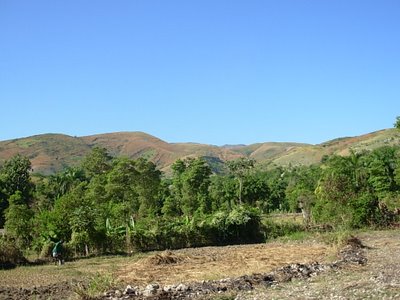
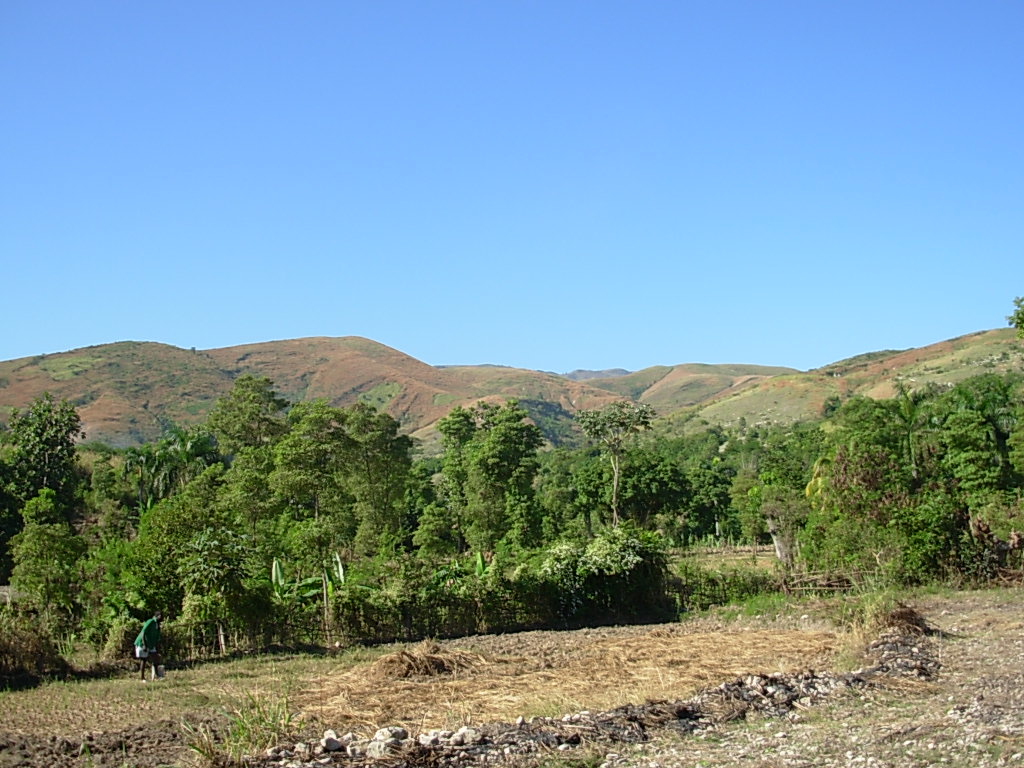
These are the hills above Christan. 60 years ago they were thick with tropical rainforest. Now the trees are gone, which even affects weather patterns. Less rain falls now in Haiti than ever before.
Here's a photo from the rice harvest. What you do is cut down the stalks with a sickle, then pile them up, and this guy bats them against that stone a couple times and shakes off all the little husked grains. I took a turn at batting myself, which was, of course, hilarious to everyone.

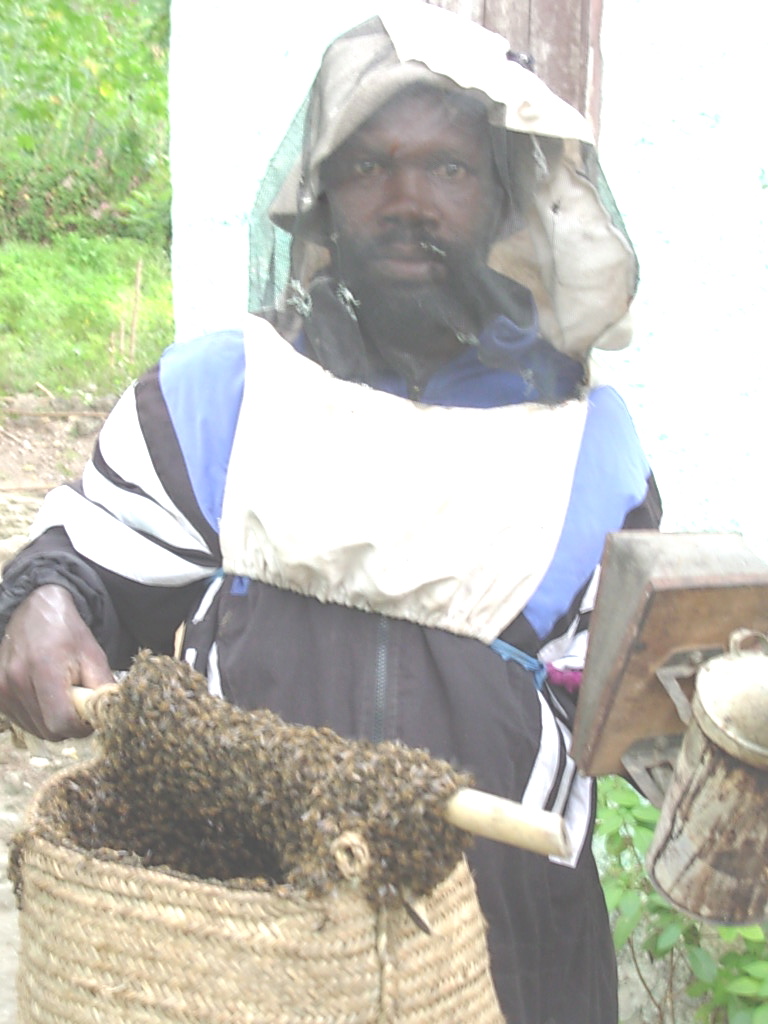
Here's some photos of my wonderful host family. First, my host uncle Miguel, who in addition to managing a bunch of little crops, is a beekeeper. Those are bees in his right hand and a little smoker in his left which was full of smouldering wood shavings. He gave me a bottle of delicious fresh honey as a going away gift.

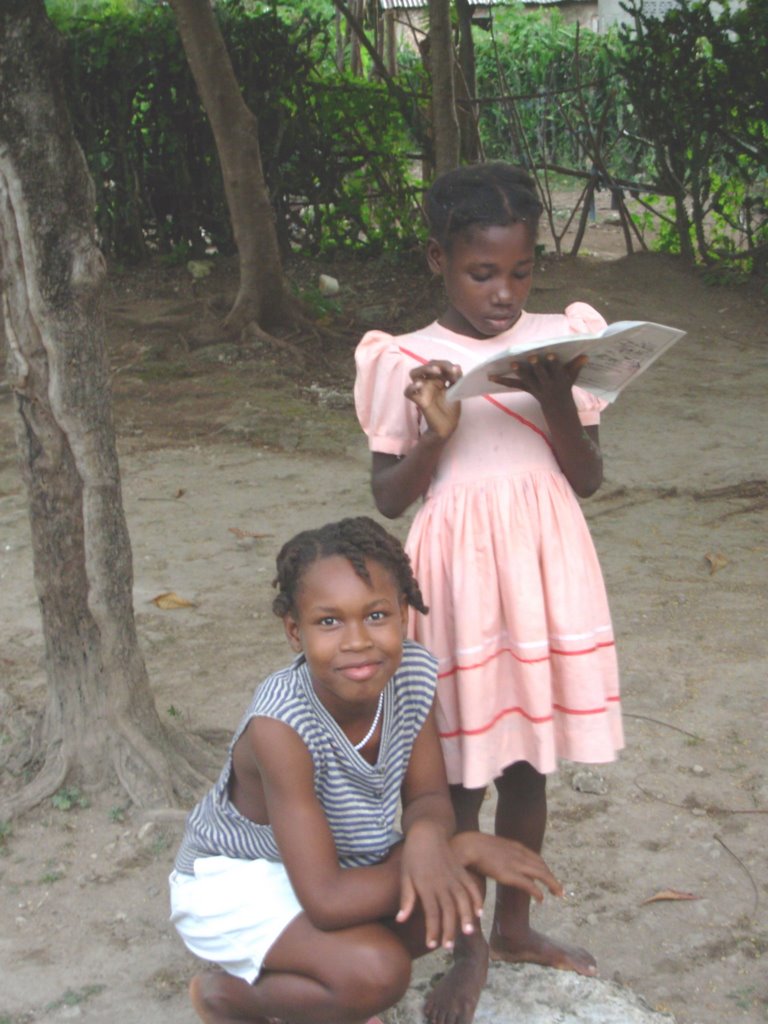
Here's his daughter Midgline. She would beg me to sing songs like the national anthem, the alphabet, stuff like that. Her friend with the notebook is Sandrine.

Here's Sandrine braiding Denise's hair - always a community activity.

The littlest kids just wail the whole time this is happening. It's very painful apparently, but it's the only way to manage such kinky hair without relaxing chemicals (expensive) or dreadlocks (incredibly rare in Haiti, even with Jamaica just a few miles away). This is why most boys just shave it off periodically. But here's little Bechi, my host brother, with his hair waiting to be braided. For a while he had it ultrapoofy and going straight up, and he looked like one of those troll dolls.

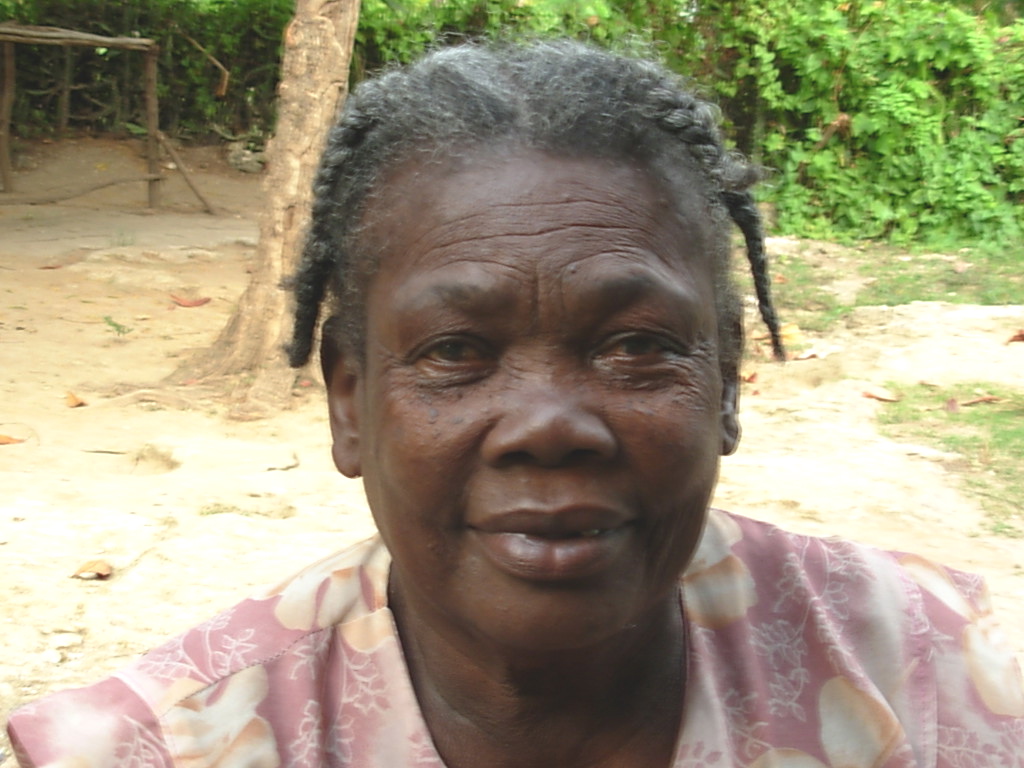
Here's Rosalie, my host mother, with Bechi, and grandma. Grandma scared me a little at first, the way she would sit on the porch and sleep, snoring with her eyes open. She used to be the town butcher. The last MCC homestay person went to wash clothes at the river with Rosalie. She offered to scrub some from Rosalie's load, and got handed the bloody meat dress.

Grandma again. She really grew on me.

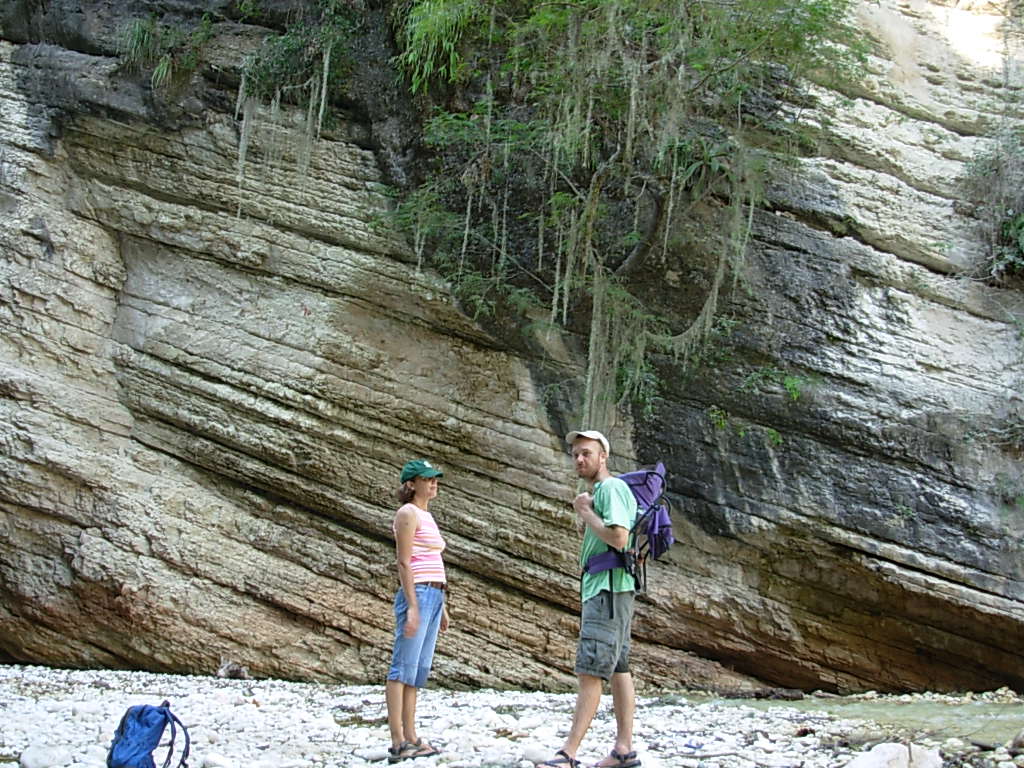
On my last Saturday I went on a hike with Matt and Esther and little Gabriela in tow. We walked up along the side of a river for a mile or so, until steep walls of limestone rose up from the bank.

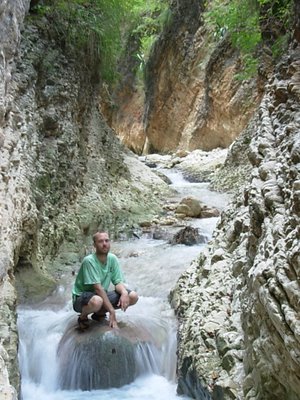
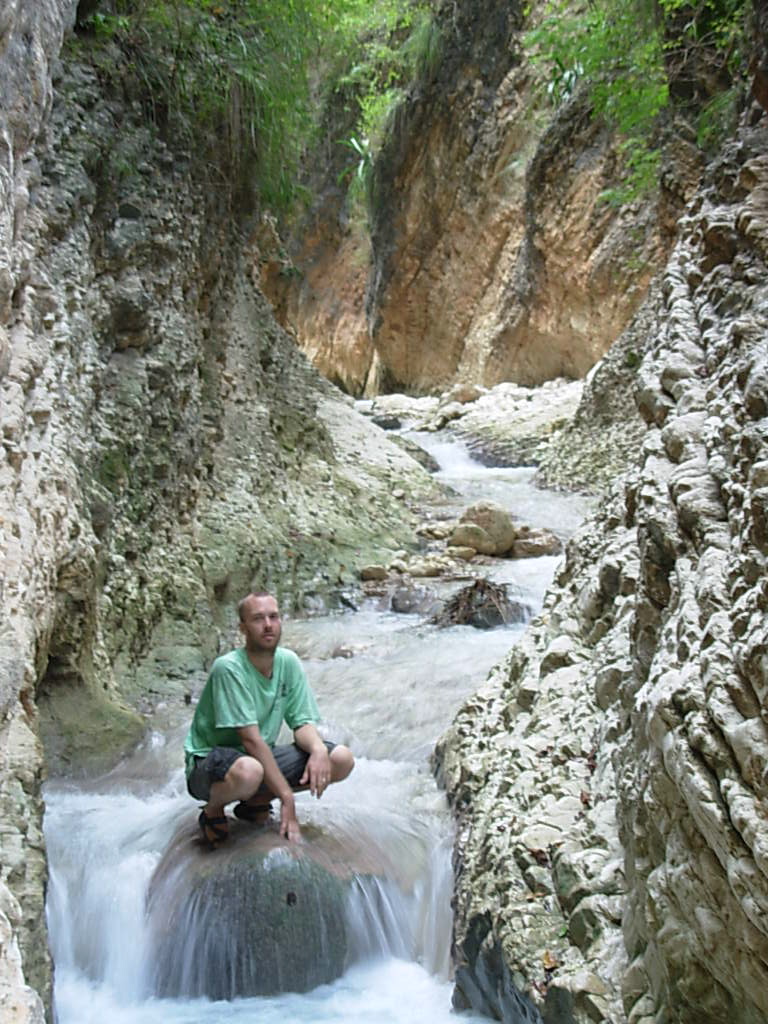
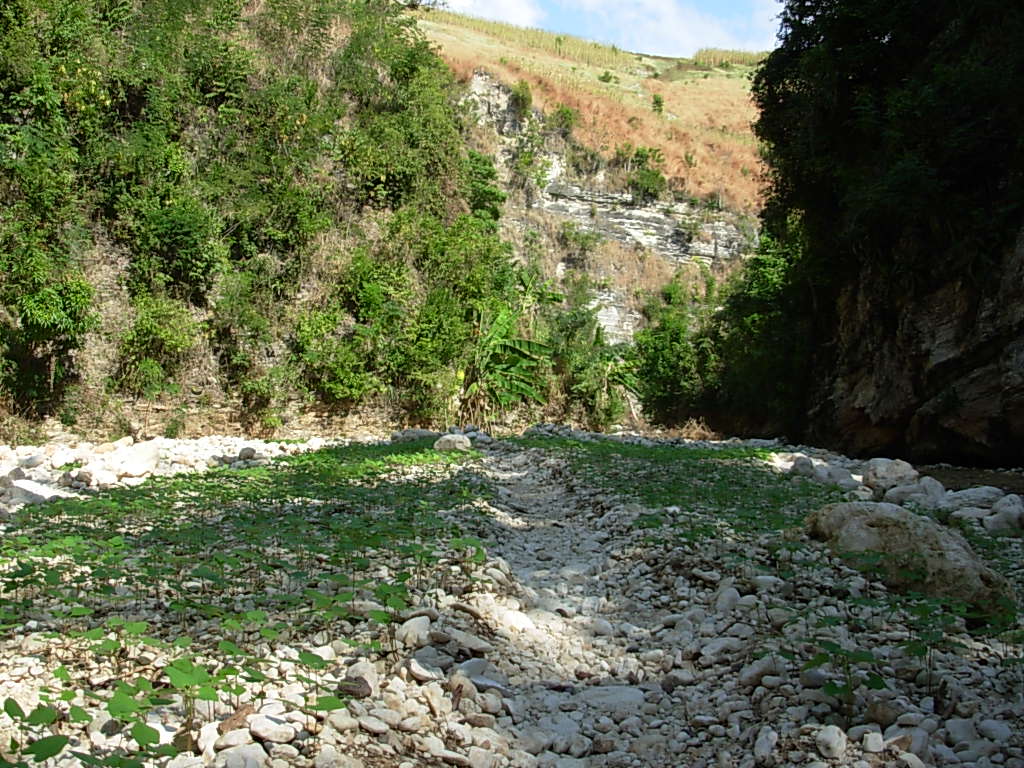
From there, we were hiking in the river, through a winding gorge and all kinds of beautiful gnarled rock formations.
On the way back I noticed this. It's a bean crop. There's a little bit of dirt down below, but these stalks are pretty much just growing up through rocks, fed by water from the river flowing on both sides.

These are the hills above Christan. 60 years ago they were thick with tropical rainforest. Now the trees are gone, which even affects weather patterns. Less rain falls now in Haiti than ever before.
Here's a photo from the rice harvest. What you do is cut down the stalks with a sickle, then pile them up, and this guy bats them against that stone a couple times and shakes off all the little husked grains. I took a turn at batting myself, which was, of course, hilarious to everyone.

Here's some photos of my wonderful host family. First, my host uncle Miguel, who in addition to managing a bunch of little crops, is a beekeeper. Those are bees in his right hand and a little smoker in his left which was full of smouldering wood shavings. He gave me a bottle of delicious fresh honey as a going away gift.
Here's his daughter Midgline. She would beg me to sing songs like the national anthem, the alphabet, stuff like that. Her friend with the notebook is Sandrine.
Here's Sandrine braiding Denise's hair - always a community activity.
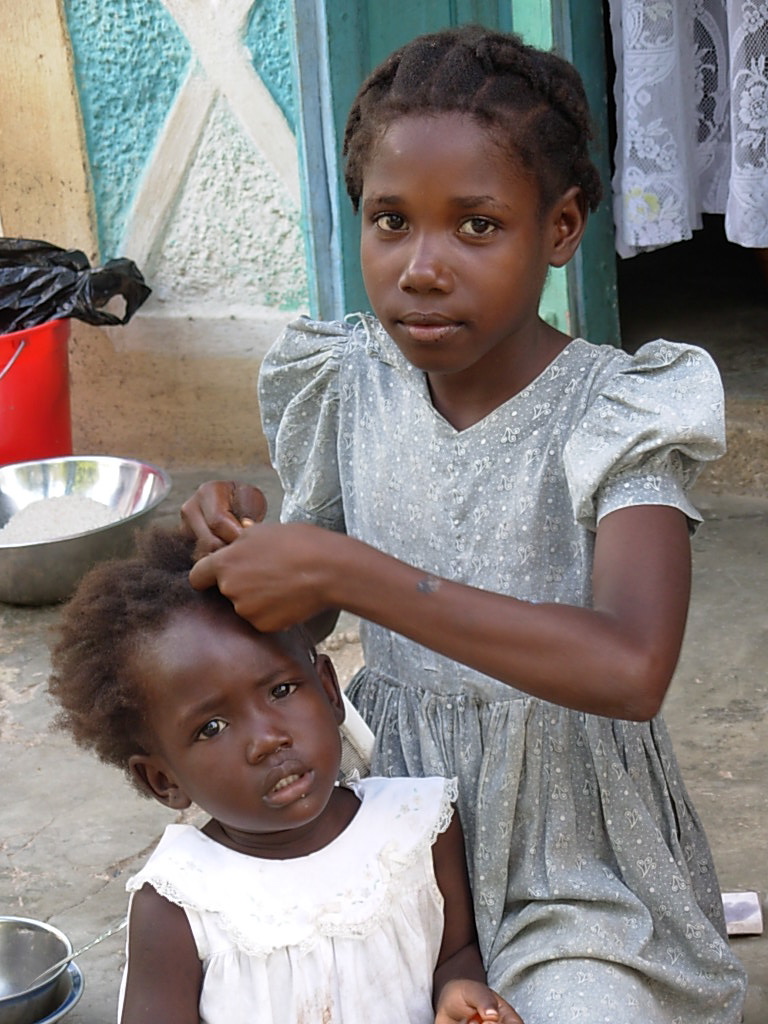
The littlest kids just wail the whole time this is happening. It's very painful apparently, but it's the only way to manage such kinky hair without relaxing chemicals (expensive) or dreadlocks (incredibly rare in Haiti, even with Jamaica just a few miles away). This is why most boys just shave it off periodically. But here's little Bechi, my host brother, with his hair waiting to be braided. For a while he had it ultrapoofy and going straight up, and he looked like one of those troll dolls.
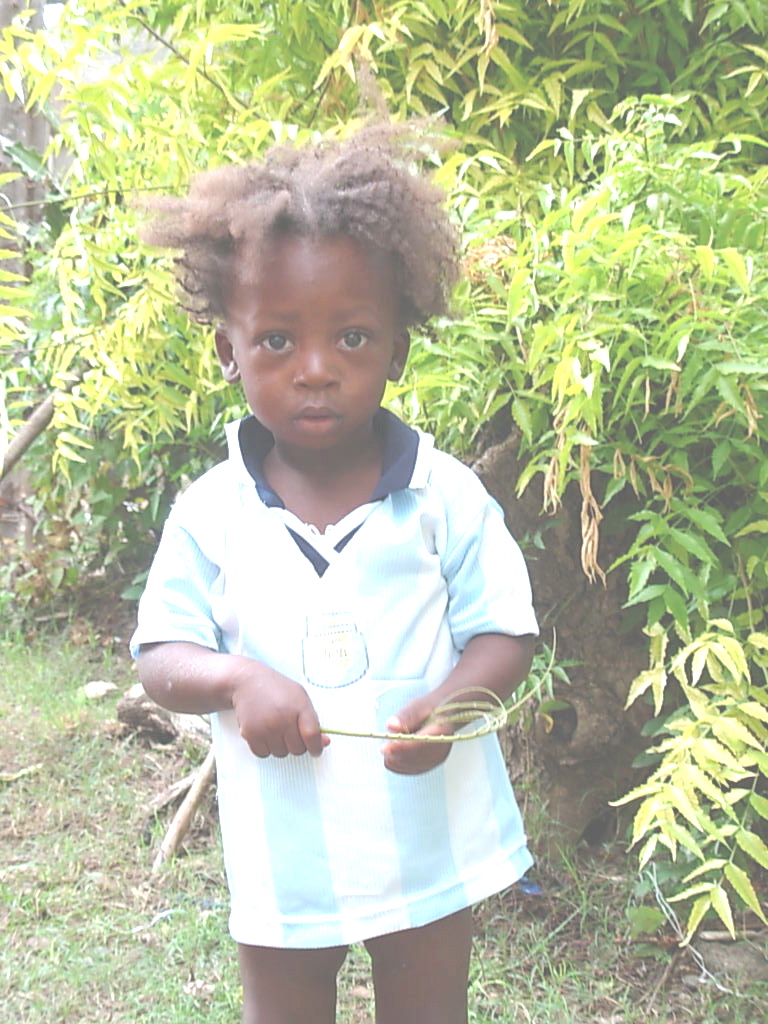
Here's Rosalie, my host mother, with Bechi, and grandma. Grandma scared me a little at first, the way she would sit on the porch and sleep, snoring with her eyes open. She used to be the town butcher. The last MCC homestay person went to wash clothes at the river with Rosalie. She offered to scrub some from Rosalie's load, and got handed the bloody meat dress.

Grandma again. She really grew on me.
On my last Saturday I went on a hike with Matt and Esther and little Gabriela in tow. We walked up along the side of a river for a mile or so, until steep walls of limestone rose up from the bank.
From there, we were hiking in the river, through a winding gorge and all kinds of beautiful gnarled rock formations.
On the way back I noticed this. It's a bean crop. There's a little bit of dirt down below, but these stalks are pretty much just growing up through rocks, fed by water from the river flowing on both sides.
Tuesday, December 12, 2006
Life Andeyo
Haitians that live "andeyo" are rural folks--probably 99% of them are very poor. I just got back yesterday from my monthlong homestay in the Artibonite valley, which was definitely andeyo. I'm not sure how to begin describing the experience. Life there was a lot how I imagine life in the old American west, as in homesteaders and what not. Consider:
There's no running water or electricity.
Work barely stops, though there's a relaxed pace to it. Kids have time to play, but a lot of their day is work too.
School is a great idea on paper, but the learning is all by rote, the books are ancient, and it can sort of get in the way of survival sometimes, so it's not the highest priority.
Every night I ate and then later read by the light of a kerosene lamp.
And, people refuse to smile for photographs.
Seriously, these are some of the smiliest people I've ever met. They would be all giggly getting into position to pose for a photo, and then as soon as I start counting, everybody goes stoic on me. For example, here's what grandpa looks like:

Here's what he looks like when he's aware his photo is being taken:

For the most part, life for people out there has hardly changed in 200 years. I washed my clothes by hand. I harvested rice. I thumbed dried indian corn off the cob so it could be ground, by hand, into meal. In some ways Haiti is the least stable country in the hemisphere. In some ways it's the most stable.
But it wasn't all Little House on the Prarie the whole time. For example, two sundays ago there was a national election for magistrates. There was a polling place in Dezam, the town of a few thousand people where MCC's reforestation office is based. My homestay was in the village of Christan, about 4o minutes uphill on foot. I walked down to Dezam that morning to attend the Catholic mass with Jean-Remy, one of MCC's Haitian staff.
Actually, let me digress here a minute. It was a special sunday to honor the patron saint of Dezam, so mass began at 9:00am instead of 6:00am which is usually (!) the case. There were lots of decorations and people were taking photos with a cheesy painted beach scene outside of the sunday school building. Big special day. During the service, as the choir worked through an extra long and happy number, six women with baskets on their heads came and slowly sashayed from the back to the front.
The baskets were full of fruits, veggies and sugar cane, and two of the women even added live turkeys to the mix. The homily was nice. It stressed the people's duty to vote, to vote not for friends, or friends of friends, but for candidates who were honest and who cared about the needs of all Haitiens. At one point in the service, during a calm moment, I remember hearing some commotion outside. But soon the choir was singing again and I thought nothing of it.
Afterwards, I was invited to the priest feast. It was myself, Jean-Remy and his wife, the padres, and a couple dozen others.

Apparently, being the only "blan" in the place obliged me to pour the champagne you see there for everyone. No mishaps, fortunately, except I probably shouldn't have given any to the girl that looked about 16. Or her brother who was in his early teens (I hope). But their dad didn't seem to mind, and it was only a little.
After about an hour of feasting, I walked fat and happy back up the hill to Christan. On the way I met one of the guys from the rice harvest. He told me that the election had been disqualified in Dezam because it was violently disrupted. A truckload of guys showed up waving revolvers and a couple of shotguns and started turning over tables. They ripped up ballots and fired in the air to scare people away. One man was shot in the hand. I even heard from a couple of people later on that a man had been killed.
Two miles down the road to the Port-au-Prince was the administrative office for the election. My Creole tutor was working there as a volunteer monitor for the Lespwa (hope) party, which currently holds the presidency and is supported by a legitimate majority of Haiti's poor, which is to say a legitimate majority of Haitians. Around the time of the disturbance in Dezam, monitors from several non-Lespwa parties began tearing the office up. Weapons were brandished. Ballots were burned.
And the most scandalous, in my opinion, is the fact that in both of these situations, the armed UN soldiers -- dispatched to ensure calm and security during the election -- ran. I'm a pacifist. I'm not saying that I wish the UN soldiers had started mowing down these "vagabonds" (as villagers would always refer to the thugs). But it certainly begs the question: what in the hell is the UN doing here?
8,500 armed personnel. $500 million a year. You see them everywhere you go in Port-au-Prince. A couple of soldiers from Brazil, China, the Philippines, Senegal or wherever sitting atop a tank-like vehicle or a big jeep, chain-smoking, hands gripping a gun big enough to take down a helicopter. Just watching the cars and foot traffic go by. How does that make anyone feel safer? The posh neighborhoods uphill from PAP have a ridiculous real estate bubble inflated by all these blue helmets who need somewhere to live, and whose housing costs are covered despite already high salaries. I don't know how much the UN soldiers make, but I know that starting pay for UN policemen is $90,000 a year. It's high because there are bonuses for serving in such "dangerous" circumstances. Several reports have found that some of the worst human rights abuses in Haiti are being perpetrated by these soldiers. Should we be surprised? The commander of the Chilean contingent has been linked to some of the most heinous violence that occurred under Pinochet.
Please challenge this if I'm wrong, but as I understand it Haiti is the only country, now or ever before, to be occupied by the UN without a civil war. There's not even the threat of civil war here, not even close. Sure, there's gangs and a drug trade -- but nothing like as bad as it is in parts of Brazil, as one example. And yet Brazil gets to spearhead this mission that benefits nobody except the tiny wealthy Haitian elite that owns all the rentable real estate. That's a little simplistic. Other people benefit, but certainly not the average Haitian. I could go on, and I will, but I should save it for some future post.
So back to the election. Sounds like what happened is for some reason the secrecy of the ballot in the Dezam precinct was compromised. Some fanatical supporters of the opposition parties got word from the monitors that the election wasn't going their way, and decided to disrupt. The whole thing is really complicated, and I don't know how to resolve this kind of problem, beyond the no-brainer of ensuring that votes are kept secure and secret until after the election. But this is exactly the kind of thing I'll be working on in my job, which began today.
But while I'm on the political note, I have to mention this too. Remember grandpa from the pictures above? He's a charming, gentle, very likeable old man. His sandals are made from an innertube that was cut into strips and artfully woven into something wearable. Grandpa used to be the most feared man in Dezam. Let me explain: The Duvalier dynasty ruled Haiti with an iron fist from the 50s to the 80s. They’re responsible for the murder of tens of thousands of Haitians. Most of these murders were carried out by the ‘tonton macoutes’ – Creole for boogeymen. It was an all-volunteer army, untrained, uneducated, but armed and loyal to noone but the dictator. Their only objective was to intimidate and squelch any kind of political dissent whatsoever. For this loyalty, they were given carte blanche to confiscate any property they saw fit and inflict any violence they thought necessary, with absolute impunity.
I discovered just before I arrived at my homestay that Matt and Esther, the Canadian couple that does reforestation with MCC, had recently gotten this info. We really don’t know the extent of grandpa’s activities with the Macoutes, but we know that he did beat the hell out of a lot of people in and around Dezam back in the 70s. The whole thing really got me to thinking – how could this sweet old man, who couldn’t have weighed more than 150 pounds in his prime, do such things? And moreover, how did he get away with it? Was it fear of further reprisals that kept the villagers from exacting revenge? Did poverty train them to accept it as part of life in an unfair world? Does the church bear any responsibility?
Nowadays, grandpa is beginning to succumb to dimentia. I'd like to think that this is because somewhere deep down he wants to forget the horrible things he's done. But realistically, most everyone, myself included, find it all to easy to justify their moral shortcomings.
Okay, sorry this post is so long. I've got lots more photos and thoughts, but I'll post those later. One last little bizarre tidbit for now. One day, sitting on the porch of my homestay, I observed their horse scraping it's teeth against the limestone bedrock (which due to erosion is visible over about a quarter of the front yard) looking for pieces of loose dirt, and then eating the loose dirt it could find. I was baffled. This horse wasn't in as bad of shape as a lot of the bony nags you see andeyo. Plus there were decent patches of grass just a couple of feet away. I turned to my friend Jackson and asked, "Hey Jackson, why is the horse eating dirt?"
"Oh that? That's because the horse needs minerals that are in the earth."
"Are you sure about that?"
"Yeah. Earth has lots of good minerals, which is why people eat it."
"People!? People eat dirt here?"
"Yeah. Especially pregnant women."
"What? Do you eat dirt?"
"Sure. Everyone does."
I tried to unfurrow my brow and not think too much about what I had just heard. Ten minutes later Jackson showed up with something in his hand. "Felix, do you want to try some for yourself?" He held out what looked like a couple of light grey meringues: flat on the bottom and dollop-shaped. I thought, maybe I misunderstood him earlier. These didn't look so bad. And shoot, I'll try anything once. I took a taste, and guess what? Tasted like dirt. On the salty side, sure--but still dirt. I couldn't help my grimace as I handed this earth-cookie gift back to Jackson and told him I wouldn't be having any more. Apparently my cultural sensitivity stops somewhere between tasting dirt and eating dirt.
There's no running water or electricity.
Work barely stops, though there's a relaxed pace to it. Kids have time to play, but a lot of their day is work too.
School is a great idea on paper, but the learning is all by rote, the books are ancient, and it can sort of get in the way of survival sometimes, so it's not the highest priority.
Every night I ate and then later read by the light of a kerosene lamp.
And, people refuse to smile for photographs.
Seriously, these are some of the smiliest people I've ever met. They would be all giggly getting into position to pose for a photo, and then as soon as I start counting, everybody goes stoic on me. For example, here's what grandpa looks like:
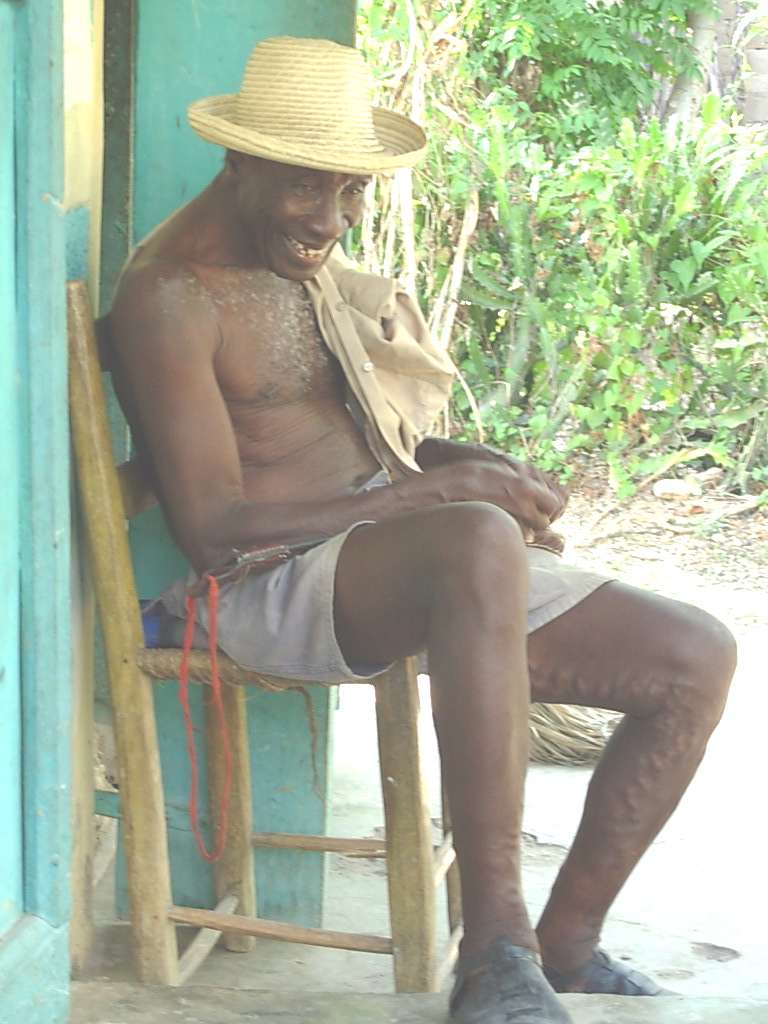
Here's what he looks like when he's aware his photo is being taken:

For the most part, life for people out there has hardly changed in 200 years. I washed my clothes by hand. I harvested rice. I thumbed dried indian corn off the cob so it could be ground, by hand, into meal. In some ways Haiti is the least stable country in the hemisphere. In some ways it's the most stable.
But it wasn't all Little House on the Prarie the whole time. For example, two sundays ago there was a national election for magistrates. There was a polling place in Dezam, the town of a few thousand people where MCC's reforestation office is based. My homestay was in the village of Christan, about 4o minutes uphill on foot. I walked down to Dezam that morning to attend the Catholic mass with Jean-Remy, one of MCC's Haitian staff.
Actually, let me digress here a minute. It was a special sunday to honor the patron saint of Dezam, so mass began at 9:00am instead of 6:00am which is usually (!) the case. There were lots of decorations and people were taking photos with a cheesy painted beach scene outside of the sunday school building. Big special day. During the service, as the choir worked through an extra long and happy number, six women with baskets on their heads came and slowly sashayed from the back to the front.
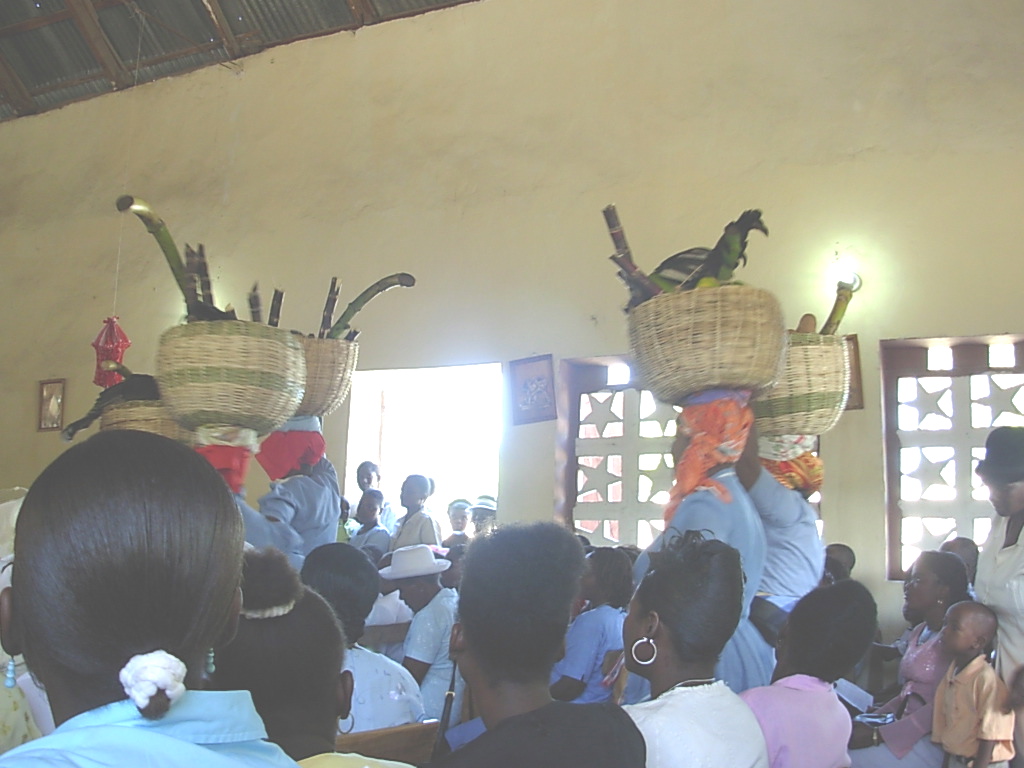
The baskets were full of fruits, veggies and sugar cane, and two of the women even added live turkeys to the mix. The homily was nice. It stressed the people's duty to vote, to vote not for friends, or friends of friends, but for candidates who were honest and who cared about the needs of all Haitiens. At one point in the service, during a calm moment, I remember hearing some commotion outside. But soon the choir was singing again and I thought nothing of it.
Afterwards, I was invited to the priest feast. It was myself, Jean-Remy and his wife, the padres, and a couple dozen others.
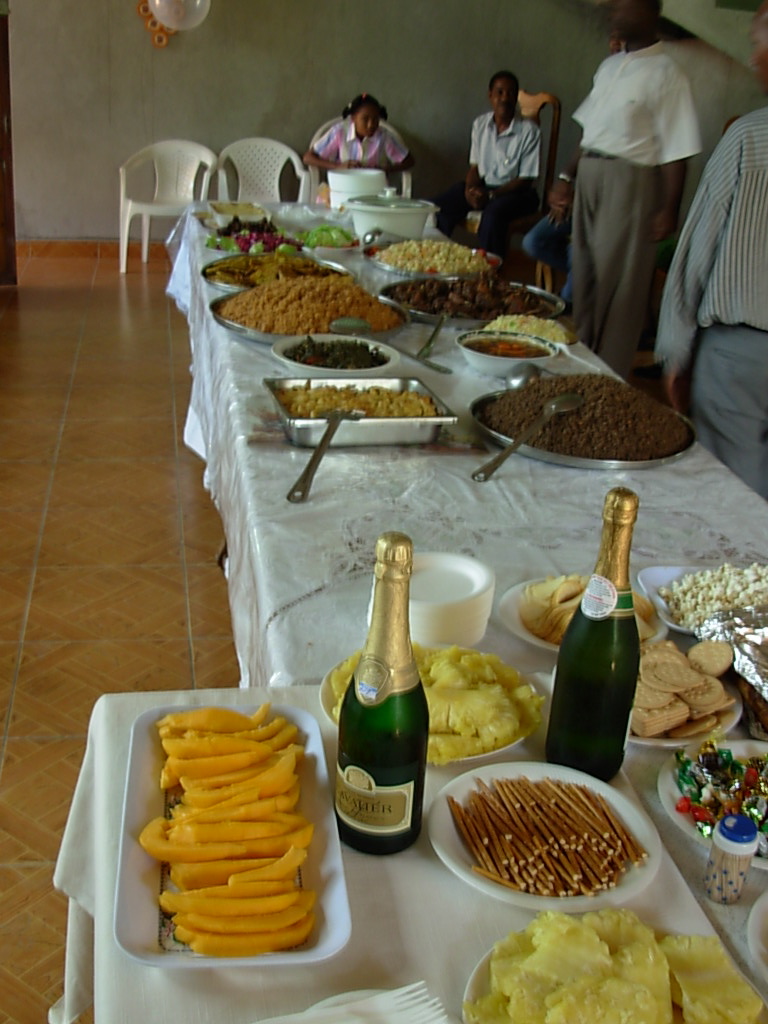
Apparently, being the only "blan" in the place obliged me to pour the champagne you see there for everyone. No mishaps, fortunately, except I probably shouldn't have given any to the girl that looked about 16. Or her brother who was in his early teens (I hope). But their dad didn't seem to mind, and it was only a little.
After about an hour of feasting, I walked fat and happy back up the hill to Christan. On the way I met one of the guys from the rice harvest. He told me that the election had been disqualified in Dezam because it was violently disrupted. A truckload of guys showed up waving revolvers and a couple of shotguns and started turning over tables. They ripped up ballots and fired in the air to scare people away. One man was shot in the hand. I even heard from a couple of people later on that a man had been killed.
Two miles down the road to the Port-au-Prince was the administrative office for the election. My Creole tutor was working there as a volunteer monitor for the Lespwa (hope) party, which currently holds the presidency and is supported by a legitimate majority of Haiti's poor, which is to say a legitimate majority of Haitians. Around the time of the disturbance in Dezam, monitors from several non-Lespwa parties began tearing the office up. Weapons were brandished. Ballots were burned.
And the most scandalous, in my opinion, is the fact that in both of these situations, the armed UN soldiers -- dispatched to ensure calm and security during the election -- ran. I'm a pacifist. I'm not saying that I wish the UN soldiers had started mowing down these "vagabonds" (as villagers would always refer to the thugs). But it certainly begs the question: what in the hell is the UN doing here?
8,500 armed personnel. $500 million a year. You see them everywhere you go in Port-au-Prince. A couple of soldiers from Brazil, China, the Philippines, Senegal or wherever sitting atop a tank-like vehicle or a big jeep, chain-smoking, hands gripping a gun big enough to take down a helicopter. Just watching the cars and foot traffic go by. How does that make anyone feel safer? The posh neighborhoods uphill from PAP have a ridiculous real estate bubble inflated by all these blue helmets who need somewhere to live, and whose housing costs are covered despite already high salaries. I don't know how much the UN soldiers make, but I know that starting pay for UN policemen is $90,000 a year. It's high because there are bonuses for serving in such "dangerous" circumstances. Several reports have found that some of the worst human rights abuses in Haiti are being perpetrated by these soldiers. Should we be surprised? The commander of the Chilean contingent has been linked to some of the most heinous violence that occurred under Pinochet.
Please challenge this if I'm wrong, but as I understand it Haiti is the only country, now or ever before, to be occupied by the UN without a civil war. There's not even the threat of civil war here, not even close. Sure, there's gangs and a drug trade -- but nothing like as bad as it is in parts of Brazil, as one example. And yet Brazil gets to spearhead this mission that benefits nobody except the tiny wealthy Haitian elite that owns all the rentable real estate. That's a little simplistic. Other people benefit, but certainly not the average Haitian. I could go on, and I will, but I should save it for some future post.
So back to the election. Sounds like what happened is for some reason the secrecy of the ballot in the Dezam precinct was compromised. Some fanatical supporters of the opposition parties got word from the monitors that the election wasn't going their way, and decided to disrupt. The whole thing is really complicated, and I don't know how to resolve this kind of problem, beyond the no-brainer of ensuring that votes are kept secure and secret until after the election. But this is exactly the kind of thing I'll be working on in my job, which began today.
But while I'm on the political note, I have to mention this too. Remember grandpa from the pictures above? He's a charming, gentle, very likeable old man. His sandals are made from an innertube that was cut into strips and artfully woven into something wearable. Grandpa used to be the most feared man in Dezam. Let me explain: The Duvalier dynasty ruled Haiti with an iron fist from the 50s to the 80s. They’re responsible for the murder of tens of thousands of Haitians. Most of these murders were carried out by the ‘tonton macoutes’ – Creole for boogeymen. It was an all-volunteer army, untrained, uneducated, but armed and loyal to noone but the dictator. Their only objective was to intimidate and squelch any kind of political dissent whatsoever. For this loyalty, they were given carte blanche to confiscate any property they saw fit and inflict any violence they thought necessary, with absolute impunity.
I discovered just before I arrived at my homestay that Matt and Esther, the Canadian couple that does reforestation with MCC, had recently gotten this info. We really don’t know the extent of grandpa’s activities with the Macoutes, but we know that he did beat the hell out of a lot of people in and around Dezam back in the 70s. The whole thing really got me to thinking – how could this sweet old man, who couldn’t have weighed more than 150 pounds in his prime, do such things? And moreover, how did he get away with it? Was it fear of further reprisals that kept the villagers from exacting revenge? Did poverty train them to accept it as part of life in an unfair world? Does the church bear any responsibility?
Nowadays, grandpa is beginning to succumb to dimentia. I'd like to think that this is because somewhere deep down he wants to forget the horrible things he's done. But realistically, most everyone, myself included, find it all to easy to justify their moral shortcomings.
Okay, sorry this post is so long. I've got lots more photos and thoughts, but I'll post those later. One last little bizarre tidbit for now. One day, sitting on the porch of my homestay, I observed their horse scraping it's teeth against the limestone bedrock (which due to erosion is visible over about a quarter of the front yard) looking for pieces of loose dirt, and then eating the loose dirt it could find. I was baffled. This horse wasn't in as bad of shape as a lot of the bony nags you see andeyo. Plus there were decent patches of grass just a couple of feet away. I turned to my friend Jackson and asked, "Hey Jackson, why is the horse eating dirt?"
"Oh that? That's because the horse needs minerals that are in the earth."
"Are you sure about that?"
"Yeah. Earth has lots of good minerals, which is why people eat it."
"People!? People eat dirt here?"
"Yeah. Especially pregnant women."
"What? Do you eat dirt?"
"Sure. Everyone does."
I tried to unfurrow my brow and not think too much about what I had just heard. Ten minutes later Jackson showed up with something in his hand. "Felix, do you want to try some for yourself?" He held out what looked like a couple of light grey meringues: flat on the bottom and dollop-shaped. I thought, maybe I misunderstood him earlier. These didn't look so bad. And shoot, I'll try anything once. I took a taste, and guess what? Tasted like dirt. On the salty side, sure--but still dirt. I couldn't help my grimace as I handed this earth-cookie gift back to Jackson and told him I wouldn't be having any more. Apparently my cultural sensitivity stops somewhere between tasting dirt and eating dirt.
Subscribe to:
Posts (Atom)