Monday, May 19, 2008

Waiting for Bubba

Last night I was on my way to use the bathroom and the secret service told me to hold on and wait while President Clinton finished up in there. A little context: I am back at home in Medford, Oregon right now for vacation. My sister got married on Saturday in a beautiful service at a winery. Here she is on her way to the altar with dad (who also performed the wedding):


Here's the new husband and wife:


And here's the three Hildebrand kids all together:


What can I say? The wedding was perfect. Everybody cried a lot. And then everybody danced a lot. The bride and groom arrived at the reception with my sister driving a creamsicle colored 1960s Vespa, and her new husband in the sidecar. Yes, a Vespa with a sidecar.

It was of course a big day for my sister. Kind of a big day for me too, just in the fact that it was my first time back in the states since I left for Haiti in November 2006. And it was my first time back to my hometown since August 2006. The wedding was a flood of faces that I haven't seen in two, four, even ten years. Naturally everyone was asking me what it felt like to be back and whether I was freaking out or not. I generally told people that if I had gone straight from Haiti to some random place in the states for, say, a conference, and had to stay in a hotel and be surrounded by strangers, I probably would have gone nuts. But, being surrounded by family and friends made it possible for me not to miss Haiti too much. My digestive system couldn't be fooled though. It's still in open rebellion against non-Haitian food.

I'm hoping to spend some of my time back home on this blog and fill in some of the big gaps since I haven't been very good about blogging for the last few months. For now I'll just finish the story about the former president.

If you're following the US democratic primaries, you'll know that tomorrow, May 20th, is Oregon's day to vote. It sounds like Barack Obama may clinch the majority of pledged delegates. Over the weekend he held a rally in Portland that was the biggest in US political history. Bill and Chelsea Clinton were campaigning in Southern Oregon over the weekend, giving a talk at the state university in Ashland (just south of Medford) on Sunday. A neighbor and friend of ours owns a restaurant in Medford - and we got word that the Clintons would be eating there Sunday night afterwards. So after all the friends and family and the bride and groom left town on Sunday, mom and dad and I decided to go down and try to get a look at the former president.

Once we heard he had arrived, I left the outdoor patio to walk through the restaurant to the bathroom and get a glimpse on the way. I squeezed by Chelsea, and then I saw the big, pink-faced man himself. He was dressed just like he is in the picture below, which came from the Medford newspaper:


I was going to walk by and pretend I didn't recognize him, but before I got there, he turned around and went to go take a leak. So I ended up waiting outside the bathroom. A burly secret service guy told me to step back away from the door. And so I stood and waited. When the door opened up, and the security detail turned around to lead him to the dining room, I waited for just the right moment and grabbed his collar and slammed him up against the bathroom door and shouted in his face, "Because of your craven political posturing Haiti has become dependent on subsidized rice exports from the United States! Thanks Bill! Now the country is starving and protesting and rioting and the prime minister lost his job because of forces far beyond his control! Forces that you helped set in motion! Haiti's food problems are more your fault than his! Shame on you! SHAME ON YOU!!!" That's when I got the tasered.

Kidding, of course. I just let him walk by and then took my turn in the bathroom. But I do wish I could have told him that. If you want to read more about the factors that created Haiti's current crisis with food prices, here is an article that gives a good analysis of the situation, though it doesn't specifically name Clinton's role in forcing Aristide to drop tariffs in 1994.

I'll write more this week about the motorcycle trip in Haiti with my dad and his friend John, and also about how Haitians are viewing the US presidential race.

Sunday, April 27, 2008

Follow up on "Lavi chè"

My teammate Lindsay made a comment on that post that is worth copying here. Specifically, what she says about Preval's comment to "pase cheche m."


Lindsay said...
Here are my 2 cents worth (which you, Kurt, already know but others might not)...

The Le Matin photographer was shot with a rubber bullet. Still shot, but at least it wasn't lethal.

Digicel is also well known amongst the population for its foundation's work, which may have added to it being protected. Saul also sighted the 50gd phone cards Digicel sells, which are more accessible for the general public.

I heard that Preval's inital statement was "pase cheche m," meaning he wanted to join in if people were going to protest. hmm...I wonder which he actually said...

Shortly before Preval's speach was broadcast on TV, there was a series of shooting by the palace. We figured it was evoked by the crowd getting impatient. During Preval's broadcast, you could hear that very same round of shooting in the background. So he did record it in advance, but not by much.


I really misunderstood what Preval was saying, but Lindsay gets it right. He wasn't making a "bring it on" type of provocation. He was saying that if the crowd was protesting the high cost of living, they should come by the palace and get him so he could join in the protest. A funny note is that when they took him up on his offer, he reportedly sent word that he couldn't come out and join them because he didn't bring his tennis shoes to work that day. So protesters showed up with tennis shoes for him to wear. No more excuses after that.

Friday, April 18, 2008

First the disclaimer. I am a guest blogger. My name is Don Hildebrand and I am proudly known as Kurt's dad.

John Mills and I arrived this morning. John is a close friend from college and and we have shared many adventures over the last 35 years. Riding bikes across Haiti is the current goal.

Because of the situation in Haiti the past 2 weeks, we considered postponing our trip to a later date. And in fact there have been some truly terrifing moments since we have been here---but they all were a result of the car ride out to Desarme this afternoon. Somehow we arrived safely and no pedestrians were hurt either.


It is a beautiful country in so many ways with so many beautiful people. We rested a bit after we arrived and then took a walk to see some of the reforestration projects that are happeining here. Jean Remy, a resident of Desarme began planting trees on a wood lot about 20 years ago and you can see the result. As we were walking through the woods we came upon several large baskets with clothing, ghord shells and some money inside of them. Apparently voodoo practices take place in the woods from time to time. Brian, our guide and host of the Mennonite project here in Desarme said that when people try to drive out an evil spirit they will come here and cleanse themselves. They remove all their clothing and change into new clothes and leave other objects like the money and ghords that have some special significance. We left it all undisturbed.


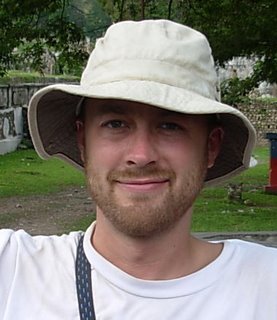
The Artibonite Valley is beautiful and one of the most fertile places in Haiti. You can see rice and sorghum plants in the valley behind Kurt and John.


Tomorrow we leave for the motorcycle part of the trip. We will wind our way up to Papaye for tomorrow and then on to Cape Haitian on Sunday.

But it is dinner time in Haiti for us and we are about to head off to the town square--a single street light at a crossroad. I am told they have great egg sandwiches there.

Some wonderful girls met us on the hike and offered us some mangoes. They tasted so good. Here the guys are taking care of the natural result of eating those mangoes. Doesn't anybody carry floss anymore?

Tuesday, April 15, 2008

Lavi chè!

Okay, so, where to begin? The initial outburst of street demonstrations has subsided. The movement began in the southwest corner of Haiti, in a relatively peaceful beach town called Les Cayes. There have long been murmurings of unrest over the skyrocketing cost of living ("lavi chè" in Creole). For at least four months there has been a vague expectation that something like this might happen. But a lot of factors came together to light the fuse. The UN force stationed in Les Cayes got drawn into a violent confrontation which incited a major demonstration. The protests were driven in part by students.

The Haitian government responded by saying that the unrest was being provoked by drug traffickers. I have no idea what truth there is to this statement, but it certainly is true that drug traffickers have benefited from the chaos. The protests spread to Jeremie and other places before finally arriving in Carrefour, just west of Port-au-Prince, within a few days.

I went to work on Tuesday morning unaware of what was going on in the city. By 10:00 a.m., there were large crowds in the streets all around our office, chanting, banging things around, making plenty of noise. I found out that a photographer from a newspaper where a friend of mine works was shot while taking pictures in Champs de Mars, the public area surrounding the national palace. The protesters nearly succeeded in destroying the barricade surrounding the palace, chanting all along that the president must leave the country.

This is an intriguing part of the story. When President Preval was elected for his current term, in 2006, there were some questions as to whether some sort of runoff vote would be needed. There were reports of ballots being burned in parts of the country (my organization has photos) and crowds began forming. The masses of people that turned out in the streets were by and large the supporters of President Aristide who had been aggrieved ever since he left the country under murky circumstances on February 29, 2004. Their aim was clear: the obvious winner of the election – Rene Garcia Preval, former prime minister to Aristide, president from 1995-2000, champion of the poor – must be declared the winner immediately. The crowds stormed the Montana Hotel, where the election headquarters were located, and eventually everybody in charge decided not to test the wrath of a desperate population. Preval was declared the winner.

If you’ve seen the movie “V for Vendetta” you probably remember a line where the hero says something like, “People shouldn’t be afraid of the government. The government should be afraid of the people.” So when I think about those crowds of people demanding that their sheer mass be respected, I think, sure, whatever, patience is a virtue, but if the point of a democracy is to represent the will of the people, then a big enough crowd is effectively a vote, and one that cannot be vetoed without destroying that democracy. The people protesting for Preval to be declared the winner were largely being driven by a distrust of the election authorities, thinking that the elites would pull their strings and use some obscure legal maneuvering to undermine Preval. This is not a paranoid delusion. Both rich and poor countries offer plenty of examples of the popular will being subverted even under the banner of democracy.

However, this time around things were much more complicated. The enormous crowds of people protesting last week were the largest seen here since the 2006 election. Only this time, two years later, the crowds were demanding that President Preval leave office. The primary demand of all of the protests has been to lower the price of basic foods and gas. (Gas is over $6 a gallon here, the minimum wage is $2 a day, and most people are unemployed.) Secondary to these demands has been the demand for the UN mission to leave Haiti, and the demand for President Preval and Prime Minister Alexis to step down.

So this begs the question, were these anti-Preval crowds made up of the same people that made up those pro-Preval crowds just two years before? Did “the masses” really turn so decisively against the man they used to support? In just two years? I won’t try to answer, but I’m sure it’s not just a yes or no kind of thing. People often think of Haiti as an overwhelming majority of very poor people with a tiny middle class and a tiny elite. There is some truth to this, but it’s a mistake to then assume that any one of these three groups thinks or votes all the same. The tension between Evangelicals and Catholics and, of course, Vodouisants, is another frame that doesn’t really adequately explain the situation. And, as in any protest, the property damage and looting was being carried out by a small minority of the people in the streets. Always good to keep in mind when you’re looking at pictures of mayhem and destruction.

I was in the office listening to the radio reports of crowds of people forming all over the city, barricades of flaming tires going up on the main roads, windows being broken, etc. I started a googlechat (surreal? yes) with another MCCer, who was at a house outside of the city. His wife was stuck at her house right on the main road of Delmas which had massive crowds marching past it constantly. She watched the convenience store for the gas station across the street as it was looted until completely empty. It was only then I realized that this thing was going to last a while.

A friend of mine called from Champs de Mars where she went to see the aftermath. The building for Air France was gutted entirely. One of the strangest things she observed was that Digicel was left alone. There are two major cell phone companies in Haiti: Digicel and Voila. They each have their signature colors, they each have endorsements from Haitian celebrities, and they each give away lots and lots of t-shirts and backpacks and the like. And yet the protesters drew a clear line between them. They destroyed a Voila office just a few doors down from a Digicel office. My friend saw one protester get beaten up by other protesters after he threw a rock at Digicel. She saw a guy raise his fist in the air and say, “Digicel. Respect.” She saw another man come out of the Voila office with a laptop. He declared that he could take it and sell it for a lot of money, but since Voila is run by thieves, he preferred to make a point with it. Which he did, by cracking it in two over his knee.

I have to say that I’m baffled by this. It’s true, Digicel has superior customer service. It’s also true that Digicel has invested a lot into making Haiti’s soccer team competitive. But how in the world could that make such a crucial difference to an angry crowd? I don’t know. I guess it just attests to the fact that an angry crowd is not a mindless crowd. It is made up of people who are making very specific choices for very specific reasons.

Around 4pm, people started leaving the office in groups, planning only to take routes that were verified as clear. There was one road I could take to get to my house up the hill in Petionville. My friend called from Champs de Mars to tell me that a big crowd had just left there to march up that same road. I thought I was going to be stuck at the office for another couple hours, but my boss told me to get on my motorcycle and high-tail it home while I could.

Driving up Rue John Brown I passed a couple of burned out cars, one upside down. There were burning tires here and there, and several big trash containers had been upset into the street. In Petionville the mood was tense. Every other intersection had something burning in it. There were few cars on the road. I talked to all the other MCCers on the phone. I entertained the thought of getting up early and getting out of town to wait things out with friends away from the action. Ultimately we decided to hunker down where we were.

On Wednesday I woke up and turned on the radio. There was lots of talk about protests in Petionville. I heard shots from time to time. I called my boss to check in and he made me promise to stay in my house all day. I was glued to the radio, while at the same time listening to the sporadic fire and the occasional roar of a crowd not more than a few blocks away.

Radio reporters were talking about how the president had promised to make an address to the Haitian people at 8:00am, and everyone was hanging on to see what he would say. While he may in many ways be a captive to this horrible situation, his handling of the protests so far left much to be desired. His reaction to the Les Cayes protests, as I mentioned, blamed drug traffickers for the unrest. While this could be true, it also seemed to dismiss the validity of the protest, at a time when all Haitians are hurting, and some starving, because of rising food costs. When protesters announced to the press that they were going to come to the national palace and demand Preval’s resignation, Preval responded saying, “Pase cheche l.” This is Creole for “go and find it,” but a more appropriate translation would be Bruce Campbell’s “come get some.” Probably the best comparison is with George W. Bush, who responded to the insurgency in Iraq with “bring it on.” Note to all world leaders: don’t bluff with big crowds of thousands of people that already don’t like you. It wasn’t much longer after “pase cheche l” that the protesters decided to take the president up on his challenge. So here we were, a day after the protesters trashed his front yard. Millions of us with our ears cocked to the radio speaker, waiting to see what the hapless president would say. Eight o’clock came and went, and nothing.

Mid-morning I watched a very large crowd come up my street, moving along at a jogging speed. In stark contrast to what I had expected, I saw a lot of smiles. The people in the front were carrying leafy branches. I didn’t see any guns or rocks. Eventually the crowd thinned out and then I saw people running a lot faster to catch up, as the sound of shooting got closer. Several of the people in the street ran into the narrow, clogged entrance to the huge slum of Jalousie, which is about 100 feet from my window. A white UN S.U.V. and two big armored UN vehicles pursued the crowd past the entrance to Jalousie, firing tear gas canisters into the slum. I saw lots of troops with guns, though I don’t specifically remember seeing any of them aim and shoot. It all happened pretty fast.

Perhaps 15 minutes later I heard my landlady’s housekeeper running and saying “gas! gas!” Soon the guard, the housekeeper and my landlady and myself were all doubled over coughing with tears streaming down our cheeks. Being Haitian, they knew immediately what to do in the situation – we picked a few limes from a tree in the yard and bit into them, and then flushed our faces with water. Not long after that there was several minutes of intense gunfire coming from Petionville’s main park, a block away. I still don’t know exactly what was happening there, but I believe it was mostly the UN firing, since they have rubber bullets. The Haitian National Police were also in the mix, and they don’t have rubber bullets. But if live rounds were used, they must have been fired in the air, because otherwise what I heard would have been a massacre. There is still no clear picture of the casualties. I’ve heard six most often as the number killed, with 60 injured. That’s for all of Port-au-Prince, for the duration of the unrest. I’ve also heard stories about the UN bagging up corpses and chucking them into dump trucks, but these are probably not so reliable. Still, six?

Sometime around 11:00am the radio started playing the president’s address on a loop. I’m not sure if the speech was ever broadcast live. I got the impression that he recorded it and sent it out to the media outlets. Reaction to the speech was swift and unanimous: BOO! People started calling into the radio stations to complain that the president didn’t really say anything. He talked about some long term solutions, but not enough short term ones. He talked about how the whole world is dealing with high food prices, not just Haiti. True, perhaps, but not what a starving person wants to hear. Everyone agreed that the president blew it. Some announced that they were still waiting for the president to address them, because what they had just heard must have been a joke. And yet, there haven’t been any major protests since the speech aired. The country finally had something to react to and debate about. It was like everyone took a big breath of air, stretched their arms, and took a look around. The situation we found wasn’t pretty. Lots of businesses damaged, which would surely mean more people unemployed. Everyone I talked to had the same attitude: the president hasn’t done enough to avoid the situation we have now, his speech definitely sucked, but those people who took advantage of a tense situation to break and steal things are making the situation worse for everyone.

Shortly, the news on the radio shifted to a group of senators who was demanding Prime Minister Alexis to step down. This is where the politics get really murky, and I must confess I know very little about all the ins and outs of how this works. But as background, there was an effort just a few weeks ago in the senate to force Alexis out with a vote of no confidence. It appears that these senators are simply taking advantage of the situation to achieve a political victory against President Preval. Over the weekend, everyone went through the motions and Alexis found himself and his whole upper level of government employees without jobs. It’s too bad, really. True that there’s a whole lot of dead wood in the Haitian government. But Alexis has a good reputation as an honest, serious, uncorrupt prime minister. It’s hard to judge someone on job performance whose main task is to save Haiti.

Well, that’s about it for now. Things are calm. Still a lot of broken glass everywhere. Lot of trashed gas stations. Other than that, situation normal. Port-au-Prince is already in permanent bunker mode with big walls and gates absolutely everywhere. There have been scattered reports of protests in other parts of the country – but never all at once.

It’s frustrating to be right here in the country and still not have a clear idea of what exactly happened, why it happened, and what’s happening now. Oh, I should say, it’s kind of embarrassing that a story was on cnn.com quoting me as “Felix Kurt Hildebrand.” That’s just how my name got passed along to him. I’m not running around down here introducing myself to CNN as Felix.

Also, I’m sorry I didn’t take any photos of anything I saw. It honestly didn’t occur to me until days later that I should have had my camera ready. Another MCCer on the team got some footage of the Haitian National Police beating a crowd of totally nonviolent protesters without provocation.

Sorry this is so long, and congratulations if you made it all the way through! I’m sure a lot of it is vague, and you might have a lot of questions about what’s going on. If so, send them along. I’ll do my best.

I’m not just saying this because I need a silver lining to every cloud, but there have been some positive aftereffects rippling out from the chaos. Communities pull together. It’s Haiti, so there’s always going to be a lot of sidewalk debate. But the sidewalk debates these days seem to be more about big picture stuff. How are we, as Haitians, going to free ourselves from the abusive international relationships that ensnare us? What can we expect from the government? Are we a free country, or an occupied country? None of these questions are simple.

I also don’t want to gloss over the fact that the situation is, in every way, dire. Just looking at the numbers of people in Haiti who live on less than a dollar a day, I cannot possibly imagine how people aren’t starving by the thousands. The very survival of the Haitian poor is a miracle. But that’s how it was before the prices started doubling.

Thank you, cousin Jay, for praying. Everyone else, whether you pray or not, please pray for the Haitian people, especially those who are most vulnerable, and all people suffering acutely from the convulsions of our global economy.

Thursday, April 10, 2008

Safe and sound

I know that it's been a really long time since I've written anything here, so I doubt many people will see this. But in case you heard the news about what's going on in Haiti and wanted to check in, I'm fine. Everything is calm now, Friday morning, April 11th. It's been chaos for two days. Lots of property destroyed. I heard five deaths and about 60 people wounded, but that seems really low.

I will write a lot more about this later, but rest assured that I am okay and the situation seems to be more or less normal on the streets of Port-au-Prince.

Friday, February 22, 2008

At long last...

...the photos from the Caribbean vacation! Thanks Shane. Slacker.

Enjoy:


You should be able to click on the photos to see them full-size and you can click the pause button to look through at your own pace.

Thursday, January 10, 2008

Che - Bob 2007

November 23: Port-au-Prince - - - > Miami, FL


I knew for sure that I was becoming at least partially Haitian when I caught myself staring, slack-jawed, at the endless lines of white people shuffling past me in the Miami airport. The last snippets of Creole faded away throughout the customs process. The stores were overwhelming too – I get the impression that the Miami airport contains more cash value in goods than whole swaths of Port-au-Prince.


Miami, FL - - - > Montego Bay, Jamaica


The last three flights of the evening arrive in Montego Bay airport at the same time, meaning that the beleaguered staff of four occupy a fraction of the agent booths, and are forced to process an instant crowd. Not that they could be hurried in any way. They took their time. When I finally made it out to the taxis, the first person I saw was a cheerful 40-something guy holding a sign that said “Esquerto” – my bogus Nicaraguan travel nickname from 2006’s adventure with Shane and Kamala.


The cabbie’s name was Trevor. He became our man in Jamaica. I found Shane and Carly at our hotel - a place called Toby’s Resort - around 10:00 pm. We had a lot of catching up to do, and we did it over Red Stripes and barbecued chicken in a second-story, open air restaurant located right on the “hip strip” that runs parallel to the Montego Bay waterfront. The waitress was wonderful and she gave us all kinds of Jamaican slang. And there was a little Rastafarian guy named Troy there too. I asked him all kinds of questions about the religion. I can’t do it justice here, of course, but here are a couple interesting things about Rastafarianism: (apologies if this is not new information)


- Rastafarians have churches.

- The churches always have a table to one side that holds the “chillum pipe.”

- The true Rasta man never consumes alcohol or tobacco.

- They worship the 20th century Ethiopian Emperor Haile Selassie as a black messiah. Ethiopia is their holy land.

- Their cosmology is shaped by biblical terms, and they represent oppression and suffering with the name Babylon in their music and literature.


We were out pretty late and didn’t get up until 10 the next day. Our man Trevor was there waiting for us and we drove to Negril, a miles-long strip of perfect white beach. It’s almost completely developed with enormous all-inclusive resorts – the mothership of which, is Sandals. We didn’t go in or near any of these places, and chose instead to stick to the public beach with its endless restaurants and shops and beautiful sand. We drove back after sunset.


November 25: Montego Bay, Jamaica - - - > Havana, Cuba


Leaving Jamaica, Shane and Carly and I were all careful to watch the officials and make sure that they didn’t stamp our passports as leaving the country. This, of course, because U.S. citizens traveling to Cuba can be fined $250,000 and thrown in the clink for 10 years. Despite this, I read that some 100,000 Americans visit Cuba each year. Plenty of those are legally authorized trips, but most aren’t. Jamaica is a big entry point for this kind of illegal tourism, along with Toronto and Mexico City. So we knew that when the officials saw our U.S. passports and tickets to Cuba, they’d let it slide. They did. But, in the months after September 11th, when the Bush administration absurdly launched a crackdown on travel to Cuba, some Jamaican officials began stamping American passports again. It’s long since stopped, though.


In preparation for the Cuba trip, I consulted with a friend of mine here in Port-au-Prince. She’s Cuban, and she runs a video rental near where I live. She renounced her Cuban residency by coming to live in Haiti for more than nine months. Since then, she cannot return for more than a few weeks at a time. She can never live in Cuba again. She has a friend who has an amicable ex-husband in Havana. My friend told me that he would drive us around Havana for $25 a day – a pretty good deal. She said he would come to the airport to pick us up, and that he would be dressed all in black and carrying a single red rose, for Carly.


And true to his word, Manolito was there in black. As soon as we were introduced, he said in his very limited English that if asked, we were to say that we knew his ex-wife, which wasn’t true. We made it out to his car with our luggage, and then realized that we needed to check on something at the Air Jamaica counter, back in the airport. On our way back, we were approached by a young cop. He separated Manolito from us and spoke for what seemed like a very long time. Then we were escorted to a trailer set up as a makeshift office in front of the airport. I couldn’t quite call it an interrogation, but there were a lot of questions, mostly in Spanish, and they took our passports. There were a few cops there, and they were all pretty young and unintimidating. They didn’t give the impression that they knew or cared much about what they were doing. Eventually, they brought Manolito back to us. And then after that was an even longer wait, answering the same questions, sharing a half cup of coffee between us three Americans, Manolito, and the Cuban keystone cops.


Finally, we were allowed to go with our passports on the condition that we hired another cab to follow Manolito’s car, which would carry our luggage. Another $25 down the tube. We drove through the outskirts of Havana, then towards the Miramar district where we were to stay at an apartment with a nice retired woman named Dora. This was another arrangement made by my friend in Haiti. Manolito helped us carry our luggage up to the fourth floor of this modest apartment building in what is considered the “posh” part of Havana, where most ambassadors and embassy staff live. When we landed, Manolito broke it down for us about the ins and outs of Cuba. He explained that we could hire him for the whole day, and he could take us anywhere except the old city (the best part) and anywhere outside of Havana. So in the end we didn’t need help from Manolito. We opted to take taxis, which occasionally included beautiful fifty-year-old Chevys and what not. There are some 60,000 classic automobiles on the roads in Cuba. Most of them have Russian parts under the hood to help them along. Some are flawless like new, some of them are more like warriors of the Revolucion.


According to my video store friend, everyone in Cuba has some way of making a little cash on the side. The government rations will keep you alive and not without luxuries like cigars and rum, but in reality people will want more than that, and there are a lot of ways to find it. One man lured Shane into a bar to buy some cigars. He had a big plastic gasoline container with a false bottom. He lifted it to reveal a box full of contraband. Cuban citizens buy these cigars for a pittance, but are forbidden to resell them. The government does what it can to funnel tourists into its state-owned stores where the cigars sell for many times what the Cubans pay. There’s a kind of ever-present moral dilemma. On the one hand, it’s nice to get a good deal, and it’s nice to help out a guy just trying to get a birthday present for his kid or something like that, but it’s not the same as in other countries. The Cuban government is of course repressive and far from perfect, but I don’t feel good about denying money to a cash-strapped state that is struggling to provide food, education and health care to every single one of its citizens, and doing an admirable job.


The dilemma was the worst with the taxis. Unmetered taxi trips are a huge source of untaxed revenue in Cuba. Most cabbies wouldn’t negotiate much, they would just quote a price that would work out to be more or less what the meter would end up reading. But instead of that $5 going to further the revolucion, it would go into the guy’s pocket. Of course you could insist on using the meter, but we never really did.


We went to Old Havana. Block after block of dense history, with the brightly colored, yet crumbling buildings morphing from one era into another. I could have paid $2 to see the hotel room where Hemmingway wrote some of his best stuff, but I opted out.


There was music everywhere, and there was more laundry than I’ve ever seen in my life hanging out to dry between fire escape ladders. It’s one of those places that has such a look and feel to it, it makes you stop and soak it in. And of course, pictures don’t do it justice.


I don’t have much to say about the food in Cuba. We had some lovely meals, but overall it was unimpressive. The sandwiches sold on the street were nice and cheap and greasy and salty, but you can only do that so much. I do remember one restaurant we searched out after reading the Lonely Planet guide. It was a hole-in-the-wall that would have been more suited for Seattle, with it’s kitschy plastic decorations and shrine featuring a few Buddhas, a Jesus and a three-foot tall Native American. The beans and rice were delicious, and I got a giant chunk of ham that I could barely finish.


We crossed under the canal in a big screaming black Buick from the 1940s, on our way to the traditional firing of the cannon. Every evening at 9:00, a troop or garrison or whatever of people dressed as colonial troops gets itself into formation and marches to the 16th century fortress walls to fire a cannon to the oohs and aahs of tourists both foreign and Cuban.


We spent some quality time in the posh neighborhood where we were staying. We checked out a couple of the very un-communist-looking high-rise hotels on the water. Their pools were beautiful, the lobbies were like those of any other luxury hotel. Except, every single one had a wall with a series of photos from the revolution, including a couple good close-ups of Fidel and Che, chomping cigars. The words “A Moment in History…” were painted on the wall above the photos in English and Spanish.


As far as I know, Cubans are not allowed as guests into hotels like this. The world of tourists and the world of Cubans coexist, though they are carefully segregated. The two populations pay different prices. They use different money. Each has their own restaurants, hotels, and forms of transportation that the other is forbidden to use. You heard that right. Havana has scores of hotels and restaurants that will kick out any Cuban citizen who tries to enter. I guess this is to discourage underground markets by cutting the supply of places to spend your illegally earned cash. A Cuban citizen could never afford to eat at these restaurants which only accept the tourist currency, which has ten times the value, but about the same spending power as the money that Cuban nationals use, if that makes any sense at all.


But of course the two spheres do intersect in plenty of places. There are indeed hotels, restaurants, and of course cabs which serve both tourists and Cubans. By and large the Cubans we encountered were lovely people. Salty, for sure. Many of them are working on their English and eager to try it out. The woman we were staying with, Dora, was not herself Cuban. She used to work for a South American embassy in Havana. She was sweet and attentive and between her 60 year-old high school English courses and pathetic travel Spanish from me and Shane, we were able to communicate. Her favorite food to make for us was toasted rolls with scrambled eggs and diced hot dogs. Deeee-licious!


After a few days of Havana we headed to Varedero, a long, very thin peninsula with white sandy beaches on both sides. It is dotted with resorts and hotels of all shapes and sizes – thousands of rooms. Fifty flights a week arrive directly to the Varedero international airport from Toronto alone. It is surely the most un-Cuban place in Cuba. And yet, ironically, the all-inclusive resort is probably the closest we could get to the experience of a Cuban citizen. I’m being trite, but the cafeteria-style food, the little cups, the avoidance of circulating too much cash was, in the end, equal parts liberating and limiting. We spent two nights in an a lower-middle range all-inclusive. First time ever, I swear. Probably the last. Not that it was all that bad. There was certainly a variety of food, but nothing very special. The bureaucracy was stifling. It took something like six trips by foot across the sprawling compound to get beach towels, which involved deposits and receipts and multiple desks and unmotivated personnel. Getting reservations to the sit-down-and-order-like-a-real-restaurant restaurant was just too complicated for us.


The best part was when we took the pedalboat. They had a few of those side-by-side bicycle-pedal style boats, but these ones were fitted with seats in the back, so Shane and I powered out past the waves and down the coast while Carly snapped photos from the back. We all took turns pedaling and steering. We checked out the other resorts. When we got back to our own beach, two hours later, we got chastised by resort staff. We had violated the rules on taking the boats out for 30 minutes at a time only. Never mind the fact that there were other pedalboats lying there unused.


Ican’t complain at all really. It was two days on a perfect beach in the Caribbean. But once we decided to quit the resort and find a hotel in town, we sort of wished we had done that in the first place. There, we found a restaurant that was in an old house – every wall of which was covered with graffiti, signatures, mottos, proverbs, drawings and whatever else. I can’t even remember what I got, but it was good. Italian I think. I know I bagged on the food earlier, but I do have to say that I was impressed by the variety of cuisines, styles, and atmospheres of the different state-owned restaurants we visited. I have no idea how much the management of these is controlled by the government. On the one hand, there was about as much ethnic variety in food as you would find in a mid-sized American city. Chinese, Indian, Italian, Spanish, Mexican. On the other hand, I noticed that for a lot of the bars and restaurants in Havana that were supposed to be “hip” had a similar look, and their signage was all in the same funky font. I imagined some poor guy at the Ministry of Restaurants or something trying to come up with cool names and slogans for these places.


I didn’t expect to see products advertised in a communist country. But there were plenty of billboards displaying not only pro-government messages, but rum, cigars, and all kinds of other stuff. Not far from where we were staying was a restaurant with a giant inflatable can of Bucanero beer, Cuba’s own. The grocery store we checked out looked in many ways like something from the states. Except for that entire aisle devoted to mayonnaise. A lot of times they would put a couple hundred bottles of a single product on the shelf, right next to a hundred bottles of another single product. So it looked full, but it could have taken up only a fourth of the space.


Anyhow, back in Varedero – for our last night in bizarro Cuban resort-land, we decided to go see a cabaret. Don’t judge me! There’s a lot of different kinds of cabaret, and this was a very innocent, very Latin-American version of what goes on in Las Vegas and Paris and wherever else. In fact, I would have to say that Cuba is the country least polluted by sexual exploitation that I have ever visited. I’ll bet there’s more pornography in Salt Lake City than all of Cuba. It’s totally illegal.


Back to the cabaret - it was in a cave. With blacklights. The female dancers looked like peacocks and the vocalists blasted out song after song while people danced and spun around in perfect symmetry. It was called the Pirate’s Cave Cabaret, and had a seedy feel despite the ostensibly family-friendly show. I’m not sure how to account for the contradiction. It seems like most of the watering holes we saw in Cuba were somewhat seedy. Maybe this is because almost everyone engages in illegal buying or selling, so everyone’s got a little something to hide. Everyone’s a little on edge. Any time a Cuban gets stopped by a cop, they must be thinking of all the different ways they could get into big trouble at that moment.


We went back to Havana for a couple of days, and then headed back to Jamaica. There’s so much more to write about Cuba, I just have no idea where to start. There were police officers everywhere. It’s Cuba’s answer to unemployment. In the neighborhood where we stayed, every intersection on the main road had a little booth with a cop inside. There’s pictures of Hugo Chavez all over that say something like, “welcome to your homeland, brother.” And how could I not mention Che?! He is more beloved than Fidel, and he is absolutely everywhere. Books, postcards, photos, posters, keychains, wood carvings, underwear, hats, and of course, t-shirts.


Cuba was lovely. Seven days was not nearly enough. There are some challenges there for the illegal tourist, for sure. We had to travel with all of our money in cash, since ATMs and credit cards that are issued by American banks are not accepted – and if they were used by accident, Uncle Sam and his Patriot Act could be all up in our business. Internet was expensive and slow, and at times seemed to be shut off, island-wide. There’s so much we didn’t see. Trinidad, Santiago de Cuba, the Isle of Youth, the tobacco fields of the west, the mountains, the cooperative farms, the caves, the Bay of Pigs. Next time.


December 2: Havana, Cuba - - - > Montego Bay, Jamaica


Coming back to Jamaica was our last big hurdle in terms of keeping our tracks covered. All of us had entry stamps to Jamaica, but no exit stamps yet. As long as we didn’t get stamped again until leaving Jamaica, our passports would only have a record of us being in Jamaica the entire time. But my immigration official didn’t get the memo. She had the stamp up in the air about to bring it down on my passport until I screamed, “STOP!” She looked up at me like I was crazy. I explained I was in Cuba illegally and that my passport must not reflect this. She said that she had to stamp it. I made her ask the official next to her, who backed me up and said it was okay not to stamp it. Which is why I’m not writing to you from sunny Guantanamo Bay right now.


As cool as Cuba was, Jamaica was in many ways a relief. People spoke English. ATMs and visa cards worked. The food was fantastic. And best of all, Trevor was there. He met up with us at the airport food court before we took off for Ocho Rios, two hours away. Ocho Rios is a very special place in Jamaica, laying claim to both Bob Marley and civil rights activist Marcus Garvey. Trevor set us up in a perfect, classy old hotel right on the water. We had a room looking out on the catamarans, fishing boats and jet-skis that crossed from time to time. A short paddle out from our back yard was a long stretch of coral, just full of colorful fish, perfect for snorkeling. We spent the next five days there, managing to get in one good activity each day, but with plenty of time left over for cards, books, backgammon, iPod, and alternating between the pool and the calm, salty Caribbean.


One day we went somewhere called the Dunn’s River Falls. Since we had arrived, everyone was asking us if we’d seen the falls, so we went. We didn’t know what to expect. What we found was a series of waterfalls, and chains of white folks from the all-inclusives, laughing and slowly walking up the rocky steps of the cascades wearing little rubber shoes. We had to pay admission and then rent the shoes. Once we had worked our way up the exciting part of the river, we changed back into street clothes and tried to leave. But to do that, we were forced through a little village of tourist trap shops with, hands down, the most aggressive sales guys I have ever seen. One guy grabbed my wrist, shoved a wooden carving in my hand, closed my hand, and continued to hold it there while he pitched me about how this was his gift to me, I just had to take a look at the other stuff he had to sell. Once we got out of there we all breathed a sigh of relief. It made me long for the more lackadaisical service workers of Cuba.


The two countries seemed about as different as could be. And they aren’t in a hurry to understand each other, either. Everyone in Cuba asked us why we would want to spend any time in Jamaica. People in Jamaica asked us the same thing about Cuba. Jamaica is very unrepressed, convenient, expensive, and dangerous. Cuba is very safe, difficult, and bound by lots of rules. Jamaica has a lot more wealth and a lot more misery. There are three murders a day in the Capitol of Kingston. Cuba is very integrated, with lots of intermarriage between people of African and Spanish descent. Jamaica felt more monocultural. Superficially, it’s more like Haiti: almost totally black, and on average, poor, with a wealthy light-skinned and white elite as well as some smaller ethnic groups from Asia. The difference is that instead of white missionaries and development and relief workers and UN soldiers, like we have in Haiti, Jamaica just has a bunch of white tourists. And the streets are all paved and they have 24-hour electricity and fast food – that part’s pretty different from Haiti too. Drugs are everywhere. Walking down any street, really at any hour, you will be offered every kind of drug. We got used to ignoring it, even though a couple times we were accused of being racist for doing so. Needless to say, this doesn’t happen in Cuba.


One of the great ironies of Cuba-American relations is that the hardliners on both sides have very similar ideas of social policy. Both abhor pornography, liberal drug laws and homosexuality, and have a soft spot for baseball and classic American cars. Fidel used to publicly denounce homosexuality as a decadent outgrowth of the cancer that is capitalism.


Jamaica on the other hand has a thriving sex trade and drug laws are just another opportunity for police corruption. They do share the aversion to homosexuality, though. Gay people are killed from time to time in Jamaica. It’s deeply offensive to the conservative Christians and Rastafarians alike. Whereas among the younger generation of Cubans, homosexuality is becoming more accepted. At one point while Shane and Carly and I were in a taxi driving along the malecon, the cabbie pointed out a big crowd sitting on the seawall. He snickered and said that they were all gay, and as we looked closer we saw that there were a lot of same-sex couples. Cuba’s a-changin’.


December 8: Montego Bay, Jamaica - - - > Miami, FL


zzzzzzzzzzzzzzzzzzzzzzzzzzzzzzzzzzzzz……zzzzzzzzzzzzzzz


Miami, FL - - - > Port-au-Prince


It’s been said that Haiti begins in the Miami airport. In addition to the janitors, who are almost all Haitians, there are the planeloads that pass through, always hauling giant bags full of stuff for friends and family back in the city, town or village. As I start to recognize those Creole words, those vivid expressions, a part of my brain that is like a dried sponge begins to absorb each drop, getting more supple every minute. My favorite Haitian musician, Belo, was seated three rows behind me in coach. He was just as cool and humble in person as his songs would suggest.


It felt so good to touch down in Haiti. I was picked up at the airport by Joseph, MCC’s chauffeur and one of my top ten favorite people of all time. He gave me all the news of friends, coworkers, the security situation and what not. He told me about the new class of police officers that just graduated from the academy. We passed a couple of them, wearing their strange new camouflage uniforms which look nothing like any other police uniform in Haiti. And on we rolled, catching up, running side errands, until we arrived at the big, locked gate to my house.


Wednesday, January 09, 2008

Cuba and Jamaica...

Yes! Still working on it! In the meantime here's pictures of a pre-Christmas trip to Jacmel...


...a New Year's trip to Jérémie...


...and a close-up of my foot injuries from falling off a waterfall during that last trip. Believe me, it used to be a lot worse. I just took this photo after five days of antibiotics and not walking anywhere.


Thursday, December 27, 2007

Okay, I’m finally going to sit down and write about my trip to Cuba and Jamaica. But first I have to talk about an incident that has somewhat haunted me. It happened just before I left on my Caribbean vacation. I tried to write about it then, but I just wasn’t able, emotionally.

As I mentioned in my most recent post, my birthday was on October 31st, and I was lucky enough to have a couple parties in my name, both of which were wonderful. But the best party, without a doubt, was held on the weekend after. I hosted a joint birthday party along with three women who are working at GHESKIO, an AIDS clinic and research facility in Port-au-Prince.

To prepare for the big day, I got up at 4:30 am to ride my Honda down to the MCC guesthouse where we were to hold the party. There I met up with Joseph, the MCC chauffeur, and Saul, the guardian who lives there on the property with his family. We took off in the pickup towards La Saline, the number one place in Port-au-Prince to purchase a live goat on Saturday mornings.

I stayed in the car during the actual negotiation and purchase so as not to double the price. Here’s a picture of Saul and Joseph returning with their find. I snapped it through the rear-view mirror of the pickup.


After that, we picked up a hundred oranges and passionfruit, spices for the goat, a giant sack of charcoal, a pile of avocados, bunches of plantains, a couple flats of soda, and plenty of other things that I can't even remember now.

Let me explain how parties work in Haiti. If you throw a party, it is assumed that you will provide food - including some kind of meat - along with rice, beans, and a bevy of side dishes and a plethora of desserts. A wide assortment of soft drinks must be available. Most occasions also provide a healthy supply of Prestige, the national beer. And believe me, this is the bare minimum. Asking invitees to pay anything is a faux pas most grave. When I invited people in my office to the party a couple days ahead of time, they got very excited, and then got down to business telling me how not to blow it. I heard stories about foreigners living in Haiti who threw parties where there wasn't enough of this or that or big events where people were asked to chip in at the door. My coworkers were slapping each others backs, laughing hysterically at the thought of it.

So, does it seem like the expectations are a little high for hosts and hostesses in the poorest country of the Americas? Yes, they are. Ridiculously so. People go absolutely broke and into debt all the time just trying to fulfill their social obligations. The other option is to have friends over just for drinks and dessert or maybe just for some rice and chicken, but this requires you to insist at every opportunity that you are not throwing a party - it's just a little get-together.

As unfortunate as that is, it's great to go to a party knowing that you'll be well taken care of. But for our own party, we tried to lower the expectations a bit, reminding people that it was just us ignorant blans throwing it. The party was going to cost plenty already, and we were all on pretty tight budgets. We let people know we wouldn't be providing drinks. Still, we wanted to go for it and throw a party that was a step above the chips-and-salsa hangouts that we are used to back home. So we decided to kill and barbecue a goat.

I'll be merciful with the pictures from that whole process. I'll just show you a video of just before the deed was done...


...and what the goat looked like about an hour later.


As you can imagine, goats aren't very meaty. This one cost us about $30. A female. We could have gotten a male with more meat for about $45. And $60 would have bought us a strapping "chatre" or neutered goat, which is the meatiest of all.

For the slaughter, they cut the jugular while keeping the windpipe intact so that the goat would stay alive long enough to pump out as much blood as possible. After this rather excruciating display, Joseph went and pulled a long-stemmed papaya leaf off a tree. He removed the leaf and inserted one end of the two-foot long stem into a slit cut into one of the goat's rear ankles. He started blowing, and the goat's fur began separating from the muscle. The bubble grew and grew until the goat became an inflated goat. The ankle was tied off and the goat hung from a tree for slaughter. In about fifteen minutes, using only a machete and a kitchen knife, they had a bucket of organs and a bowl of meat.

I didn't stick around for the rest of the process, but it involved thoroughly washing each morsel of meat with sour oranges. This tenderizes the meat and removes that gamey, goaty smell and flavor. Then the morsels are marinated for hours in a sauce that includes a long list of spices, the only one of which I remember is garlic. Eventually, the goat is roasted over coals, in what they call buccaneer style. The result is a big plate of tender, delicious and flavorful meat. Unfortunately, the big plate wasn't quite big enough to feed everyone there at the party. The birthday kids all went without, but most people got at least a few bites. Plus there was a mountain of rice and beans, crispy fried plantains, salad, and plenty of other food. Plus a few pitchers of fresh squeezed orange-passionfruit juice. Plus three birthday cakes and an artistic birthday jello, made by the husband of one of the birthday girls.

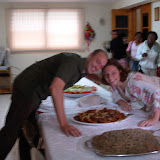
The party was a great success. Probably fifty or sixty people all told. Some photos:


And the birthday kids:


But I have to write now about what happened afterwards. One of my coworkers had come to the party with a birthday present for me. I put it down on a table in the kitchen while we continued to prepare some of the food. Later, as the last of us were leaving, I looked and saw the gift on the table, and decided I would pick it up the next day when I came to clean up the giant mess left from the party.

The next day, the gift wasn't there. I hoped there was an explanation. I looked at my house, just to be sure. I called everyone that might have known where it was. But the more I looked at the situation, the more it seemed to me that the gift was taken by Saul. Saul is my friend. He is a warm and cheerful man. Physically, he is somewhat imposing, which is thrown off by his surprisingly high voice.

I played through the facts over and over again. Saul was the only person who had been in the house during the time when the gift disappeared, except for a woman who is living in the guesthouse - another friend of mine - who wasn't able to make it to the party until later on, and went straight to bed anyways as she was exhausted from writing papers for her online graduate courses. It was either Saul or her that took it, and I immediately suspected Saul. How could I? Things have gone missing at the guesthouse before. One time, just a couple weeks after I arrived here, I lost some cash. I was sure that I had left in on my dresser. The same thing happened to a female colleague. From that time, I had always held a little suspicion of Saul. It seemed to me at the time that he was the only person who would have the access, or at least he would have the most access. The truth is, things just go missing a lot in Haiti. It happens to everyone who lives here long enough. It's a very poor country, and of course people steal. Most houses in Haiti don't have a simple nuclear family living inside. Most live with relatives or friends. And in big houses with guards and housekeepers, there are even more people. And there is therefore a steady stream of friends and visitors coming and going, hanging out and what not. The MCC guesthouse is no exception. This is what I was told when I mentioned back then that the money seemed to have been taken - that it was probably someone who slipped in unnoticed when there were a lot of people around. Or perhaps a friend of one of our Haitian support staff who was visiting, saw the money, and couldn't resist what would seem to them like a lot of cash.

I still don't know what happened to that money. If someone took it, I don't know who. And of course I could have lost it all on my own. I always assumed it was Saul, though I never felt like I could ask him directly. When the gift went missing, however, I felt like I had to say something. He is the guardian, and MCC trusts him to keep things from getting stolen. If he himself is stealing things, well, that's not acceptable. I started thinking about how to deal with it. The next day after the gift went missing, I was in the office for a meeting and I took the opportunity to ask Saul if he had seen it. I tried to phrase it in a way that would allow him to save face by saying that he had it, but only because he wanted to make sure that it was safe until he could give it to me in person.

So I explained the situation, and he said he clearly remembered seeing the gift, but that if I didn't have it then he had no idea who did. I was frustrated. I became even more convinced that it was him. I began thinking about how I would deal with the issue. Often in Haiti, when someone needs to approach someone else over a very sensitive issue, they will send a third party to talk for them. I decided to take this route. I spoke with Garly, our office administrator, who I like a lot and consider a very thoughtful person. At times I felt uncomfortable there as a white man telling a Haitian man that I thought another Haitian man - his friend - had stolen from me, and I wanted him to help me find out if it was true. I tried to lay out the situation as fairly as I could. I told him that if Saul had taken the gift, and he simply gave it back once confronted, nothing drastic would happen. But I had no idea what to expect from my emissary. I became very afraid of the possibility that it would turn into an ugly situation. That Saul would be fired. That he would be forced to find not only a new job, but a new house for his wife and three children. And yet another part of me felt that I had been violated. The episode was like an open wound in my mind that festered more each day. I wanted badly for it to be resolved.

One week after the party, I stopped by the guesthouse to pick up my mail. Garly was there along with Saul and Joseph. I wasn't expecting the confrontation to happen then, but before I knew it we were sitting down together around the dining room table. We talked around the issue. I never accused Saul directly, but everyone there, including Saul, knew that I suspected him.

Garly and Joseph calmly and carefully laid out the facts, and arrived at the only conclusion possible, which is that the gift must have been taken by either Saul or the woman who was living at the guesthouse who, alas, was not Haitian. I said that I would go talk to her and ask about it, but being convinced that she hadn't taken it, I said that I didn't know what to do if she said no. Faced with the real consequences, I said that if both she and Saul denied responsibility, we would just have to forget about it. But Joseph and Garly were insistent that we could not do that. That it was necessary for us to resolve the issue for people to feel secure in that house.

So I went upstairs to talk to my friend, the woman living there. I began to ask about the gift, trying not to sound accusatory in any way, and she quickly said, "Oh yeah, I have that, was that yours?"

My first reaction was a wave of relief. There would be no further confrontation with Saul. Then my friend started feeling extremely guilty. She had been exhausted that night, and she saw something she thought was leftover from the party, and assumed it didn't really belong to anyone. And I told her then, and honestly still believe, that I completely understand. I've lived in big houses before where people are always coming and going, and the idea of property gets blurry. I explained my relief that it was her and not Saul, and that I did not in any way consider her a thief. She began crying all the same. That felt horrible.

Then I went downstairs to clear things up with Saul. I went out into the yard and found him and Garly and Joseph. I quickly explained that the gift was upstairs and everything was okay. I looked at Saul, and began to tell him that I was sorry. Before all the words came out, he winced, and then began to cry, and then sob. He staggered towards the door as Garly and Joseph moved to stop him. They held him and tried to calm him and explain why it was necessary to do this, and why it wasn't my fault. Joseph wisely said that we had to take this kind of thing head on because, "se Ayisyen nou ye": what we are is Haitians. He acknowledged in these few words, that being Haitian meant dealing with these kinds of accusations - and that overcoming these perceptions could only be done with fearless transparency. But Saul just stopped and said yes, while that may be true, he always felt that I was accusing him. And he continued to cry.

He was right. I always accused him. He could barely eat during the prior week. To be accused of stealing in Haiti is a very big deal. Thieves in the marketplace are sometimes beaten to death. And for Saul, to be accused by a white man, someone he considered a friend, was more painful than I can imagine. I'll never know what it feels to be judged like that. It was prejudice pure and simple, and prejudice hurts. I could probably spend the next ten years here and not see another Haitian man cry. It's very rare. But I saw it that day because of the emotional violence I had inflicted on this kind man.

I looked at Saul and it dawned on me just what I had done. I began to cry as well. Immediately he embraced me and told me that everything was fine, and that I shouldn't worry about it.

I couldn't stay at the house, I had to leave. I went home and didn't really go out much for the rest of the weekend. I kept playing over the events in my mind, wondering how I could be so wrong, so presumptuous. I felt like a monster. The comforts were few and small. I called Garly to tell him that I was having a very hard time with it, and he assured me that he too had thought it was most likely Saul who took the gift. Still, I though, how much of that was due to the way I explained and interpreted the whole affair from the beginning?

I went back to the house a couple days later, just to tell Saul that I still felt awful, and that I didn't deserve his forgiveness, and that I would be marked for the rest of my life with the lesson I learned there. Again the tears flowed. He just smiled and put his hand on my shoulder and that said it all.

I know this is a very personal thing to write on my blog. I was reading Geez magazine (if you're unfamiliar, check out www.geezmagazine.org) and I came across a quote that struck me. An activist named Sherene Razack "observes that white, privileged and respectable identity builds itself by being able to enter places of degeneracy and come out unscathed, willing and ready to tell the tale." I saw myself in this description, and I regret that. I do want to keep writing about my experiences here. Haiti has a tale to tell that's worth hearing. But not for the sheer thrill of it. It's important to hear because it reflects back on all of us who live lives of comfort and convenience, and who never have to suffer injustice and racism the way that people here do. I don't want to seem unaffected by the reality here. I am affected. I am quite scathed. Haiti has exposed me to my own ugliness, and as much as I'm ashamed of that, I don't want to hide it and pretend that I'm invincible and righteous and intent on teaching the people of Haiti a thing or two. I'm just glad I have an excuse to be here for the time being.

Saturday, November 03, 2007

Year one, year thirty

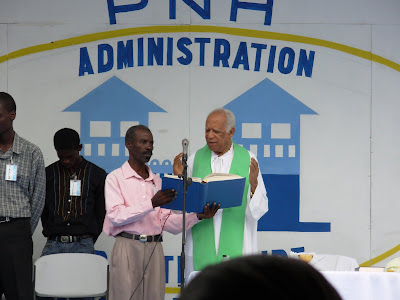
Last Sunday, October 28th, was International Prisoners' Day. To mark the occasion, I went to the National Penitentiary with a couple of my Haitian colleagues.

Imagine a U.S. prison big and crowded enough to hold about half of the country's prisoners. Now imagine that it was built just a couple of blocks away from the white house. Imagine that there was one day every year when the highest ranking officials of the prison and justice systems, along with a bunch of journalists and human rights activists, sat down together on one side of the main prison yard under a big tent. Across the aisle from these civilians was a corresponding number of prisoners, selected to represent all of the inmates. Imagine a religious service held there in the prison yard that emphasized the dignity and worth of all prisoners, stating in no uncertain terms that they were no different from anyone else, and that all free people would be judged for every injustice suffered by those incarcerated people. Then, imagine representatives of the government taking turns speaking to the crowd, doing their best to provide explanations for the problems of the criminal justice system. And finally, imagine that the prisoners themselves were then able to send their own representatives up front to say whatever they want, no matter how angry or inflammatory.

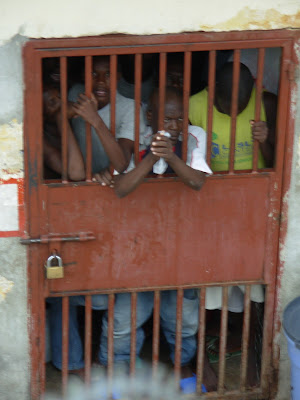
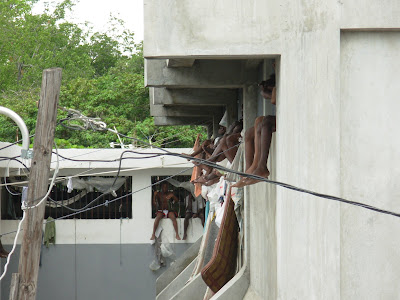
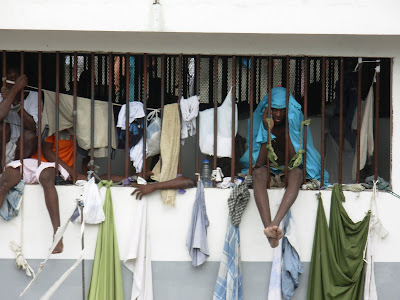
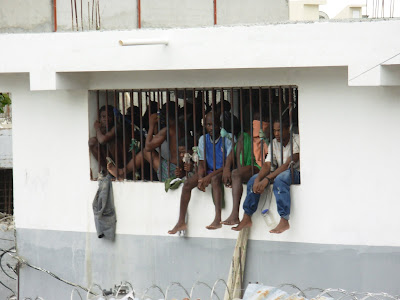
This was the scene, more or less last Sunday, and it was quite remarkable. The shame of the officials and the anger of the prisoners was not without reason. The prisons here are hellish. International treaties on prisoners' rights declare that each prisoner should have at least 4.5 square meters of space to themselves. In Port-au-Prince's National Penitentiary, as in most of Haiti's prisons, the actual figure is less than a square meter per inmate. The prisoners are packed in their cells worse than sardines; they have to sleep in shifts because there is not enough room for everyone to lie down on the floor at once. Many suffer from tuberculosis, HIV/AIDS, beriberi (vitamin B deficiency), contagious itchy rashes, and other sicknesses which are impossible to contain in such overtaxed conditions.

Only a tiny fraction of the inmates have even been convicted of any crime. In Haiti it is legal to lock someone up once they have appeared before a judge to learn what crimes are being brought against them. But after that time, they are not supposed to spend more than two months in prison before going to trial. Of course, the vast majority of the prisoners at the National Penitentiary have been there for at least two months - some longer than two years - without yet going to trial. The reasons for this include corruption, gross incompetence, and a plain lack of resources on the part of the justice system.

Still, all told, I was impressed by the courage of the state authorities to acknowledge these problems, and the courage of the inmates to speak out against them, demand better treatment, and continue to hope that a better future is possible. The Haitian government is the author of many -- NOT all, but many -- of it's own troubles. But on this one occasion, you have to give them points for humility.

Special mass for the prisoners:


At times the priest's voice was drowned out by prisoners chanting in anger from their cells. It was a painful reminder that we all might be equal in God's eyes, but that spiritual reality means precious little to these miserable detainees.

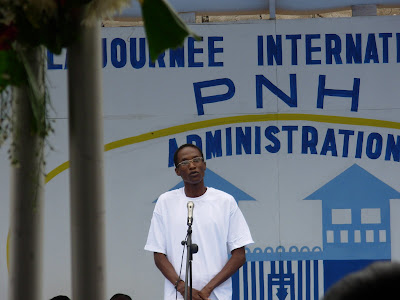
Here's one of the prisoners speaking to the audience.


He was calm and dignified, but his words were heavy with determined, righteous anger.

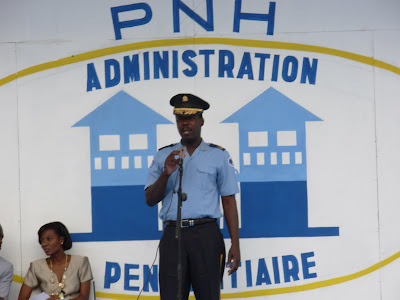
The director of the penitentiary authority:


I've actually met with this man before. He's a giant. He is also a very serious and somber man, who I dare say feels real compassion for the prisoners that have been put under his charge. More than you can say for many of the wardens of individual prisons around the country.

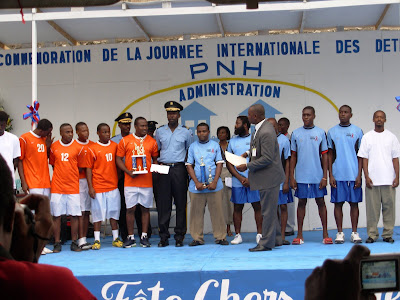
The director presenting trophies to the soccer teams that won the tournament they played on the prison yard concrete.


There were also awards given to the winners of the dominos and checkers competitions. All of the winners were given the microphone to make a victory speech. And every one of them opted instead to denounce their conditions, demand justice, or mourn fellow inmates who had died.

Finally we were given a tour of the prison from the top of the wall that surrounds the complex. Here's some of what I saw:


How do you feed three thousand prisoners?


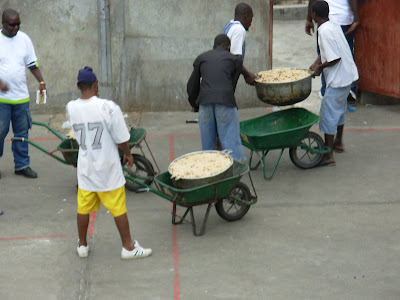
Surely this was made special for International Prisoners' Day -- the rice doesn't usually have beans in it. And even on this day, the beans were pretty skimpy by Haitian standards.

* * *

Wednesday was a fairly significant milestone. It marked my 365th day in Haiti, as well as my 30th birthday. I had a party at my office for lunch, along with Stephanie from Belgium, who's birthday was on the 30th. Then that evening I had my fellow MCCers and Remi over to my house, where my landlady/Haitian mother cooked an amazing, all local feast for us. Photos here:


Birthday 2007


I was kind of lazy and didn't write any captions. Remi did a better job on her album here.

I've heard several Haitians refer to a folk belief they have, that if a person isn't married by age 30, they will never be married at all. So all day on Wednesday, my Haitian coworkers were wishing me a happy birthday and promising to find me a nice wife, or telling me that they'd be praying for the right woman to find me. Even Russa, my Haitian mother, true to her role, gave me a big talk about how she was just sure that this year I would meet that special someone. Then she said something that my own mother definitely would not have included: "Because, Felix, I don't have to tell you that there are all kinds of dangerous diseases out there like AIDS and what not."

Uhhh, right. I'm not too worried about getting AIDS, so this wasn't a big selling point for marriage. I'm not one for superstition, either. But for all those women out there who are, I've got two words for you: last chance. Just one year to go! Start your engines! Fly, row, swim, do whatever you need to do to get to this island if you want a shot to be Mrs. Felix. Because if this fish gets away before Halloween 2008, he's gone for good!

I'll alert the coast guard to prepare for the major spike in immigration to Haiti.

* * *

Finally, I wanted to share some photos and video from the Gede celebrations. two Saturdays ago I went to a seminar on the celebrations that occur within Vodou every November 1st and 2nd. These are national holidays, and they focus on a class of Vodou spirits known as the Gede, who are the mediators of the life and death cycle. Chief among them is a figure known as Baron Samedi - sometimes depicted as a black man, sometimes as a skeleton, but always wearing a black suit and top hat.

One of my coworkers invited me to go with him to the Port-au-Prince cemetary -- the Gede ground zero -- on the morning of November 1st. The colors of Gede are black, white and purple, as you'll notice. The video Dafus and I took below is pretty rough, and I didn't edit it at all. I'm leaving it in its entirety for those of you who are really curious. First you'll see us approaching a crowd gathered around the black cross of Baron Samedi, where people are lighting candles and offering prayers and pouring out sacrifices of rum. Then, you'll see a couple of men dressed in purple and black approach from far away while the crowd makes a hubbub. There's some debate whether these men were actually gay or only pretending to be gay, but everyone started chanting right away men masisi!, which is a somewhat vulgar way of saying "here come the homosexuals."

Homosexuals live very secret lives in Haiti because public persecution can be very serious, but there was a certain tolerance on this occasion. There was also a lot of tolerance for taking photos. Normally, snapping close photos without permission can get you roughed up in Haiti, but people weren't bothered at all when Dafus and I were snapping shots or taking video.

After the scene by the Baron Samedi cross, you'll see some panning footage of the cemetary chapel as well as the tall, New Orleans-style graves. In Haiti, the graves are almost always these above ground plots for stacking caskets, or they are shaped like little houses. you'll be able to pick out a couple of those in the video too.

Finally, you'll see a crowd of people dressed all in white, chanting and singing. These are a bunch of new initiates into the Vodou priesthood. There's a lot more I could write about the things I saw there, but I don't even know where to start. Feel free to send questions, and I'll try and answer them.

Here's the video:


Here's some photos:


Gede