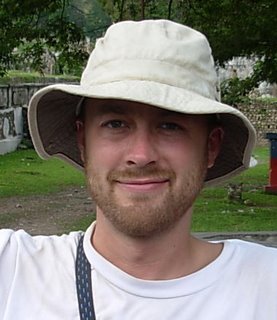
I'll just come out and say it, so you can judge me however you want: Hurricane Dean was a letdown. I wanted more. I know that's a horrible thing to think, let alone write, but there it is. I only say it because I've heard other people, blans and Haitians, say the same thing. And actually, I got a better show than most of the people I know in Port-au-Prince. The capital just got a little bit of rain, nothing compared to the torrential downpours that hit the city at least a couple times each week in the rainy season. When the hurricane came, I was on the southern coast, a little closer to the action.
On Friday I flew from Port-au-Prince to Jeremie, a good sized city, and one of the most remote parts of the country. If you look at a map of Haiti, it resembles a lobster claw, with the southern half of the country as one long peninsula. Out at the end of the peninsula, on the north side, sits Jeremie. Jeremie calls itself the city of poets, and it has produced some great writers, including Alexandre Dumas, who wrote "The Three Musketeers" among other books. The city is well-known for a pastry you can get there called "konparèt"; it's about the size of a hamburger bun, but sweet, dense, and hard as a rock. The closest thing I can compare it to is biscotti. It's made with lots of ginger and it's delicious.
I was glad to be flying because I've heard nothing but horror stories about the road that connects Jeremie to Les Cayes, the nearest city. I went there for another human rights training for police officers. All day Friday was perfect and sunny. Saturday was noticeably windier, but still quite sunny. The UN outpost next to where we did our training was busy stacking sandbags all around their compound. I was supposed to fly back to Port on Saturday afternoon, but the flight was canceled on account of hurricane. But generally, people weren't very anxious about it, speaking casually of the coming storm, which they referred to as "move tan" pronounced to rhyme with "mow a lawn." In literal translation, move tan is Creole for "bad time" or "evil time" and refers to tropical storms, hurricanes, or anything that causes a day or two to go by without sunshine.
So, with no flight back, my coworkers and I had to decide what to do. Most of them had come a few days earlier by SUV to take care of other stuff. We decided to drive to Les Cayes, hopefully getting there before dark, and well before the hurricane. Thing is, there were six of us, and only five seats. I knew they'd be happy to cram four into the back seat, but I figured I'd just as well ride in the back with the luggage, and they'd definitely be more comfortable that way. So for five hours I was getting pitched around with the cooler and suitcases while we worked our way south. I can't overstate how bad the road was. It would have been impossible without a 4x4, and even then it was slow and torturous.
We landed at our hotel in Les Cayes, which happened to have CNN. One of their correspondents was in Port-au-Prince, breathlessly reporting that people were doing nothing to prepare. The computer models showed the storm coming right for us, since Les Cayes is out at the southwestern end of the peninsula. It looked like a buzz saw tearing through the city. After a little while I went upstairs and slept right through the whole thing.
In the morning, one of my coworkers came and woke me up to survey the destruction. He had woken up at 3 in the morning when the eye passed by several miles to the south, and said that the wind was very strong. When I went outside to take a look, it was cloudy and rainy and windy, which is incredibly rare here in the morning. The wind wasn't too very strong, but every few minutes a big gust would come through and rattle the tin roofs all around us, threatening to pull off the ones that weren't nailed down tight. Off on the horizon I could see the hundreds of coconut and palm trees that line the seashore, their branches flapping in the wind like pompoms held out the window of a moving car.
We left Les Cayes after breakfast. We got news that the worst part of the storm would be rolling through there at noon, so it seemed prudent to hit the road and get further inland, driving east back to Port-au-Prince. Leaving Les Cayes we drove along the coast where the water, usually azure, was muddy brown and beating against the shore in big, rough, irregular waves. The wind was intense along the shore, pushing the car around quite a bit. As the road took us away from the coast, we saw banana and plantain trees that had been blown down in their fields. Several big trees had been knocked down onto the road, but they were already pulled off to the side and in the process of being hacked into firewood.
The drive back was generally uneventful. Around 11, we hit the tail of the storm, which packed the biggest punch. It was a solid wall of rain that forced our chauffeur, who normally drives like a maniac, to creep along, hunched over the wheel and unable to see, even with the wipers full-speed. But once we made it through that it was smooth sailing. We got back to Port-au-Prince and talked to people who said the storm was a little anticlimactic for them. Oh well, maybe next time.
Just kidding.
Sort of.
Tuesday, August 21, 2007
Saturday, August 11, 2007
The Family Hour
My family, or most of it, was here from the 21st to the 30th of July. I was so excited in the week before they came that I could barely concentrate on work. And then once they were here the time flew by and before I knew it we were saying our sad goodbyes at the airport.
I asked my mom, dad and sister to jot down a paragraph about their experience here. Here's what they had to say.
Dad:
A vacation in Haiti!!! Friends gave me THE LOOK when I explained that Haiti was our destination. Now, eleven days after returning, I can report that it was a great time. Exiting the airport and seeing the BLAN, Kurt, across the parking lot still ranks as one of the highlights of the trip. Other highlights:
*Visiting with Kurt's (Felix's) co-workers and getting a sense of the mission
*Cool showers out of a 5 gallon bucket
*Gabby's Birthday party
*The beautiful beaches and warm water
*Driving through the DR and having the road blockaded by 40 women and children
*-and them telling us that they wanted our money................ so they could make soup for their husbands/fathers for Father's Day, which was the next day, and then seeing them all laugh hysterically, was wonderful.
*Watching and listening as Kurt conversed with the Haitian people and sensing his pride in this country and its people
*A late night meal by candlelight, roadside in Desarmes--best egg sandwich I have ever had
*Meeting and seeing some of the most beautiful people I have ever met in my life
*Holding our son again
*Meals, travel, conversations, sweating together, laughing, praying and having most of our family together again was just so good!
Now I am looking forward to that motorcycle trip across Haiti!!
Don (Dad)
Mom:
Haiti is such a place of contrasts: Intense poverty, but a wealth of pride in its history and culture. Poor infrastructure, but orderliness with street vendors' merchandise and sweeping of front steps. Lack of organized labor, but Haitians are well-dressed, polite and their children follow suit. We found the people to be lovely and accommodating. The food was wonderful (although we said, "Nyah-ah-ah" to Kurt's offer of a bite of goat stew). Haiti is not for the faint of heart....but one can't help but be impressed by its most important resource: its people.
And Holly:
One of the most impressive things I observed about Haiti was the community. Considering the very little I've learned about Haitian history (about as much as Cuba), I knew enough to realize that the small country has pretty much seen it all. However, despite the amount of violence and danger that we usually associate with Haiti, it is yet another place of community, of homes, of families, of friends. On a normal walk down the street I exchanged more "good mornings" than in my own hometown, and even the most persistent hawkers will share a laugh when possible. The people we came into contact with on our short visit were always hospitable in a way that seemed more customary than merely kind. And while I'd like to say it was because of Kurt's Kreyol that people were so quick to converse, I think it has more to do with the culture. We met a few nationals or second generation Haitians visiting from the States, and each one was so eager to move back to Haiti. This was also common among many Californian Central Americans I've met in the past few years, however the Haitians I met were not doing various hard labor jobs away from their families. These were privileged Haitians who were given the opportunity to leave home and pursue a completely different life. There was a sincere appreciation from the people I talked to that did not dismiss either their American or Haitian culture, but preferred the Haitian lifestyle to that in the States. I realize that this is not the case for all, that many Haitians would probably love to go to America and work, as many families depend on expatriate earnings overseas. Maybe it's because of my own discontent with parts of our culture that I would so gladly live somewhere else that it was refreshing to hear of such appreciation. Either way, the country's political and economic situation are definitely not making people want to stay- it's obviously because of the community and culture. These are of course the most important assets to any country, and in my own experience, Haiti is rich in both.
I picked up mom, dad and Holly at the Port-au-Prince airport on the morning of the 21st. Right away we drove out of the city and up the interior coast, called the Arcadian Coast. We stopped at a place called Moulin Sur Mer, or windmill on the sea, which used to be a sugarcane plantation, but now is a beach resort and a museum.
I had imagined my family showing up here, being somewhat bewildered by the sights and smells, and I would confidently stride in and show them how Haiti works. But in what became a sort of theme while they were here, I had plenty of firsts, bests, worsts, new experiences and revelations of my own while they were here. For starters, I had never been to Moulin Sur Mer before. I showed up with my family, and walked around thinking that this has to be one of the loveliest places I've seen in Haiti.
We walked into the buffet area just as the best man was delivering his toast at a wedding reception held there on the beach. It was typically flowery and tedious, and of course in French. We didn't waste much time. After eating we jumped in the warm Caribbean water and just floated around, catching up on everything that we could think to ask. If I remember right, we were the only white folks at the place -- somewhat surprising, considering that it wasn't exactly cheap to get a day pass there. My family looked around at our Haitian beach-mates, remarking about how beautiful everyone was. It's something they continued noticing throughout their stay in Haiti.
After the beach, we continued driving until we arrived in Desarmes. We walked out and bought egg sandwiches on the street, which is always one of my favorite part about visiting the reforestation program, and my dad mentioned it above as well. The next day, Sunday, we woke up for some bread, fruit and delicious Haitian coffee. We took a little hike and looked at the Artibonite river, guided by Esther and Gabriela:

Then we hoofed it over a small ridge to check out the view of Desarmes, and all the trees growing there, thanks in part to the work they've been doing there for the last 20 years.

On Sunday afternoon, Matt and Esther had a party to celebrate the one-year anniversary from when they brough Gabriela home. Check out their blog about the event here. There was pineapple upsdide-down cake, water baloons, bubbles and other fun stuff. The Haitian kids who came with their parents to the celebration were all dressed up, and not quite ready to go crazy with water baloons and the like. Some were more outgoing...

others not so much:

On Monday we drove back to Port-au-Prince in time for lunch at my office. Even though the Hildebrands were running late, everyone there waited until we arrived, after 2:00, to eat. It went well. My boss, Pierre, welcomed my family by telling them that they were much better looking than me. Oh yes, this was another theme: everywhere we went in Haiti, people said the exact same thing, "you parents are so young!" Then, inevitably, about ten minutes later, at least one of the guys would take me aside, put his hand on my shoulder, and discreetly say into my ear, "Kurt, your sister is very beautiful." I never really knew how to respond to this. Thank you?
There was a good mix of me translating for coworkers, coworkers doing as well as they could in English, and my family just speaking English to each other. My mother thanked them for lunch with a box of See's Candies which somehow, miraculously, didn't turn into a box of See's chocolate syrup in the tropical heat.
After lunch, we got back into the car and took a little tour of Port-au-Prince. At the absolute busiest, hottest part of the day, I attempted a drive down Jean Jacques Dessalines (the George Washington of Haiti), which is basically main street. The building facades all rusted and crumbling, traffic at a near standstill, and the street and sidewalks pulsating with human activity. Merchants selling everything from produce to cell phone chargers sat beneath umbrellas, crowds pressed up against them. At each intersection was a mountain of slimy refuse, much of it organic matter trimmed from produce. And there we were, watching it all from the cool, air conditioned bubble of a beige Nissan SUV. As I was focused on not running anyone over -- surprisingly hard, considering we probably never got above 10 miles per hour -- a man was standing outside of the car trying to get my family's attention. I didn't see him, I just heard their responses. "Kurt, this guy just said he was going to kill us." "Wait, what's that mean? He wants to eat us? He wants to kill us and eat us?!" "Oh, and now he's acting all nice like he wants to be friends with us."
This became a big revelation for me. The man in question approached the car windows to get their attention. First, he drew his index finger across his neck. Then he moved his fingertips, clustered together, towards his mouth. Then he smiled, hand held out. My family was surprisingly calm during this confusing display. The very next day, I saw a young boy make the same gesture as we passed. Finger across the neck, hand held out. That's when it all came together for me.
In my nine months here so far, I've been in some fairly dicey situations. Apocalyptic rainstorms, surging crowds, belligerent police, stone-throwing mini-riots. Last night I was at a vodou ceremony (more about that later), which wasn't scary at all, though I can imagine a time in my life when that would have been nothing but heebie jeebies. But, the scariest moment, hands down, happened on an afternoon in February. I was hiking around the hills north of Port-au-Prince with a friend, when we passed a field where two men were working. They were about 200 feet away. When one of the men saw us, he turned towards us, shrugged his shoulders with his arms up in the air -- a machete in his right hand -- and then pretended to slit his throat with the machete, and finally put his arms back up in the air. I have always assumed that the throat-slitting gesture is a fairly universal way of saying, "I am going to kill you" or "you're going to die" or something along those lines. I didn't think he was actually going to come kill me. It just struck me as a very hostile gesture. In my mind, he was saying, "Who do you think you are? You don't belong here, and you're going to learn that the hard way, maybe even the violent way, and there's nothing you can do about it." How wrong I was.
What I realized that day when the little boy made the same gesture, is that in Haiti, it doesn't mean "I'm going to kill you," it means "I'm dying." So the man standing outside of our car that day wasn't telling my family that he wanted to kill and eat them, he was telling them that he was starving to death, he needed food, and he needed them to give him either food or money. The scary machete guy was just asking me for some money, nothing more, nothing less. Amazing what a little miscommunication will do. It still chills me to think about the impression that machete guy left on me. It was always there, in the back of my mind. Anytime I felt like I was getting really comfortable in Haiti, this red button marked REMEMBER THE MACHETE GUY would start blinking and beeping. Nice to know it was unnecessary. That's not to say that Haiti is Disneyland, but it's good to realize when your own fears have been unfairly projected onto other people.
Anyway, as intense and interesting as the main street tour was, we all breathed a sigh of relief once we got out of the hurly burly of the downtown market. Our tour of Port-au-Prince continued the next day when we drove up into the mountains overlooking the city, where it looks so much more peaceful:

The two nights that we slept in Port-au-Prince, we stayed in Bethany's apartment, which is right next door to mine. As luck would have it, a blown transformer had knocked out all the power on the block. (to this day, we haven't gotten power back.)
I've gone weeks with only one or two hours of power a day, but I'd never been stuck with absolutely no electricity, at least not until my family came to visit. But we made the best of it. We lit candles. We took bucket showers (no power means no pumping the water up to the tanks on the roofs, which means no running water). And generally we crashed out pretty early.
On our last night in Port-au-Prince, I was lucky enough to introduce my family to the Assalis, the family from which I rent a studio. I was worried that my landlady would be out of town and unable to meet them, but her trip was delayed, so they got to meet her after all. My mother came bearing gifts: aplets and cotlets, which my landlady loves, and smoked salmon. They couldn't have given us a more gracious reception. Madame Assali chided me for not letting her cook us a big Haitian dinner. She called her 15-year-old daughter Tarah, who spends the school year in Tampa Bay, down to entertain the family in English. While they were all chatting, Madame pulled me into the parlor boutique that she runs out of her house. It's an aromatic little showroom where she sells fancy French perfumes and toiletries and designer clothes and shoes and that kind of stuff. She made me pick which fragrance of body wash my mom would most appreciate: citrus or lavender. I protested that it wasn't necessary, and she wouldn't hear anything of it. She wrapped it in newspaper and then wrapping paper and a little bow, all the while going on and on about how great my family is, how young my parents look, how gracious and perfect my mother is, how I really should have told her earlier so she could cook dinner, on and on. Just as we were finally about to go deliver this little gift, Monsieur Assali showed up.
Robert: What's that?
Russa: It's a gift for Felix's mom.
Robert: What about his dad? Why is everybody always giving things to moms? What about dads?!
Russa: Alright, let's wrap up this [very fancy looking hygiene product].
Robert: That's what I'm talking about!
Me: Please, really, you don't need to-
Robert and Russa: Nonsense!
-- the wrapping rigamarole ensues again, we're on our way out again --
Russa: But what about Holly? We can't just give Felix's parents these gifts and leave Holly with nothing! What about this lotion?
Robert: Yes, good idea! Wrap it up!
Me: Honestly, please, please don't worry about it.
Russa: I can't believe you didn't give me the chance to cook for your family!
At this point, my 75-year-old, charming, toothless landlord sidled over to me, put his hand on my shoulder and said, "Felix, your sister really is very pretty."
So we finally got out of there after being showered with gifts. We stashed them in my apartment and then headed out for dinner. Before we could open the front gate, my landlady called me back over.
Russa: Felix, Tarah just told me that it's your mom's birthday today!
Me: Yes it is.
Russa: Well, I just gave your family welcome gifts, but I had no idea it was your mother's birthday!!
Me: Oh, no, please, madame, don't-
Russa: I have to give your mother something! Would she like this painting?
Me: Of course she would like it, but it really isn't nec-
Russa: It will be wrapped and waiting for you when you get back from dinner.
On day five we took a bus to the Dominican Republic. The music was way too loud. It was all Dominican music until we got to the chaotic border crossing. Once we left Haiti and were driving across the smooth-paved Dominican freeway, it switched to Haitian music.
We found a hotel in Santo Domingo, across the park from the first cathedral built in the western hemisphere.


There were a lot of firsts in Santo Domingo. First hospital; first monastery; first fortress; first paved road; tallest building of the 16th century and that kind of thing. Dominicans are very proud that this was the first island where Christopher Columbus chose to settle down. We walked right by the house where Columbus' son lived for many years, as well as the house of Cortes, where he lived before he set out to destroy the Aztec civilization of Mexico. I couldn't help thinking that this island is so full of history and tragedy. European colonization started here. The utter annihilation of the indigenous population was done first here - I wonder if Columbus would be celebrated as much if even a tiny fraction of those Taino and Arawak people had survived the 16th century. The intercontinental slave trade started right here. The only bright spot is the Haitian slave revolt, the only successful one in history. And even after this, Haitian society went to war with itself, slavery began again in earnest, this time with Haitian masters. It also invaded the Dominican half of the island, and was later kicked out. A hundred years later the Dominican dictator Trujillo ordered the killing of 20,000 Haitians who were living on the Dominican side as field workers. Both sides of the island have had more than their share of tragedy, and they have nursed a steady grudge towards each other, despite the fact that their economies are completely intertwined. Haitians provide no less than 90% of all agricultural and construction labor in the Dominican Republic.
But anyways, I should really wrap this up. We hit the beach, we snorkeled, we ate delicious seafood, we drove many miles through the lush Dominican countryside. It was relaxing and wonderful. We stayed at one beach with, literally, boatloads of white folks getting shipped around like cattle, boozing all the way. We were a little more low key. We hired a fisherman to take the four of us out to an island for swimming and snorkeling.
Then we drove from the south coast to the north coast. Instead of a beach packed with pasty whitefolks, we found this beach where, with a couple exceptions, you couldn't see anyone on that entire stretch of sand in either direction. Mom and I were out in the waves when an official coast-guard looking guy showed up and told Holly that we shouldn't get too far out, because there were sharks in the water. Maybe that explains why the beach wasn't so crowded.

That night, the random hotel we found in the middle of nowhere served us a big, beautiful Dominican dinner, family style. Dad and I followed it up with island-made stogies. The next couple of days took us back to Santo Domingo and then back to Port-au-Prince, and then, for my dear family, back to the mainland. I still can't believe how quick it all flew by. It took me no time at all to get comfortable with them being here. But when they left, I became so aware of how much I had missed them in those first 9 months, and how much more I would miss them now that they'd visited and seen my life here.
So to console myself, two days after my family left I went on a dirt-bike trip with the other MCC guys. We spent three days and two nights up in the central plateau. Except for me getting giardia, and Brian getting a flat tire, it was a pretty smooth ride. We spent a couple afternoons at a waterfall called Bassin Zim. Here's me almost plowing over Josh as I dive off the rocks.

Here's what the falls look like from above, where there are three more pools:

And here's the whole thing. Those light colored dots near the middle of the photo are me and Brian, to give you a sense of scale.

Here's what we looked like when we got back. No Brian doesn't have an identical twin, this is a composite of two photos.

And just to bookend this post with another significant Gabriela life event, her baptism was held on the day after we got back from the bike trip. You can read about it on Matt and Esther's blog here.
I asked my mom, dad and sister to jot down a paragraph about their experience here. Here's what they had to say.
Dad:
A vacation in Haiti!!! Friends gave me THE LOOK when I explained that Haiti was our destination. Now, eleven days after returning, I can report that it was a great time. Exiting the airport and seeing the BLAN, Kurt, across the parking lot still ranks as one of the highlights of the trip. Other highlights:
*Visiting with Kurt's (Felix's) co-workers and getting a sense of the mission
*Cool showers out of a 5 gallon bucket
*Gabby's Birthday party
*The beautiful beaches and warm water
*Driving through the DR and having the road blockaded by 40 women and children
*-and them telling us that they wanted our money................ so they could make soup for their husbands/fathers for Father's Day, which was the next day, and then seeing them all laugh hysterically, was wonderful.
*Watching and listening as Kurt conversed with the Haitian people and sensing his pride in this country and its people
*A late night meal by candlelight, roadside in Desarmes--best egg sandwich I have ever had
*Meeting and seeing some of the most beautiful people I have ever met in my life
*Holding our son again
*Meals, travel, conversations, sweating together, laughing, praying and having most of our family together again was just so good!
Now I am looking forward to that motorcycle trip across Haiti!!
Don (Dad)
Mom:
Haiti is such a place of contrasts: Intense poverty, but a wealth of pride in its history and culture. Poor infrastructure, but orderliness with street vendors' merchandise and sweeping of front steps. Lack of organized labor, but Haitians are well-dressed, polite and their children follow suit. We found the people to be lovely and accommodating. The food was wonderful (although we said, "Nyah-ah-ah" to Kurt's offer of a bite of goat stew). Haiti is not for the faint of heart....but one can't help but be impressed by its most important resource: its people.
And Holly:
One of the most impressive things I observed about Haiti was the community. Considering the very little I've learned about Haitian history (about as much as Cuba), I knew enough to realize that the small country has pretty much seen it all. However, despite the amount of violence and danger that we usually associate with Haiti, it is yet another place of community, of homes, of families, of friends. On a normal walk down the street I exchanged more "good mornings" than in my own hometown, and even the most persistent hawkers will share a laugh when possible. The people we came into contact with on our short visit were always hospitable in a way that seemed more customary than merely kind. And while I'd like to say it was because of Kurt's Kreyol that people were so quick to converse, I think it has more to do with the culture. We met a few nationals or second generation Haitians visiting from the States, and each one was so eager to move back to Haiti. This was also common among many Californian Central Americans I've met in the past few years, however the Haitians I met were not doing various hard labor jobs away from their families. These were privileged Haitians who were given the opportunity to leave home and pursue a completely different life. There was a sincere appreciation from the people I talked to that did not dismiss either their American or Haitian culture, but preferred the Haitian lifestyle to that in the States. I realize that this is not the case for all, that many Haitians would probably love to go to America and work, as many families depend on expatriate earnings overseas. Maybe it's because of my own discontent with parts of our culture that I would so gladly live somewhere else that it was refreshing to hear of such appreciation. Either way, the country's political and economic situation are definitely not making people want to stay- it's obviously because of the community and culture. These are of course the most important assets to any country, and in my own experience, Haiti is rich in both.
* * *
I picked up mom, dad and Holly at the Port-au-Prince airport on the morning of the 21st. Right away we drove out of the city and up the interior coast, called the Arcadian Coast. We stopped at a place called Moulin Sur Mer, or windmill on the sea, which used to be a sugarcane plantation, but now is a beach resort and a museum.
I had imagined my family showing up here, being somewhat bewildered by the sights and smells, and I would confidently stride in and show them how Haiti works. But in what became a sort of theme while they were here, I had plenty of firsts, bests, worsts, new experiences and revelations of my own while they were here. For starters, I had never been to Moulin Sur Mer before. I showed up with my family, and walked around thinking that this has to be one of the loveliest places I've seen in Haiti.
We walked into the buffet area just as the best man was delivering his toast at a wedding reception held there on the beach. It was typically flowery and tedious, and of course in French. We didn't waste much time. After eating we jumped in the warm Caribbean water and just floated around, catching up on everything that we could think to ask. If I remember right, we were the only white folks at the place -- somewhat surprising, considering that it wasn't exactly cheap to get a day pass there. My family looked around at our Haitian beach-mates, remarking about how beautiful everyone was. It's something they continued noticing throughout their stay in Haiti.
After the beach, we continued driving until we arrived in Desarmes. We walked out and bought egg sandwiches on the street, which is always one of my favorite part about visiting the reforestation program, and my dad mentioned it above as well. The next day, Sunday, we woke up for some bread, fruit and delicious Haitian coffee. We took a little hike and looked at the Artibonite river, guided by Esther and Gabriela:

Then we hoofed it over a small ridge to check out the view of Desarmes, and all the trees growing there, thanks in part to the work they've been doing there for the last 20 years.

On Sunday afternoon, Matt and Esther had a party to celebrate the one-year anniversary from when they brough Gabriela home. Check out their blog about the event here. There was pineapple upsdide-down cake, water baloons, bubbles and other fun stuff. The Haitian kids who came with their parents to the celebration were all dressed up, and not quite ready to go crazy with water baloons and the like. Some were more outgoing...

others not so much:

On Monday we drove back to Port-au-Prince in time for lunch at my office. Even though the Hildebrands were running late, everyone there waited until we arrived, after 2:00, to eat. It went well. My boss, Pierre, welcomed my family by telling them that they were much better looking than me. Oh yes, this was another theme: everywhere we went in Haiti, people said the exact same thing, "you parents are so young!" Then, inevitably, about ten minutes later, at least one of the guys would take me aside, put his hand on my shoulder, and discreetly say into my ear, "Kurt, your sister is very beautiful." I never really knew how to respond to this. Thank you?
There was a good mix of me translating for coworkers, coworkers doing as well as they could in English, and my family just speaking English to each other. My mother thanked them for lunch with a box of See's Candies which somehow, miraculously, didn't turn into a box of See's chocolate syrup in the tropical heat.
After lunch, we got back into the car and took a little tour of Port-au-Prince. At the absolute busiest, hottest part of the day, I attempted a drive down Jean Jacques Dessalines (the George Washington of Haiti), which is basically main street. The building facades all rusted and crumbling, traffic at a near standstill, and the street and sidewalks pulsating with human activity. Merchants selling everything from produce to cell phone chargers sat beneath umbrellas, crowds pressed up against them. At each intersection was a mountain of slimy refuse, much of it organic matter trimmed from produce. And there we were, watching it all from the cool, air conditioned bubble of a beige Nissan SUV. As I was focused on not running anyone over -- surprisingly hard, considering we probably never got above 10 miles per hour -- a man was standing outside of the car trying to get my family's attention. I didn't see him, I just heard their responses. "Kurt, this guy just said he was going to kill us." "Wait, what's that mean? He wants to eat us? He wants to kill us and eat us?!" "Oh, and now he's acting all nice like he wants to be friends with us."
This became a big revelation for me. The man in question approached the car windows to get their attention. First, he drew his index finger across his neck. Then he moved his fingertips, clustered together, towards his mouth. Then he smiled, hand held out. My family was surprisingly calm during this confusing display. The very next day, I saw a young boy make the same gesture as we passed. Finger across the neck, hand held out. That's when it all came together for me.
In my nine months here so far, I've been in some fairly dicey situations. Apocalyptic rainstorms, surging crowds, belligerent police, stone-throwing mini-riots. Last night I was at a vodou ceremony (more about that later), which wasn't scary at all, though I can imagine a time in my life when that would have been nothing but heebie jeebies. But, the scariest moment, hands down, happened on an afternoon in February. I was hiking around the hills north of Port-au-Prince with a friend, when we passed a field where two men were working. They were about 200 feet away. When one of the men saw us, he turned towards us, shrugged his shoulders with his arms up in the air -- a machete in his right hand -- and then pretended to slit his throat with the machete, and finally put his arms back up in the air. I have always assumed that the throat-slitting gesture is a fairly universal way of saying, "I am going to kill you" or "you're going to die" or something along those lines. I didn't think he was actually going to come kill me. It just struck me as a very hostile gesture. In my mind, he was saying, "Who do you think you are? You don't belong here, and you're going to learn that the hard way, maybe even the violent way, and there's nothing you can do about it." How wrong I was.
What I realized that day when the little boy made the same gesture, is that in Haiti, it doesn't mean "I'm going to kill you," it means "I'm dying." So the man standing outside of our car that day wasn't telling my family that he wanted to kill and eat them, he was telling them that he was starving to death, he needed food, and he needed them to give him either food or money. The scary machete guy was just asking me for some money, nothing more, nothing less. Amazing what a little miscommunication will do. It still chills me to think about the impression that machete guy left on me. It was always there, in the back of my mind. Anytime I felt like I was getting really comfortable in Haiti, this red button marked REMEMBER THE MACHETE GUY would start blinking and beeping. Nice to know it was unnecessary. That's not to say that Haiti is Disneyland, but it's good to realize when your own fears have been unfairly projected onto other people.
Anyway, as intense and interesting as the main street tour was, we all breathed a sigh of relief once we got out of the hurly burly of the downtown market. Our tour of Port-au-Prince continued the next day when we drove up into the mountains overlooking the city, where it looks so much more peaceful:

The two nights that we slept in Port-au-Prince, we stayed in Bethany's apartment, which is right next door to mine. As luck would have it, a blown transformer had knocked out all the power on the block. (to this day, we haven't gotten power back.)
I've gone weeks with only one or two hours of power a day, but I'd never been stuck with absolutely no electricity, at least not until my family came to visit. But we made the best of it. We lit candles. We took bucket showers (no power means no pumping the water up to the tanks on the roofs, which means no running water). And generally we crashed out pretty early.
On our last night in Port-au-Prince, I was lucky enough to introduce my family to the Assalis, the family from which I rent a studio. I was worried that my landlady would be out of town and unable to meet them, but her trip was delayed, so they got to meet her after all. My mother came bearing gifts: aplets and cotlets, which my landlady loves, and smoked salmon. They couldn't have given us a more gracious reception. Madame Assali chided me for not letting her cook us a big Haitian dinner. She called her 15-year-old daughter Tarah, who spends the school year in Tampa Bay, down to entertain the family in English. While they were all chatting, Madame pulled me into the parlor boutique that she runs out of her house. It's an aromatic little showroom where she sells fancy French perfumes and toiletries and designer clothes and shoes and that kind of stuff. She made me pick which fragrance of body wash my mom would most appreciate: citrus or lavender. I protested that it wasn't necessary, and she wouldn't hear anything of it. She wrapped it in newspaper and then wrapping paper and a little bow, all the while going on and on about how great my family is, how young my parents look, how gracious and perfect my mother is, how I really should have told her earlier so she could cook dinner, on and on. Just as we were finally about to go deliver this little gift, Monsieur Assali showed up.
Robert: What's that?
Russa: It's a gift for Felix's mom.
Robert: What about his dad? Why is everybody always giving things to moms? What about dads?!
Russa: Alright, let's wrap up this [very fancy looking hygiene product].
Robert: That's what I'm talking about!
Me: Please, really, you don't need to-
Robert and Russa: Nonsense!
-- the wrapping rigamarole ensues again, we're on our way out again --
Russa: But what about Holly? We can't just give Felix's parents these gifts and leave Holly with nothing! What about this lotion?
Robert: Yes, good idea! Wrap it up!
Me: Honestly, please, please don't worry about it.
Russa: I can't believe you didn't give me the chance to cook for your family!
At this point, my 75-year-old, charming, toothless landlord sidled over to me, put his hand on my shoulder and said, "Felix, your sister really is very pretty."
So we finally got out of there after being showered with gifts. We stashed them in my apartment and then headed out for dinner. Before we could open the front gate, my landlady called me back over.
Russa: Felix, Tarah just told me that it's your mom's birthday today!
Me: Yes it is.
Russa: Well, I just gave your family welcome gifts, but I had no idea it was your mother's birthday!!
Me: Oh, no, please, madame, don't-
Russa: I have to give your mother something! Would she like this painting?
Me: Of course she would like it, but it really isn't nec-
Russa: It will be wrapped and waiting for you when you get back from dinner.
* * *
On day five we took a bus to the Dominican Republic. The music was way too loud. It was all Dominican music until we got to the chaotic border crossing. Once we left Haiti and were driving across the smooth-paved Dominican freeway, it switched to Haitian music.
We found a hotel in Santo Domingo, across the park from the first cathedral built in the western hemisphere.


There were a lot of firsts in Santo Domingo. First hospital; first monastery; first fortress; first paved road; tallest building of the 16th century and that kind of thing. Dominicans are very proud that this was the first island where Christopher Columbus chose to settle down. We walked right by the house where Columbus' son lived for many years, as well as the house of Cortes, where he lived before he set out to destroy the Aztec civilization of Mexico. I couldn't help thinking that this island is so full of history and tragedy. European colonization started here. The utter annihilation of the indigenous population was done first here - I wonder if Columbus would be celebrated as much if even a tiny fraction of those Taino and Arawak people had survived the 16th century. The intercontinental slave trade started right here. The only bright spot is the Haitian slave revolt, the only successful one in history. And even after this, Haitian society went to war with itself, slavery began again in earnest, this time with Haitian masters. It also invaded the Dominican half of the island, and was later kicked out. A hundred years later the Dominican dictator Trujillo ordered the killing of 20,000 Haitians who were living on the Dominican side as field workers. Both sides of the island have had more than their share of tragedy, and they have nursed a steady grudge towards each other, despite the fact that their economies are completely intertwined. Haitians provide no less than 90% of all agricultural and construction labor in the Dominican Republic.
But anyways, I should really wrap this up. We hit the beach, we snorkeled, we ate delicious seafood, we drove many miles through the lush Dominican countryside. It was relaxing and wonderful. We stayed at one beach with, literally, boatloads of white folks getting shipped around like cattle, boozing all the way. We were a little more low key. We hired a fisherman to take the four of us out to an island for swimming and snorkeling.
Then we drove from the south coast to the north coast. Instead of a beach packed with pasty whitefolks, we found this beach where, with a couple exceptions, you couldn't see anyone on that entire stretch of sand in either direction. Mom and I were out in the waves when an official coast-guard looking guy showed up and told Holly that we shouldn't get too far out, because there were sharks in the water. Maybe that explains why the beach wasn't so crowded.

That night, the random hotel we found in the middle of nowhere served us a big, beautiful Dominican dinner, family style. Dad and I followed it up with island-made stogies. The next couple of days took us back to Santo Domingo and then back to Port-au-Prince, and then, for my dear family, back to the mainland. I still can't believe how quick it all flew by. It took me no time at all to get comfortable with them being here. But when they left, I became so aware of how much I had missed them in those first 9 months, and how much more I would miss them now that they'd visited and seen my life here.
So to console myself, two days after my family left I went on a dirt-bike trip with the other MCC guys. We spent three days and two nights up in the central plateau. Except for me getting giardia, and Brian getting a flat tire, it was a pretty smooth ride. We spent a couple afternoons at a waterfall called Bassin Zim. Here's me almost plowing over Josh as I dive off the rocks.

Here's what the falls look like from above, where there are three more pools:

And here's the whole thing. Those light colored dots near the middle of the photo are me and Brian, to give you a sense of scale.

Here's what we looked like when we got back. No Brian doesn't have an identical twin, this is a composite of two photos.

And just to bookend this post with another significant Gabriela life event, her baptism was held on the day after we got back from the bike trip. You can read about it on Matt and Esther's blog here.


Wednesday, July 11, 2007
Haitian Wedding
Two Saturdays ago, I went to the Sacre Coeur Cathedral in downtown Port-au-Prince for a special treat: the wedding of my coworker Rosy Auguste.

Beautiful, isn't she?

I don't expect to see a lot of weddings in my time here. From what I've seen and heard, they don't happen very often. There's definitely not a wedding industry the same way there is back home. I believe that Seattle has something like three different wedding magazines. Seattle Bride and Seattle Wedding and that kind of nonsense. Rosy, on the other hand, had to wait for her mother to visit the United States, where she bought the wedding gown and brought it back to Haiti.
I can't say that weddings are rare. On the whole, there's plenty of Haitians getting married. But doing the whole official wedding thing doesn't seem to be a big "must" for most Haitians. This may be due to economics; weddings are pretty expensive no matter where you are. But at the same time, Haitians both rich and poor place a very high priority on baptims and funerals, often going way into debt for the sake of these social and religious obligations. But when it comes to marriages, there is a much more relaxed attitude.
This could be because dating is taken very seriously, there's nothing casual about it. Haitians don't generally "date around" much. They refer to their boyfriends and girlfriends as "menaj," which comes from the French word "ménage" that usually refers to a married couple. There is no step below menaj. You don't work your way up to menaj. Once you've declared that someone is your menaj, it's assumed that you are quite serious, perhaps even living together as if you were married. Perhaps with children. Women in relationships like this are often referred to as the "madam" or wife, of their boyfriend. Men, however, don't earn the title of "mari" or "husband" until they produce a ring. There's also a fairly common practice of men who are already in relationships taking a "ti menaj," or "little girlfriend" or two on the side. This double-standard is a Latin America-wide phenomenon, and some would say it's much less common in Haiti than in some of it's Spanish- or Portuguese-speaking neighbors.
But maybe there is a real split between Haiti and the rest of Latin American when it comes to marriage. Whereas abortion is completely illegal here, much like other Latin countries, divorce is as easy as can be. The laws are incredibly accommoding. Steely Dan even wrote a song called "Haitian Divorce," owing to the fact that there used to be a sort of niche market for "divorce tourism" here in the 70s. North American couples that wanted to untie the knot without all the legal fuss could get it done in an afternoon, and then stay for the weekend and come home tanned and ready for life as a single once again. Haiti is to divorcing what Las Vegas is to getting married. You can even get a unilateral divorce here, no matter how much your poor spouse protests.
But like I said, weddings still happen all the time, and I'm sure they're usually as lovely as the one I saw. It's especially interesting that Rosy chose to have a traditional wedding considering this: her father was a prominent houngan, or voodou priest, who had several madams. Rosy was the last of the thirty children he fathered. We've never spoken at length about it, so I don't know if her mother had a traditional catholic wedding or not, but I would guess not.

Beautiful, isn't she?

I don't expect to see a lot of weddings in my time here. From what I've seen and heard, they don't happen very often. There's definitely not a wedding industry the same way there is back home. I believe that Seattle has something like three different wedding magazines. Seattle Bride and Seattle Wedding and that kind of nonsense. Rosy, on the other hand, had to wait for her mother to visit the United States, where she bought the wedding gown and brought it back to Haiti.
I can't say that weddings are rare. On the whole, there's plenty of Haitians getting married. But doing the whole official wedding thing doesn't seem to be a big "must" for most Haitians. This may be due to economics; weddings are pretty expensive no matter where you are. But at the same time, Haitians both rich and poor place a very high priority on baptims and funerals, often going way into debt for the sake of these social and religious obligations. But when it comes to marriages, there is a much more relaxed attitude.
This could be because dating is taken very seriously, there's nothing casual about it. Haitians don't generally "date around" much. They refer to their boyfriends and girlfriends as "menaj," which comes from the French word "ménage" that usually refers to a married couple. There is no step below menaj. You don't work your way up to menaj. Once you've declared that someone is your menaj, it's assumed that you are quite serious, perhaps even living together as if you were married. Perhaps with children. Women in relationships like this are often referred to as the "madam" or wife, of their boyfriend. Men, however, don't earn the title of "mari" or "husband" until they produce a ring. There's also a fairly common practice of men who are already in relationships taking a "ti menaj," or "little girlfriend" or two on the side. This double-standard is a Latin America-wide phenomenon, and some would say it's much less common in Haiti than in some of it's Spanish- or Portuguese-speaking neighbors.
But maybe there is a real split between Haiti and the rest of Latin American when it comes to marriage. Whereas abortion is completely illegal here, much like other Latin countries, divorce is as easy as can be. The laws are incredibly accommoding. Steely Dan even wrote a song called "Haitian Divorce," owing to the fact that there used to be a sort of niche market for "divorce tourism" here in the 70s. North American couples that wanted to untie the knot without all the legal fuss could get it done in an afternoon, and then stay for the weekend and come home tanned and ready for life as a single once again. Haiti is to divorcing what Las Vegas is to getting married. You can even get a unilateral divorce here, no matter how much your poor spouse protests.
But like I said, weddings still happen all the time, and I'm sure they're usually as lovely as the one I saw. It's especially interesting that Rosy chose to have a traditional wedding considering this: her father was a prominent houngan, or voodou priest, who had several madams. Rosy was the last of the thirty children he fathered. We've never spoken at length about it, so I don't know if her mother had a traditional catholic wedding or not, but I would guess not.
* * *
I also wanted to follow up on one of the comments to the last thing I posted here, about sayings in Creole. Matt shared one of his favorites, which I totally should have included the first time:
M ap kraze rak
I heard this a few times in my office before asking what it meant. A "rak" is a big bunch of trees, or a small forest. The phrase "m ap kraze rak" literally means, "I'm going to destroy a forest." People say it when they're about to leave somewhere. "Whoa, look at the time, I'm going to destroy a forest." The idea is that you're going to take off, you're going to hit the road, you're getting out of there at full speed, and you'll be going so fast that there won't be any trees left standing near the path you blaze.
My friend Almarie e-mailed me about the phrase "anpil bet" or "lots of animals" referring to wisdom. Whereas I thought it had to do with valuing wisdom as much as livestock, she had a more enlightened understaning: "my theory is one more based on animism, and on all the animals really being there, talking, with input, like in mythical times." A couple of days ago, a friend used the phrase this way, "moun sa a te gen anpil bét nan tét li." Translation: That person had a lot of animals in his/her head" -- which means "that person was incredibly wise." In light of this, I think Almarie has it right.
M ap kraze rak
I heard this a few times in my office before asking what it meant. A "rak" is a big bunch of trees, or a small forest. The phrase "m ap kraze rak" literally means, "I'm going to destroy a forest." People say it when they're about to leave somewhere. "Whoa, look at the time, I'm going to destroy a forest." The idea is that you're going to take off, you're going to hit the road, you're getting out of there at full speed, and you'll be going so fast that there won't be any trees left standing near the path you blaze.
My friend Almarie e-mailed me about the phrase "anpil bet" or "lots of animals" referring to wisdom. Whereas I thought it had to do with valuing wisdom as much as livestock, she had a more enlightened understaning: "my theory is one more based on animism, and on all the animals really being there, talking, with input, like in mythical times." A couple of days ago, a friend used the phrase this way, "moun sa a te gen anpil bét nan tét li." Translation: That person had a lot of animals in his/her head" -- which means "that person was incredibly wise." In light of this, I think Almarie has it right.
Thursday, July 05, 2007
These are a few of my favorite things...
...that Haitians say. I've said before here that Haitian Creole has a lot of colorful expressions, perhaps to offset the utter simplicity of the grammar and vocabulary. Here's some of the more interesting expressions I've learned in the last few weeks:
Tèt nèg
Literally, it means a black man's head. In normal conversation, it's used to describe something that's expensive. If Haiti had Starbucks, you'd probably hear someone say "You're getting a frappuccino?! Those things are a black man's head!" The expression probably goes back well over two hundred years, to the days of slavery, when saying that something cost as much as a human being may have been shorthand for "it ain't cheap."
Radyo trant-de
Or, Radio 32. It's another way of saying "the grapevine." Why number 32? Because there's 32 teeth in most people's mouths. "What? Those two hooked up? That's crazy! Where did you hear that?" "Oh, you know, Radio 32!" I don't know if I've ever seen people that love talking as much as Haitians, which of course means that they're also terrific gossips. I can attest to this by the fact that I've heard at least 4 other expressions for "the grapevine" in addition to Radio 32.
Bèt
A friend of mine, a Haitian journalist, was recently in Geneva for a human rights seminar. When he got back I called him up and asked how it was. He replied. "Li te vreman enteresan. Te gen anpil bet la." Translation: "It was really interesting. There were a bunch of animals there." Huh? I got off the phone with him and asked one of my coworkers about it. He just laughed and said, that's a way of saying a lot of useful information was shared. "Bèt" comes from the same latin word that gives us "beast" in English. Here, it refers to any animal. Insects are called "ti bèt," or little beasts. But in the context of a classroom, a seminar, or a long conversation with a wise person, when you say that there were animals there, or that a person had a bunch of animals, or that you gained a bunch of animals, you're saying that you learned a lot. This has become one of my favorite sayings; my theory is that it reflects how much Haitians value knowledge. Since animals are a form of wealth for most Haitians, it means that learning something new is like someone handing you a nice fat pig. But that's just my theory.
Depi berejenn goumen ak konkonmb
This one is rare, and it makes absolutely no sense to me. When something has been a certain way for a long time, Creole has a couple ways of remarking on it. You can say "se konsa", or "that's how it is." You can say "it's been like that since the king was a colonel," which has a nice ring to it, even in English. Or you can say "se konsa depi berejenn goumen ak konkonmb." Which means, literally, "it's been like that since eggplant fought with cucumber." I've asked people to explain this to me, and so far everyone is at a complete loss. Of course, those are some of the best expressions, the ones that nobody can figure out, though we go on using them, like habits we don't remember picking up.
Sa ki pa touye w, li angrese w
"What doesn't kill you makes you fatter." I'm not sure if this means the same as, or the polar opposite from "what doesn't kill you makes you stronger." It could go either way.
Tèt nèg
Literally, it means a black man's head. In normal conversation, it's used to describe something that's expensive. If Haiti had Starbucks, you'd probably hear someone say "You're getting a frappuccino?! Those things are a black man's head!" The expression probably goes back well over two hundred years, to the days of slavery, when saying that something cost as much as a human being may have been shorthand for "it ain't cheap."
Radyo trant-de
Or, Radio 32. It's another way of saying "the grapevine." Why number 32? Because there's 32 teeth in most people's mouths. "What? Those two hooked up? That's crazy! Where did you hear that?" "Oh, you know, Radio 32!" I don't know if I've ever seen people that love talking as much as Haitians, which of course means that they're also terrific gossips. I can attest to this by the fact that I've heard at least 4 other expressions for "the grapevine" in addition to Radio 32.
Bèt
A friend of mine, a Haitian journalist, was recently in Geneva for a human rights seminar. When he got back I called him up and asked how it was. He replied. "Li te vreman enteresan. Te gen anpil bet la." Translation: "It was really interesting. There were a bunch of animals there." Huh? I got off the phone with him and asked one of my coworkers about it. He just laughed and said, that's a way of saying a lot of useful information was shared. "Bèt" comes from the same latin word that gives us "beast" in English. Here, it refers to any animal. Insects are called "ti bèt," or little beasts. But in the context of a classroom, a seminar, or a long conversation with a wise person, when you say that there were animals there, or that a person had a bunch of animals, or that you gained a bunch of animals, you're saying that you learned a lot. This has become one of my favorite sayings; my theory is that it reflects how much Haitians value knowledge. Since animals are a form of wealth for most Haitians, it means that learning something new is like someone handing you a nice fat pig. But that's just my theory.
Depi berejenn goumen ak konkonmb
This one is rare, and it makes absolutely no sense to me. When something has been a certain way for a long time, Creole has a couple ways of remarking on it. You can say "se konsa", or "that's how it is." You can say "it's been like that since the king was a colonel," which has a nice ring to it, even in English. Or you can say "se konsa depi berejenn goumen ak konkonmb." Which means, literally, "it's been like that since eggplant fought with cucumber." I've asked people to explain this to me, and so far everyone is at a complete loss. Of course, those are some of the best expressions, the ones that nobody can figure out, though we go on using them, like habits we don't remember picking up.
Sa ki pa touye w, li angrese w
"What doesn't kill you makes you fatter." I'm not sure if this means the same as, or the polar opposite from "what doesn't kill you makes you stronger." It could go either way.
Friday, June 22, 2007
First Annual MCC Haiti Film Festival
This year, tying for the coveted golden rooster prize, were two films: one by Josh Steckley, and one put together by Matthew Van Geest and Esther de Groot.
First, by Josh Steckley, a video montage of life in Dezam, set to the music of an a capella men's chorus that performed at MCC's last team meeting. Critics are calling it a "tour de force" and "cinéma vérité at its finest."
And finally, the cinematic event that has everyone talking: Gabri Walks! Yes, Gabriella -- star of such films as Gabri Stands! and Gabri Tries to Eat a Cat! -- is now fully mobile. Watch out red carpets everywhere! This timeless tale of a baby walking takes a surprising, twenty-first century twist. To find out what, you'll have to watch it yourself. Hint: it makes walking while chewing gum look like child's play, so to speak.
First, by Josh Steckley, a video montage of life in Dezam, set to the music of an a capella men's chorus that performed at MCC's last team meeting. Critics are calling it a "tour de force" and "cinéma vérité at its finest."
And finally, the cinematic event that has everyone talking: Gabri Walks! Yes, Gabriella -- star of such films as Gabri Stands! and Gabri Tries to Eat a Cat! -- is now fully mobile. Watch out red carpets everywhere! This timeless tale of a baby walking takes a surprising, twenty-first century twist. To find out what, you'll have to watch it yourself. Hint: it makes walking while chewing gum look like child's play, so to speak.
Wednesday, June 20, 2007
Hallowed ground
Last weekend was my third return to Dezam, where I originally went for a month to learn Creole. The MCC reforestation project holds what it calls "livrezon," or delivery, each year around June. This is when their network of tree nurseries hand out thousands of trees for free to the peasants that live in this part of the Artibonite valley. I drove out with Josh and Marylynn on Saturday, picking up a couple watermelons from roadside stands on the way.
We woke up early Sunday morning to get the word out. Teaming up with tree nursery workers, we fanned out in teams of three or four and visited churches. We talked about the importance of trees, which of course wasn't lost on any of these people. We also informed them that because there had been three days of no rain, the delivery wouldn't happen on Monday morning unless the dry spell was broken. I've never actually been affected by a lack of rain before in my life. Supposedly a few years ago in Seattle was one of the worst droughts the city had ever seen, but the water kept flowing out of my tap the same as ever. Here, just three days without rainfall is enough to disrupt the normal flow of life, and everyone feels it.
Unfortunately, the rain didn't come Sunday afternoon as we had expected. So the livrezon was delayed, and we came up with other plans. Not far from Dezam is a place called Saut d'Eau, literally "jump of water."

A couple of weeks ago I received a care package from my home church, Seattle Mennonite. Among the goodies were a stack of letters written on recycled squares of paper. One of them was from Jennifer Delanty, whose children I taught in Sunday school. Last year, when Jennifer found out I was going to Haiti, she was very excited, and recommended a book to me called Quitting America. It's by a civil rights lawyer named Randall Robinson, who has fought many years for reparations for slavery. In the last few years, he got so fed up with the cynical politics of race in the Unites States that he up and left to live on the Caribbean island of St. Kitts, the birthplace of his wife. Quitting America is a challenging, and sometimes angry book. It has a whole chapter of righteous indignation towards the misery of Haiti, and America's complicity in it. Definitely not for the faint of heart, the proudly white, or the blindly patriotic. And while part of me (regretfully) was put off by his very strong rhetoric and blanket statements, what he said had a ring of truth to it. In the end, while I knew I couldn't truly understand his point of view, I felt like some of my reasons for moving to the Caribbean overlapped with his.
So I was delighted to see a letter from Jennifer included in the care package, the last line of which struck me deeply: "you walk on hallowed ground!"
She's right. I feel it often here. But I rarely feel it as strongly as at Saut d'Eau, which is a vodou pilgrimage site. Each year during Easter week, and at a couple of other times, massive crowds pack into the steep hills that surround the falls, digging their feet into the mud to experience the mystical healing powers believed to be there. Plus it's beautiful and refreshing.


And as always, Gabriela stole the show:

We woke up early Sunday morning to get the word out. Teaming up with tree nursery workers, we fanned out in teams of three or four and visited churches. We talked about the importance of trees, which of course wasn't lost on any of these people. We also informed them that because there had been three days of no rain, the delivery wouldn't happen on Monday morning unless the dry spell was broken. I've never actually been affected by a lack of rain before in my life. Supposedly a few years ago in Seattle was one of the worst droughts the city had ever seen, but the water kept flowing out of my tap the same as ever. Here, just three days without rainfall is enough to disrupt the normal flow of life, and everyone feels it.
Unfortunately, the rain didn't come Sunday afternoon as we had expected. So the livrezon was delayed, and we came up with other plans. Not far from Dezam is a place called Saut d'Eau, literally "jump of water."

A couple of weeks ago I received a care package from my home church, Seattle Mennonite. Among the goodies were a stack of letters written on recycled squares of paper. One of them was from Jennifer Delanty, whose children I taught in Sunday school. Last year, when Jennifer found out I was going to Haiti, she was very excited, and recommended a book to me called Quitting America. It's by a civil rights lawyer named Randall Robinson, who has fought many years for reparations for slavery. In the last few years, he got so fed up with the cynical politics of race in the Unites States that he up and left to live on the Caribbean island of St. Kitts, the birthplace of his wife. Quitting America is a challenging, and sometimes angry book. It has a whole chapter of righteous indignation towards the misery of Haiti, and America's complicity in it. Definitely not for the faint of heart, the proudly white, or the blindly patriotic. And while part of me (regretfully) was put off by his very strong rhetoric and blanket statements, what he said had a ring of truth to it. In the end, while I knew I couldn't truly understand his point of view, I felt like some of my reasons for moving to the Caribbean overlapped with his.
So I was delighted to see a letter from Jennifer included in the care package, the last line of which struck me deeply: "you walk on hallowed ground!"
She's right. I feel it often here. But I rarely feel it as strongly as at Saut d'Eau, which is a vodou pilgrimage site. Each year during Easter week, and at a couple of other times, massive crowds pack into the steep hills that surround the falls, digging their feet into the mud to experience the mystical healing powers believed to be there. Plus it's beautiful and refreshing.


And as always, Gabriela stole the show:

Wednesday, June 13, 2007
End chapter one
Wow, the time has flown by since my last blog entry. A lot has happened, including the passing of the seven month mark for my time in Haiti. Things feel different, in a good way. There's a sense that I've made one lap around the track, and I'm left wondering if the chapters of this trip will come in roughly half-year increments.
The first fun news is that Josh and I went to see our friend Jacky Chery graduate from seminary. You may remember him as my first Creole tutor from my first week in Port-au-Prince. Josh and I were delighted to find out that he was actually the president of his class, and therefore he gave the keynote speech. And best of all, the speech totally didn't suck! It was even relevant and inspirational. Not that I would expect any less from Jacky, but if you told me I was going to a Protestant seminary graduation to hear a keynote speech in French, I would prepare myself for a bunch of flowery blah blah blah about bringing the gospel to the unenlightened masses, and very little about the day-to-day realities of most Haitians. But Jacky put me and my expectations to shame. Here's us post-ceremony:

I feel I should point out our matching undershirts. I've never been an undershirt guy. I never really understood the point. They just add a layer of insulation, making you hotter, and won't even protect against pit stains. But since I've been here, I've never once gone to work without one. Unless you have air-conditioning (less common here than in cold-to-mild Seattle) you're constantly sweating in Haiti, even if it's just a little bit. So the undershirt comes in handy. I even wear it around the studio as I'm cooking or reading or whatever. I'm that guy. Along with my occasional indulgence in a shoe-shine, it's one of those things that make me feel like I'm living in another era altogether.
When I got home from Jacky's graduation, this was sitting on my mosquito net waiting for me:

So as I was saying, it feels like a chapter is closing. As a random example, tonight here at the guesthouse, where I blog when I can, I ran into Eileen. She was one of the first people I met here back in November, though it was very brief and I hadn't seen her since. She's on her way back home to British Columbia now, and it was good to catch up.
Another person I saw here in my first weeks was an MCC volunteer named Rebecca Bartel. She lives in Columbia and works on advocacy, lobbying North American governments to stop financing one of the most murderous conflicts on Earth. She was at the end of a two-month trip to learn about Haiti and start thinking about how to do advocacy here. We had a few good discussions, at times resembling debates. Right away she impressed me as exactly the kind of person I imagined working with when I signed up with MCC. We kept in fairly close e-mail contact. So anyway, she came back to Haiti three weeks ago for a week of vacation, and then a bunch of time working with Josh and Marylynn on their vision for advocacy.
Before she arrived, we started planning out a weekend trip for anyone who was interested. In the end, it was Rebecca and Jessica and me. We planned to do a big loop from Port-au-Prince to Jacmel on the southern coast, and then up the mountain to magical Seguin, and then back down the mountain to return to the opposite side of Port from which we departed. And we planned to do it all on public transportation or our own six feet.
And off we went. After a beautiful trip through the mountains on a not-so-bad bus pumping nonstop konpa beats, we landed at the beach. Jess made friends:

I made a coconut:

And later we landed at a lovely hotel where Rebecca made a balm for her sunburn with fresh-picked aloe.

Sitting on that pristine beach, it was a little daunting to think of going up the mountain to Seguin, only to have to hike at least four hours the next day to get home. But we decided to buckle down and do it. We woke up Sunday morning and after breakfast we took tap-taps (pickup truck with benches in the back and a canopy) to a little town called Peredo. From there, we hired three moto-taxis to drive us up to Seguin. These were not dirt-bikes or the puny little scooters that serve as taxis in the flat cities. These were chromed-up road hogs. Not quite Harleys or anything, but they flew up the mountain. We ascended quickly on the mostly unpaved road, going in and out of rainshowers and feeling the temperature drop dramatically with each big gain in elevation. Jess and Rebecca's drivers were racing each other while my guy hung back a little. I thought to myself, yeah, that's right. We've got nothing to prove. I'm glad my guy's a little more prudent.
Then about a kilometer from the Seguin market, my driver managed to run right over the top of a rock. The only big loose rock in the middle of a flat, wide road, it was about as big as a canteloupe with a sharp point on top. The impact jolted me sideways and immediately blew out the back tire, and it could have been all over right there. But somehow the driver regained control and I hung on and we rolled to a stop. He honked his horn and I whistled constantly as we watched the other two bikes roar on up the hill and out of sight. As we started walking the bike up the hill, my driver removed his shades to reveal a left eye that was completely clouded over and surely blind. I asked him if he had blown out tires like this before, and he said yes, three other times. I didn't ask if the whole half-blind thing was a cause of all these wrecks, or perhaps a result of one of them. I just made small talk until the girls turned around and came back down to meet us.
We hiked the rest of the way to the lodge where I have stayed two other times. About halfway there, the rain started dumping on us and a woman graciously welcomed us onto the covered porch of her very, very humble house. I think we probably sat there for about twenty minutes. At least twenty minutes. Almost totally in silence. I've said it before, but there's just something about Seguin that inspires reverence and tranquility. Eventually the rain eased up enough for us to go and I thanked the kind woman with some treats made of sesame seeds and cane syrup.
Just past the house, we walked through a maze of giant rain-sculpted rocks:

The explanation I've heard is that these rocks used to be covered by soil, but had become exposed after years of erosion. An ugly reality behind a beautiful thing. It's a little sophmoric, but I feel as if almost everything I observe in Haiti can become a metaphor for Haiti itself. I'll just leave it at that.
Once we arrived at the lodge we changed into dry clothes and drank some tea made of fresh-picked mint leaves - the unofficial arrival ceremony in Seguin. Rebecca sipped.

Jess bundled.

I connected.

We headed out to watch the sunset. On the way, we ran into Eliphete, the cook for the lodge. He's also the guy that loaned me his boots last time I was in Seguin, after mine were stolen from the side of a stream where I went swimming. Good guy.

Here's some dusk pictures.


And us taking it all in.

I could go on and on about that half hour or so looking out from our little spot on top of a hill. In Creole, there's a phrase to describe when something "hits you": "Sa frape m". It comes from the same word "frappé" that appears as the highest setting on most blenders. What hit me that night is that I can't share my experiences. I can try, as I'm doing here. But all I wanted up there was to put my arm around my brother, my sister, my pastor, my high school English teacher and every other person that has ever shared a connection with me, just to hold them and look out and drink it all in. And part of me wonders, as I've been here for half a year now, even if I could have all of you wonderful people here with me, would you see it the same way I do? I'm sure we could all appreciate Seguin together. But I get frape'd sometimes looking out over downtown Port-au-Prince, or the mountainside slums, or the endless street scene on the way to work. I remember when I first got here, trying so hard to appreciate it; trying not to think that it was all so ugly, or sad, or whatever. Now, it's just home, and it's full of beauty. Whew, maybe I should check back in on this in six months.
So anyway, the next day we took the long way out of Seguin, stopping to see some caves on the way:

Winnie, who runs the lodge at Seguin, recently went into the caves with some American geology professors. He said they went about four kilometers in(!), walking at times through enormous caverns, and sometimes just barely sqeezing by.
Then we hiked for a few hours, which flew by. At the end of the road, just at the point where we usually start the hike going into Seguin, I got this shot of almost the entire road:

Just over that last saddle where you see it zig up the mountain is where the road meets up with the pine forest.
Here's another view from the road:

Every little cluster of trees conceals a house or group of houses. And absolutely everything else is worked as farmland. Here's how:

So that was the trip. The day after we got back, Jess found out she would be leaving Haiti two months ahead of schedule because of an illness in the family. Here's her second-to-last day:

Left to right is Stephanie (a Belgian volunteer), Esaie (Isaiah--funniest guy ever) and Viles (pronounced Vee-less). My desk is just on the other side of that indoor window.
Here's Jess and Rosie at the going away party:

The next day, Jess and Rebecca flew out of Port-au-Prince on the same flight. And just like that, I'm now the only native English speaker in the office. This would have been a little scary even three months ago, but I feel like I'm taking it in the stride. Beth is out of town this week, so I'm riding a motorcycle to work instead of the usual grey Toyota pickup. Pictures of that whole scene next time!
The first fun news is that Josh and I went to see our friend Jacky Chery graduate from seminary. You may remember him as my first Creole tutor from my first week in Port-au-Prince. Josh and I were delighted to find out that he was actually the president of his class, and therefore he gave the keynote speech. And best of all, the speech totally didn't suck! It was even relevant and inspirational. Not that I would expect any less from Jacky, but if you told me I was going to a Protestant seminary graduation to hear a keynote speech in French, I would prepare myself for a bunch of flowery blah blah blah about bringing the gospel to the unenlightened masses, and very little about the day-to-day realities of most Haitians. But Jacky put me and my expectations to shame. Here's us post-ceremony:

I feel I should point out our matching undershirts. I've never been an undershirt guy. I never really understood the point. They just add a layer of insulation, making you hotter, and won't even protect against pit stains. But since I've been here, I've never once gone to work without one. Unless you have air-conditioning (less common here than in cold-to-mild Seattle) you're constantly sweating in Haiti, even if it's just a little bit. So the undershirt comes in handy. I even wear it around the studio as I'm cooking or reading or whatever. I'm that guy. Along with my occasional indulgence in a shoe-shine, it's one of those things that make me feel like I'm living in another era altogether.
When I got home from Jacky's graduation, this was sitting on my mosquito net waiting for me:

So as I was saying, it feels like a chapter is closing. As a random example, tonight here at the guesthouse, where I blog when I can, I ran into Eileen. She was one of the first people I met here back in November, though it was very brief and I hadn't seen her since. She's on her way back home to British Columbia now, and it was good to catch up.
Another person I saw here in my first weeks was an MCC volunteer named Rebecca Bartel. She lives in Columbia and works on advocacy, lobbying North American governments to stop financing one of the most murderous conflicts on Earth. She was at the end of a two-month trip to learn about Haiti and start thinking about how to do advocacy here. We had a few good discussions, at times resembling debates. Right away she impressed me as exactly the kind of person I imagined working with when I signed up with MCC. We kept in fairly close e-mail contact. So anyway, she came back to Haiti three weeks ago for a week of vacation, and then a bunch of time working with Josh and Marylynn on their vision for advocacy.
Before she arrived, we started planning out a weekend trip for anyone who was interested. In the end, it was Rebecca and Jessica and me. We planned to do a big loop from Port-au-Prince to Jacmel on the southern coast, and then up the mountain to magical Seguin, and then back down the mountain to return to the opposite side of Port from which we departed. And we planned to do it all on public transportation or our own six feet.
And off we went. After a beautiful trip through the mountains on a not-so-bad bus pumping nonstop konpa beats, we landed at the beach. Jess made friends:

I made a coconut:

And later we landed at a lovely hotel where Rebecca made a balm for her sunburn with fresh-picked aloe.

Sitting on that pristine beach, it was a little daunting to think of going up the mountain to Seguin, only to have to hike at least four hours the next day to get home. But we decided to buckle down and do it. We woke up Sunday morning and after breakfast we took tap-taps (pickup truck with benches in the back and a canopy) to a little town called Peredo. From there, we hired three moto-taxis to drive us up to Seguin. These were not dirt-bikes or the puny little scooters that serve as taxis in the flat cities. These were chromed-up road hogs. Not quite Harleys or anything, but they flew up the mountain. We ascended quickly on the mostly unpaved road, going in and out of rainshowers and feeling the temperature drop dramatically with each big gain in elevation. Jess and Rebecca's drivers were racing each other while my guy hung back a little. I thought to myself, yeah, that's right. We've got nothing to prove. I'm glad my guy's a little more prudent.
Then about a kilometer from the Seguin market, my driver managed to run right over the top of a rock. The only big loose rock in the middle of a flat, wide road, it was about as big as a canteloupe with a sharp point on top. The impact jolted me sideways and immediately blew out the back tire, and it could have been all over right there. But somehow the driver regained control and I hung on and we rolled to a stop. He honked his horn and I whistled constantly as we watched the other two bikes roar on up the hill and out of sight. As we started walking the bike up the hill, my driver removed his shades to reveal a left eye that was completely clouded over and surely blind. I asked him if he had blown out tires like this before, and he said yes, three other times. I didn't ask if the whole half-blind thing was a cause of all these wrecks, or perhaps a result of one of them. I just made small talk until the girls turned around and came back down to meet us.
We hiked the rest of the way to the lodge where I have stayed two other times. About halfway there, the rain started dumping on us and a woman graciously welcomed us onto the covered porch of her very, very humble house. I think we probably sat there for about twenty minutes. At least twenty minutes. Almost totally in silence. I've said it before, but there's just something about Seguin that inspires reverence and tranquility. Eventually the rain eased up enough for us to go and I thanked the kind woman with some treats made of sesame seeds and cane syrup.
Just past the house, we walked through a maze of giant rain-sculpted rocks:

The explanation I've heard is that these rocks used to be covered by soil, but had become exposed after years of erosion. An ugly reality behind a beautiful thing. It's a little sophmoric, but I feel as if almost everything I observe in Haiti can become a metaphor for Haiti itself. I'll just leave it at that.
Once we arrived at the lodge we changed into dry clothes and drank some tea made of fresh-picked mint leaves - the unofficial arrival ceremony in Seguin. Rebecca sipped.

Jess bundled.

I connected.

We headed out to watch the sunset. On the way, we ran into Eliphete, the cook for the lodge. He's also the guy that loaned me his boots last time I was in Seguin, after mine were stolen from the side of a stream where I went swimming. Good guy.

Here's some dusk pictures.


And us taking it all in.

I could go on and on about that half hour or so looking out from our little spot on top of a hill. In Creole, there's a phrase to describe when something "hits you": "Sa frape m". It comes from the same word "frappé" that appears as the highest setting on most blenders. What hit me that night is that I can't share my experiences. I can try, as I'm doing here. But all I wanted up there was to put my arm around my brother, my sister, my pastor, my high school English teacher and every other person that has ever shared a connection with me, just to hold them and look out and drink it all in. And part of me wonders, as I've been here for half a year now, even if I could have all of you wonderful people here with me, would you see it the same way I do? I'm sure we could all appreciate Seguin together. But I get frape'd sometimes looking out over downtown Port-au-Prince, or the mountainside slums, or the endless street scene on the way to work. I remember when I first got here, trying so hard to appreciate it; trying not to think that it was all so ugly, or sad, or whatever. Now, it's just home, and it's full of beauty. Whew, maybe I should check back in on this in six months.
So anyway, the next day we took the long way out of Seguin, stopping to see some caves on the way:

Winnie, who runs the lodge at Seguin, recently went into the caves with some American geology professors. He said they went about four kilometers in(!), walking at times through enormous caverns, and sometimes just barely sqeezing by.
Then we hiked for a few hours, which flew by. At the end of the road, just at the point where we usually start the hike going into Seguin, I got this shot of almost the entire road:

Just over that last saddle where you see it zig up the mountain is where the road meets up with the pine forest.
Here's another view from the road:

Every little cluster of trees conceals a house or group of houses. And absolutely everything else is worked as farmland. Here's how:

So that was the trip. The day after we got back, Jess found out she would be leaving Haiti two months ahead of schedule because of an illness in the family. Here's her second-to-last day:

Left to right is Stephanie (a Belgian volunteer), Esaie (Isaiah--funniest guy ever) and Viles (pronounced Vee-less). My desk is just on the other side of that indoor window.
Here's Jess and Rosie at the going away party:

The next day, Jess and Rebecca flew out of Port-au-Prince on the same flight. And just like that, I'm now the only native English speaker in the office. This would have been a little scary even three months ago, but I feel like I'm taking it in the stride. Beth is out of town this week, so I'm riding a motorcycle to work instead of the usual grey Toyota pickup. Pictures of that whole scene next time!
Tuesday, May 22, 2007
B-listers, big crowds, and sudden blasts. And databases.
Apropos of that last post, I’ve got a good pandemonium story this week. Last Friday was Flag Day, or Fet Drapo. In preparation for the big event, Digicel threw a big party in the Champs de Mars, the enormous cluster of public parks and monuments that surround the presidential palace. The featured artists included a couple of well-known konpa bands, Krezi and Djakout Mizik. But the headliner for the night was, get this, Shaggy. As in the states, his three or four big hits can still be heard on the radio from time to time. But there is no way that he would get a reception anywhere in North America like he got here last Thursday night.
I drove down with three other volunteers and a Haitian friend. It was supposed to start at 6, but we figured we wouldn’t miss too much if we showed up around 7 or so. When we got there, the crowd was massive already. We were a little puzzled to see Digicel still painting the VIP stands – constructed the day before – around the main stage. Apparently there were a couple wrinkles in the event planning. There was no music yet, but we were still early, according to island time. But regardless of the lack of entertainment, the people kept coming. When we approached the stage area, still a good hundred yards away, choo-chooing through the dense crowd, we were eventually stopped by a wall of solid people that simply couldn’t give an inch. We stood there for about a half hour before realizing that the music might still be a long way off, and instead of getting cooked in this 98.6 degree oven, we should probably seek out a better spot.
We eventually found a nice grassy area about four times further away. We could barely see what was going on on stage, but it hardly mattered. Hour after hour, the same roadies and techies continued meandering around the equipment. And the people just kept coming. By nine o’clock, the crowds extended as far as we could see, which was pretty far - Champs de Mars is the largest public space in the Caribbean. There were easily a hundred thousand people there; possibly many more, considering that everyone close enough to see the whites of Shaggy's eyes, if he ever showed up, was packed in like sardines.
Around eleven o'clock, Shaggy was still nowhere to be seen. Not that we were so eager to see him, but we'd been expecting live music, and we were getting restless, along with everyone else there. Josh and I went on a walk for something to do, and on our way back we heard what sounded like Shaggy. By the time we found everyone else, Shaggy (or someone impersonating him) had played his three biggest hit songs, shortened, back to back. He didn't seem to be anticipating an encore. Apparently, there were some major technical difficulties, and someone decided to give the people some Shaggy. But after the already-faint music died down, there was some sort of disturbance in the dense crowd in front of the stage. From where we were standing, all we could see was the beginnings of a stampede. People were pouring away from the stage in rivers. We still don't know what caused the panic - we didn't hear any gunshots or anything. But I was starting to get worried as the wave of people moved closer and closer to where we were standing. And just as I was starting to ask myself, how are we going to get back to the car, there was an explosion.
Some ran, some ducked, everyone looked around frantically. And then, directly overhead, the giant blossoms of Disney-scale fireworks. People stopped, laughed, and clutched their mouths and chests as thousands and thousands of frantic pulses evened out and slowed down. I've rarely felt more relieved in my life.
I thought I should write briefly about what I've been working on in the office. Shortly after I started there in December, I found out that they were going to pay a freelance software techie to build a database to store all of the information from their human rights monitoring activities. The idea was that every time my coworkers went to visit a prison or a police station, for example, they would return to the office and record the information in a series of customized forms on the computer. Luckily enough, I designed such a database, though much simpler, at my last job. So I asked if I could do it instead, since paying a private contractor to build one from scratch would take a lot of time and money.
The project has grown a lot since I began in late January, as well as going through several revisions, but at this point it's a fuctional tool for keeping track of the police, prison and justice systems of Haiti. It's actually been a lot of fun to work on. I needed to populate the database to see if it would work as desired, and to do that, I needed "dummy data." So, I started using the names of coworkers, friends, family, old college professors, musicians and whoever else I could think of. If you're reading this blog right now, there's a decent chance that you appear in my database as a Haitian police officer, prisoner, warden, or judge. Don't worry, I'll try and clean it up before we load it with real information and let the press snoop around in there. But if one of you slips through the cracks, I guess you'll know who to blame when you're summoned before the International Criminal Court.
I drove down with three other volunteers and a Haitian friend. It was supposed to start at 6, but we figured we wouldn’t miss too much if we showed up around 7 or so. When we got there, the crowd was massive already. We were a little puzzled to see Digicel still painting the VIP stands – constructed the day before – around the main stage. Apparently there were a couple wrinkles in the event planning. There was no music yet, but we were still early, according to island time. But regardless of the lack of entertainment, the people kept coming. When we approached the stage area, still a good hundred yards away, choo-chooing through the dense crowd, we were eventually stopped by a wall of solid people that simply couldn’t give an inch. We stood there for about a half hour before realizing that the music might still be a long way off, and instead of getting cooked in this 98.6 degree oven, we should probably seek out a better spot.
We eventually found a nice grassy area about four times further away. We could barely see what was going on on stage, but it hardly mattered. Hour after hour, the same roadies and techies continued meandering around the equipment. And the people just kept coming. By nine o’clock, the crowds extended as far as we could see, which was pretty far - Champs de Mars is the largest public space in the Caribbean. There were easily a hundred thousand people there; possibly many more, considering that everyone close enough to see the whites of Shaggy's eyes, if he ever showed up, was packed in like sardines.
Around eleven o'clock, Shaggy was still nowhere to be seen. Not that we were so eager to see him, but we'd been expecting live music, and we were getting restless, along with everyone else there. Josh and I went on a walk for something to do, and on our way back we heard what sounded like Shaggy. By the time we found everyone else, Shaggy (or someone impersonating him) had played his three biggest hit songs, shortened, back to back. He didn't seem to be anticipating an encore. Apparently, there were some major technical difficulties, and someone decided to give the people some Shaggy. But after the already-faint music died down, there was some sort of disturbance in the dense crowd in front of the stage. From where we were standing, all we could see was the beginnings of a stampede. People were pouring away from the stage in rivers. We still don't know what caused the panic - we didn't hear any gunshots or anything. But I was starting to get worried as the wave of people moved closer and closer to where we were standing. And just as I was starting to ask myself, how are we going to get back to the car, there was an explosion.
Some ran, some ducked, everyone looked around frantically. And then, directly overhead, the giant blossoms of Disney-scale fireworks. People stopped, laughed, and clutched their mouths and chests as thousands and thousands of frantic pulses evened out and slowed down. I've rarely felt more relieved in my life.
* * *
I thought I should write briefly about what I've been working on in the office. Shortly after I started there in December, I found out that they were going to pay a freelance software techie to build a database to store all of the information from their human rights monitoring activities. The idea was that every time my coworkers went to visit a prison or a police station, for example, they would return to the office and record the information in a series of customized forms on the computer. Luckily enough, I designed such a database, though much simpler, at my last job. So I asked if I could do it instead, since paying a private contractor to build one from scratch would take a lot of time and money.
The project has grown a lot since I began in late January, as well as going through several revisions, but at this point it's a fuctional tool for keeping track of the police, prison and justice systems of Haiti. It's actually been a lot of fun to work on. I needed to populate the database to see if it would work as desired, and to do that, I needed "dummy data." So, I started using the names of coworkers, friends, family, old college professors, musicians and whoever else I could think of. If you're reading this blog right now, there's a decent chance that you appear in my database as a Haitian police officer, prisoner, warden, or judge. Don't worry, I'll try and clean it up before we load it with real information and let the press snoop around in there. But if one of you slips through the cracks, I guess you'll know who to blame when you're summoned before the International Criminal Court.
Tuesday, May 15, 2007
The week in review
All last week I was up on the north coast of Haiti with another delegation. We went to a series of schools and conducted workshops about nonviolent conflict resolution. Here's the highlights:
Walking out my front gate Monday morning, ready for work as usual, seeing a carload of my coworkers giving me the palms-up, shrugging, "dude! what the hell?" expression, and realizing that I had, in fact, forgotton all about the trip. I ran inside and stuffed a backpack with clothes and ran back out to my exasperated colleagues.
Realizing, before we had even left Port-au-Prince, that although my book, my swimming trunks, and even my iPod made it into the backpack despite my haste, my socks, underwear, and toiletries did not. The only drawers and socks I had were the ones I was wearing on my already sweaty body.

You might have to click on it so you can read the sign.

The guy is Dafus Richard. He was one of the two trainers on the delegation. Here he's making an illustration with a couple of students, talking about an imagined conflict and how they managed to find a solution. Dafus has a James Earl Jones-style low, low bass voice. Really funny guy. My second week at RNDDH he walked up to my desk for the customary handshake. He kept his grip and said, "yon sel Feliks la, pa gen de": the one and only Felix, there is no other. He's greeted me the same way most mornings since then.
Speaking of rare Haitian names, the other trainer that came with us was Gibbs, first name Alfred, though most just call him Gibbs. Here he is:

His greeting, most days, is a wide-swinging high-five with a locking thumb grip, and "Kurt! How are you, man?!" in fairly authoritative English.
Speaking of Gibbs, something really funny happened halfway through the week. He's been teaching himself English for years with the help of the blans he works with as well as English language books, including the Bible. He's a very devout guy. So as we were hanging out after a day of workshops in Cap-Haitian, the second largest city, situated on the north coast, he asked me a language question, as he often does.
"Kurt, I have a question."
"Yes?"
"In Genesis, when it says that Adam was lonely, what does that word mean? Lonely?"
"Uh, hmmm. Well, it's how you feel when you're all alone. Sort of."
"So it is like the word solitaire, in French?"
"Yeah. No, actually it's not like that. Because sometimes you can be all alone, but you don't feel lonely. And sometimes you can be in a crowd, but you still feel lonely."
"I don't understand."
"It's like the word manke in Creole. You feel like you lack a person or people. Sorry, this is difficult to explain."
"I think I understand."
But I don't think he did. I can't help but chuckle when I think back on this exchange. It was like bad sci-fi, and I was Captain Kurt, confronted by the alien or robot or whatever, pleading "tell me of this 'loneliness' of which you speak." Incidentally, I was reading a book on Haiti during the 1994 Marine occupation shortly before this conversation, and the author said something to the effect of "Haiti is a country where it's impossible to be alone." This is something I've often felt in the last six months. There's eight million people on this little part of this little island, and it's really hard to find anyplace where you can't hear or see anyone. And even with the streets and sidewalks and public transportation jam packed with people, Haitians genuinely prefer being close to each other, holding another's hand or shoulder for the duration of a conversation, sleeping several to a bed even when there are other options. I wonder what's less likely for an average Haitian: being alone, or being lonely. Of the Haitians I have come to know thus far, the only ones I can even imagine being either alone or lonely are those who have spent significant time in the U.S. or Canada. Gibbs is going to spend a month in Montreal this summer, and I wonder if this might be the first time he experiences that Adam-esque emotion.

That's a full size truck trailer that almost totally plunged into a ravine when the semi driver turned too sharply around this hairpin corner. There were already hundreds of people hanging out at the scene when we arrived. By the time we left an hour later, there was at least a thousand. In the middle of nowhere, mind you. It was a fun atmosphere. Even the cops were able to keep cool and enjoy the spectacle.
- Biggest forehead-slapping moment:
Walking out my front gate Monday morning, ready for work as usual, seeing a carload of my coworkers giving me the palms-up, shrugging, "dude! what the hell?" expression, and realizing that I had, in fact, forgotton all about the trip. I ran inside and stuffed a backpack with clothes and ran back out to my exasperated colleagues.
- Second biggest forehead-slapping moment:
Realizing, before we had even left Port-au-Prince, that although my book, my swimming trunks, and even my iPod made it into the backpack despite my haste, my socks, underwear, and toiletries did not. The only drawers and socks I had were the ones I was wearing on my already sweaty body.
- Dorkiest joke photo:

You might have to click on it so you can read the sign.
- Most adorable Haitian schoolchildren (tied for first with all other Haitian schoolchildren):

The guy is Dafus Richard. He was one of the two trainers on the delegation. Here he's making an illustration with a couple of students, talking about an imagined conflict and how they managed to find a solution. Dafus has a James Earl Jones-style low, low bass voice. Really funny guy. My second week at RNDDH he walked up to my desk for the customary handshake. He kept his grip and said, "yon sel Feliks la, pa gen de": the one and only Felix, there is no other. He's greeted me the same way most mornings since then.
Speaking of rare Haitian names, the other trainer that came with us was Gibbs, first name Alfred, though most just call him Gibbs. Here he is:

His greeting, most days, is a wide-swinging high-five with a locking thumb grip, and "Kurt! How are you, man?!" in fairly authoritative English.
- Most telling language lesson:
Speaking of Gibbs, something really funny happened halfway through the week. He's been teaching himself English for years with the help of the blans he works with as well as English language books, including the Bible. He's a very devout guy. So as we were hanging out after a day of workshops in Cap-Haitian, the second largest city, situated on the north coast, he asked me a language question, as he often does.
"Kurt, I have a question."
"Yes?"
"In Genesis, when it says that Adam was lonely, what does that word mean? Lonely?"
"Uh, hmmm. Well, it's how you feel when you're all alone. Sort of."
"So it is like the word solitaire, in French?"
"Yeah. No, actually it's not like that. Because sometimes you can be all alone, but you don't feel lonely. And sometimes you can be in a crowd, but you still feel lonely."
"I don't understand."
"It's like the word manke in Creole. You feel like you lack a person or people. Sorry, this is difficult to explain."
"I think I understand."
But I don't think he did. I can't help but chuckle when I think back on this exchange. It was like bad sci-fi, and I was Captain Kurt, confronted by the alien or robot or whatever, pleading "tell me of this 'loneliness' of which you speak." Incidentally, I was reading a book on Haiti during the 1994 Marine occupation shortly before this conversation, and the author said something to the effect of "Haiti is a country where it's impossible to be alone." This is something I've often felt in the last six months. There's eight million people on this little part of this little island, and it's really hard to find anyplace where you can't hear or see anyone. And even with the streets and sidewalks and public transportation jam packed with people, Haitians genuinely prefer being close to each other, holding another's hand or shoulder for the duration of a conversation, sleeping several to a bed even when there are other options. I wonder what's less likely for an average Haitian: being alone, or being lonely. Of the Haitians I have come to know thus far, the only ones I can even imagine being either alone or lonely are those who have spent significant time in the U.S. or Canada. Gibbs is going to spend a month in Montreal this summer, and I wonder if this might be the first time he experiences that Adam-esque emotion.
- Best diversion

That's a full size truck trailer that almost totally plunged into a ravine when the semi driver turned too sharply around this hairpin corner. There were already hundreds of people hanging out at the scene when we arrived. By the time we left an hour later, there was at least a thousand. In the middle of nowhere, mind you. It was a fun atmosphere. Even the cops were able to keep cool and enjoy the spectacle.
- Best fake news
Wednesday, May 02, 2007
Here's some photos from a big tree planting that we did in Port-au-Prince. MCC contributed the trees, but the whole thing was organized by a Haitian youth organization called JUPED. There were about 100 students from schools in the area, and we walked around the neighborhoods in four big groups, planting trees in yards for whoever was interested.
This is before we hit the streets:


My little brigade of Johnny Appleseeds even had a banner. It reads: "No to trash! Yes to cleanliness!"


Check out the poor kid who's about to get flicked on the ear.

After handing out all the trees, Matt led the kids in an exercise to help them think of trees as one part of a bigger environmental picture.

This is before we hit the streets:


My little brigade of Johnny Appleseeds even had a banner. It reads: "No to trash! Yes to cleanliness!"


Check out the poor kid who's about to get flicked on the ear.

After handing out all the trees, Matt led the kids in an exercise to help them think of trees as one part of a bigger environmental picture.

Subscribe to:
Posts (Atom)